
Inventing the Impossible: Cornelius Drebbel and the World’s First Submarine
Before Jules Verne: The 17th-Century Submarine Pioneer Who Amazed a King

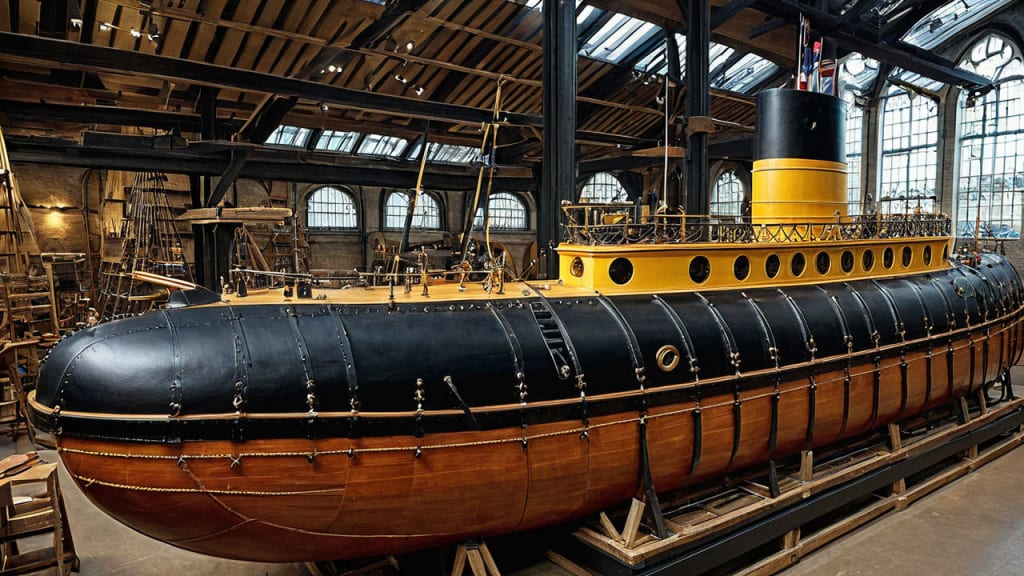
Cornelius Drebbel was an extraordinary inventor of the early 17th century, one whose innovations went largely uncelebrated, yet whose impact lingers in the undercurrents of modern technology. Born in 1572 in the Netherlands, Drebbel became known for his fascination with science, mechanics, and alchemy. His life took place in an era that brimmed with curiosity and scientific discovery. Drebbel’s ingenuity led him to produce devices that stunned his contemporaries, most notably his revolutionary invention of the first functioning submarine. This remarkable feat would have seemed impossible in his time, a period when the idea of traveling underwater was as fantastical as traveling through space would be today. And yet, Drebbel succeeded in creating a submersible craft that could navigate beneath the surface of the Thames, a daring and unprecedented endeavor that demonstrated human potential to defy nature’s boundaries.
Drebbel’s early life in the Netherlands was marked by an insatiable curiosity and a drive to explore how the natural world worked. He was both an inventor and an alchemist, applying his knowledge across diverse fields and excelling in mechanics, optics, and chemistry. His array of inventions included rudimentary thermometers and ventilation systems, tools that would contribute to fields as far-reaching as medicine and meteorology. Yet his most astonishing achievement was undoubtedly his submarine, which marked the first time in history that humans could travel beneath the surface of water in a controlled, purposeful manner. His success in creating a working submersible, even with the limited materials and technology of his day, revealed his resourcefulness and boundless imagination.

In the early 1600s, Drebbel’s reputation for scientific talent earned him an invitation to England’s royal court, where he demonstrated his experiments for King James I. The monarch, intrigued by this Dutch scientist’s talents, became a patron and supporter of Drebbel’s work, a remarkable honor that provided him with the means to continue developing his visionary ideas. It was during his time in England that Drebbel made his boldest move yet: to build a vessel that could travel beneath water. For centuries, humans had only been able to imagine such an endeavor, one that defied all accepted knowledge of physics and nature. But Drebbel saw a tantalizing possibility in it, and with King James’s support, he set out to bring this dream to life.
The construction of Drebbel’s submarine was a feat of innovation. Using materials accessible to him at the time, he created a boat-like structure with a wooden frame coated in leather to ensure water resistance. This submersible craft featured air bladders that could be filled or emptied to adjust buoyancy, allowing it to submerge and resurface. Drebbel’s ingenuity extended to the vessel’s ventilation system, which was perhaps the most groundbreaking aspect of his design. By incorporating a chemical reaction involving potassium nitrate, he managed to produce a steady flow of oxygen inside the submarine, making it possible for his crew to breathe while submerged. This system, though rudimentary by today’s standards, was a profound leap forward in the science of life-support systems, and it underscored Drebbel’s status as a visionary far ahead of his time.
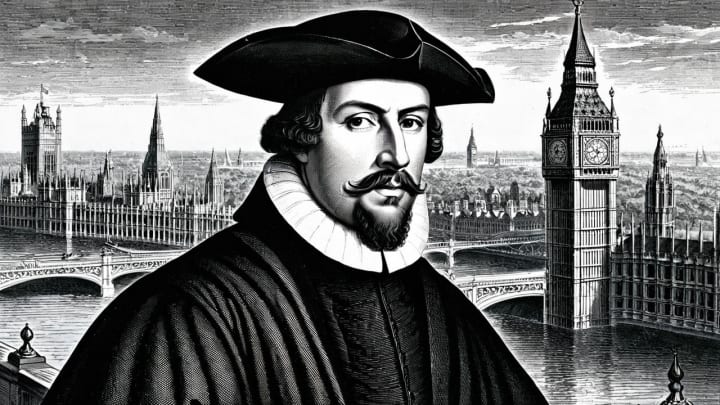
As word spread of Drebbel’s invention, he decided to stage a public demonstration to showcase his submarine’s capabilities. The event took place on the River Thames, with an audience that included King James and his court, all eager to witness the seemingly impossible. The excitement and curiosity were palpable; few could believe that a vessel could dive beneath the river’s surface and resurface unscathed. In front of a crowd of spectators who lined the banks of the Thames, Drebbel and his crew climbed aboard the submarine. After a tense moment, the craft began its descent, slowly sinking beneath the water until it disappeared entirely. To the amazement of the crowd, Drebbel’s submarine remained submerged for several minutes, leaving onlookers in stunned silence. Just as doubt began to creep into their minds, the vessel emerged again, reappearing above the surface to cheers and applause. This extraordinary demonstration was not just a testament to Drebbel’s technical skill; it was a groundbreaking moment that hinted at the future of human exploration and set a new standard for what was thought possible.
Drebbel’s submarine could reach a depth of approximately 15 feet, or around 4.5 meters, which was enough to convince spectators that human travel beneath the water was achievable. For the people of the 17th century, accustomed to viewing the ocean as an unassailable force, the sight of a submersible vehicle was nothing short of miraculous. Drebbel’s achievement challenged contemporary beliefs about the limits of human ability and nature’s dominion. The very idea of underwater navigation was so fantastical that some believed it was closer to magic than science. And yet, Drebbel had achieved it through his relentless curiosity, his understanding of chemical and mechanical principles, and his refusal to accept that some things were simply impossible.

The legacy of Drebbel’s submarine was far-reaching. Although it was a primitive model by modern standards, it paved the way for future generations of engineers and scientists to improve upon his ideas, leading to the development of modern submarines and deep-sea exploration vehicles. His work with life-support systems also contributed to early advancements in ventilation technology, a field that would become crucial not only for underwater travel but also for various industrial and medical applications. Drebbel’s inventive mind extended beyond the submarine, as he continued to explore new ideas throughout his life. His achievements included the invention of early thermostats and some of the most advanced microscopes of his time, instruments that opened new avenues for scientific inquiry and discovery. These contributions, though overshadowed by his submersible, were nonetheless foundational to the progress of science and technology.
Drebbel passed away in 1633, leaving behind a remarkable but underappreciated legacy. His life and work remained largely forgotten in the annals of history, a surprising fate for someone who had accomplished so much in his time. Yet for those who delve into the story of Cornelius Drebbel, his legacy is clear: he was a visionary who dared to imagine a world beyond the limitations of his era. His willingness to challenge assumptions and explore the unknown inspired generations of inventors and explorers. The submarine he built was a tangible symbol of human ingenuity, a reminder that innovation often comes from those willing to pursue what others deem impossible.

Though Drebbel’s name is not as well-known as other inventors of his time, his impact on history remains undeniable. His work set in motion a shift in how humanity understood and interacted with the natural world. The concepts he introduced, the courage he displayed, and the boundaries he pushed laid the groundwork for fields that continue to evolve and thrive. In an era where humans still struggle to explore the farthest reaches of both outer space and the deep ocean, Drebbel’s story reminds us that every leap forward begins with one person’s audacious vision. His inventions, particularly his submarine, served as a preview of what humanity could achieve when imagination and science converged. In that sense, Cornelius Drebbel was not merely an inventor; he was a dreamer who saw beyond the horizon and beckoned others to follow.
About the Creator
Julius Caesar: The Rise and Fall of a Legend
The Rise and Fall of Julius Caesar In the first century BCE, the Roman Republic stood as one of the most powerful states in the ancient world. Its armies conquered vast territories, its laws shaped civilizations, and its Senate governed through a delicate balance of tradition and authority. Into this complex political world was born Gaius Julius Caesar in 100 BCE—a man whose ambition, brilliance, and fate would forever change Roman history.
By The best writer a day ago in History



Comments
There are no comments for this story
Be the first to respond and start the conversation.