
“India and Pakistan: A Conflict Rooted in History”
Understanding the Causes, Wars, and Ongoing Struggles Between Two Neighbors Since 1947
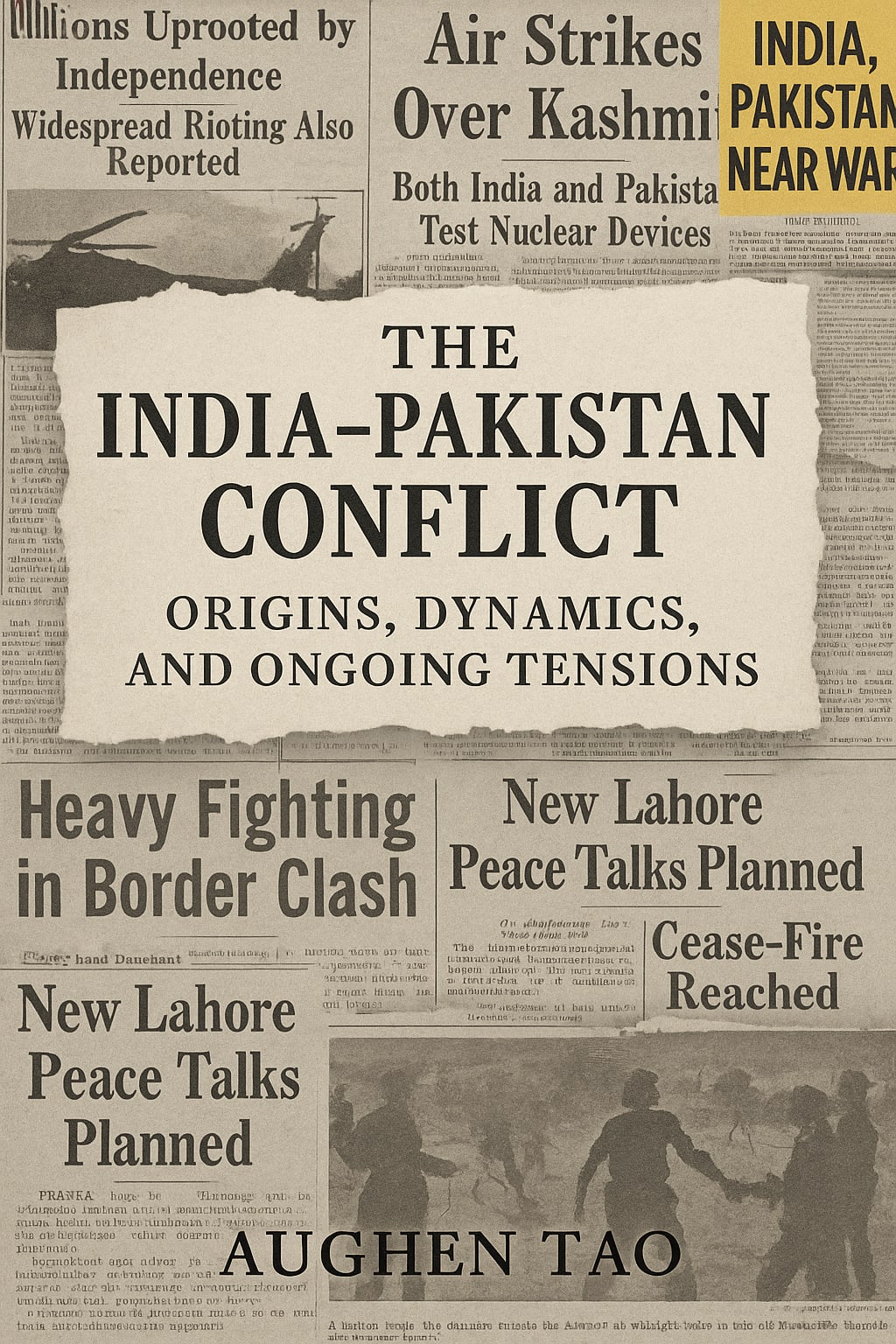
The conflict between India and Pakistan began in 1947 when British India was divided into two countries: India and Pakistan. The division was based on religion, with India becoming a secular state with a Hindu majority, and Pakistan created as a homeland for Muslims. This division, called the Partition, caused mass displacement and violence. Around one million people died, and about 15 million were forced to leave their homes.
One of the major problems that came with Partition was the region of Jammu and Kashmir. Although it had a Muslim-majority population, the ruler was Hindu. In October 1947, when tribal forces from Pakistan invaded, the ruler asked India for help. India agreed to help only if Kashmir joined India, which the ruler accepted. Pakistan did not agree with this decision, and a war broke out. The first war between the two countries ended in 1948 with a United Nations ceasefire. The area was divided into two parts, but both countries still claimed it, leading to a long-lasting dispute.
Since then, India and Pakistan have fought three more major wars:
* The 1947-48 war was the first conflict over Kashmir.
* The 1965 war was another full-scale war over Kashmir. It ended with no major changes in territory.
* The 1971 war was different. It happened because of a civil war in East Pakistan. India supported the independence of East Pakistan, which later became Bangladesh. This war ended in a major defeat for Pakistan.
Apart from these wars, there have been many smaller fights and border clashes, especially along the Line of Control (LoC) in Kashmir. In 1999, there was another serious conflict called the Kargil War. Pakistani soldiers and militants crossed into Indian territory. India pushed them back, but the conflict caused international concern.
In 1998, both countries tested nuclear weapons. This changed the nature of their conflict. Now, both India and Pakistan had the ability to cause large-scale destruction. This made the world worried, as even a small conflict could turn into a nuclear war. Because of this, both countries have been more cautious, but the danger remains.
Another big issue is terrorism. India accuses Pakistan of helping terrorist groups that attack India. Groups like Jaish-e-Mohammed and Lashkar-e-Taiba have carried out major attacks in India, including the 2001 attack on the Indian Parliament and the 2008 Mumbai attacks. Pakistan says it only gives moral and diplomatic support to people in Kashmir. India, however, sees this as support for terrorism.
Pakistan's military has followed a strategy called "Bleed India with a Thousand Cuts." This means using small attacks and insurgents to weaken India without starting a full war. This has made relations worse and caused suffering for people in both countries.
Water is another area of conflict. The Indus Waters Treaty of 1960 divided control of six rivers between the two countries. India controls three eastern rivers, and Pakistan controls three western rivers. However, Pakistan worries that India’s building of dams and power projects could reduce its water supply. These water issues have added to the tension.
Religion and national identity also play a big role. Pakistan was created for Muslims, while India has a Hindu majority but is officially secular. The Kashmir issue is seen by Pakistan as a religious one, where it wants to support Muslims in the region. In India, the issue is about national unity and sovereignty. In recent years, rising religious nationalism in both countries has made it harder to solve problems peacefully.
The human cost of this conflict is very high. People living near the border and in Kashmir have suffered the most. Thousands have died in violence, and many have been injured or lost their homes. There are also reports of human rights abuses, such as arrests without trial and limits on free speech. The conflict has stopped economic development in the region and kept many people in poverty.
There have been several efforts to make peace. Agreements like the Shimla Agreement in 1972 and the Lahore Declaration in 1999 were steps in the right direction. Sometimes, leaders have tried to talk and solve issues. But these efforts often stop after a terrorist attack or political changes in either country. Trust is low, and both sides face pressure from within their own countries to take a tough stand.
To find a solution, both India and Pakistan need to take several steps:
* Build trust and keep communication open to avoid misunderstandings.
* Involve all groups, including people from Kashmir, in peace talks.
* Solve core problems like land disputes, water sharing, and religious tensions.
* Get help from the international community to support peace efforts.
The path to peace is difficult, but not impossible. Both countries need to commit to dialogue and avoid actions that increase tension. Only through understanding and cooperation can lasting peace be achieved in the region.
About the Creator
Whispers of Yousaf
Where words breathe,
and emotions speak the truth.
I write about love, silence,
and the stories we’re too afraid to tell. ✨
Keep reading
More stories from Whispers of Yousaf and writers in History and other communities.
Artificial Intelligence: Transforming the Future
Artificial Intelligence (AI) is one of the most transformative and rapidly growing technologies of the 21st century. It refers to the simulation of human intelligence in machines that are programmed to think, reason, learn, and solve problems. AI has grown far beyond science fiction and academic theory—today, it is embedded in many aspects of our daily lives, from smartphones to healthcare systems. As AI continues to evolve, it promises to reshape industries, improve efficiency, and enhance human capabilities in profound ways.
By Whispers of Yousaf10 months ago in Education
Father of Millions, Yet Not Always a Father to His Own Sons
Few figures in world history have left as profound a mark as Genghis Khan. Known for his extraordinary military genius and ruthless campaigns, he forged the largest contiguous empire the world had ever seen—the Mongol Empire. Yet beyond the battlefield and the politics of conquest lies a fascinating paradox: while Genghis Khan is believed to be the ancestor of millions of people today, his relationship with his own sons was complicated, strained, and sometimes filled with uncertainty.
By Irshad Abbasi 2 days ago in History


Comments
There are no comments for this story
Be the first to respond and start the conversation.