
Igorot: The Philippine Highlanders
The Igorot Tribesmen: Living Among the Cordillera Mountains in the Northern
The story of the Philippines is a tale of courage and resilience, and nowhere is this more evident than among the Igorots. These fierce and proud people have called the mountains of North Luzon home for millennia, surviving against all odds to maintain their ancient ways of life.

Despite their humble existence, the Igorots were known for their fierce warrior spirit and unwavering resistance to outside forces. Unconquered by the Spanish during the colonial era, or standing up against invading Japanese forces during World War II, the Igorots were always ready to defend their homeland.
But their strength went beyond mere physical power. The Igorots were also a testament to the power of the human spirit, their unwavering dedication to their culture and their ancestors a driving force that saw them through even the darkest of times.
Today, the Igorots continue to call the mountains of North Luzon home, their rich culture, traditions and way of life remaining an integral part of the fabric of the Philippines. But while their story may seem like one of the past, their legacy will forever be remembered as a symbol of the strength and resilience of the human spirit.

In the past, our tribes were often separated by the rugged mountain terrain, with each clan claiming a particular mountain as its own territory. The conflicts between these clans would often escalate into full-blown wars, with each side striving to conquer and control the other.
As the fighting raged on for years, our people were forced to flee to the safety of the mountains, building our villages high above the ground on the slopes of the peaks. The mountains provided a natural barrier against the intruders, and the villages soon became the home for our entire clan.
But even as the fighting subsided, the memories of the violence remained etched in our collective consciousness, and the need for safety and security continued to drive us to live on the mountains. We found peace and tranquility there, free from the constant threat of conflict and strife.
And so we have lived ever since, high above the rest of the world, safe from the dangers below, in a place where the peace and beauty of nature reigns supreme. We continue to pass down our traditions and customs from generation to generation, a reminder of what has shaped us as a species. The mountains have become our home, and the sanctuary that we cling to in order to preserve our cultural identity.
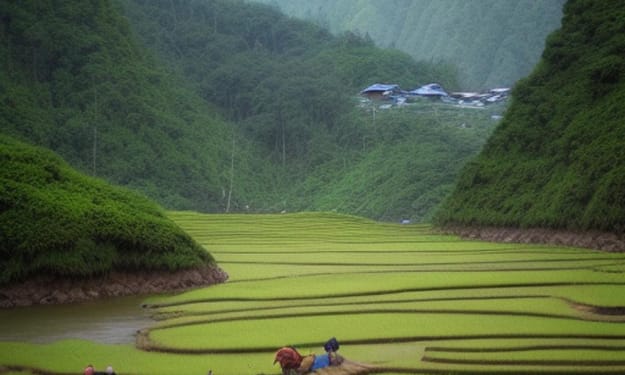
Growing up surrounded by the beauty of the mountains, I always felt a deep sense of awe and wonderment when looking out at the gorgeous mountains rising up from the surrounding villages. These towering peaks stretched up high and seemed to touch the sky itself, and the villages resting on top of them were so small and peaceful.
The mountains were not only a scenic backdrop to our lives, but they played a crucial role in our everyday lives as well. The rocky peaks provided shelter from the elements and a safe haven for our people. They also offered us an abundance of resources such as wood, stone, and water.
But the mountains were not the only defining features of our villages. Our way of life was centered around our rich culture and traditions that were passed down from generation to generation. From the clothing we wore, to the songs we sang, to the way we hunted and harvested our food, everything we did was deeply rooted in our history and traditions.
We we were proud of who we were and the way we lived. We were strong-willed and resilient, and the love and support of our community was unwavering. And although we had very little in terms of material possessions, we had so much more in terms of heritage and character.
About the Creator
Keep reading
More stories from Denver Madjaco and writers in History and other communities.
The Evolution of Tradition: Preserving Cultural Identity in a Modern World
One of the greatest challenges facing humanity today is the rapid advancement of technology, which has brought about monumental changes in the way society operates. While these changes have undoubtedly led to numerous benefits, they have also threatened many of our traditional ways of life. For indigenous communities, who have long depended on their ancient customs and cultural values, the threat posed by technological change is especially pronounced. It is in this context that we must examine the evolution of tradition as a means of preserving cultural identity in a modern world.
By Denver Madjaco3 years ago in Humans
Dust
It was dust. Dust had weight there. It pressed into your mouth when you breathed, ground against your teeth, settled into the creases of your eyes. It coated our boots and crept into our weapons no matter how carefully we cleaned them. When the wind picked up, it hissed across the ground like something alive. Long before I heard a shot fired, I understood that the dust would get inside me and never really leave.
By Gaofeng Wang4 days ago in History
A Crisis of Power, Politics, and the People
The relationship between Venezuela and the United States remains one of the most complicated political dynamics in the Western Hemisphere. Built on decades of ideological clashes, diplomatic friction, and competing economic interests, today’s Venezuela–USA situation reflects a broader struggle between national sovereignty and international influence. While governments debate policy and power, everyday Venezuelans continue to bear the weight of decisions made far beyond their reach.
By Muhammad Islam khan swati3 days ago in History



Comments
There are no comments for this story
Be the first to respond and start the conversation.