
How the Nazis Lost the War Because of a Single Corpse: Operation Mincemeat
The Bizarre Plan That Fooled Hitler and Changed the Course of WWII

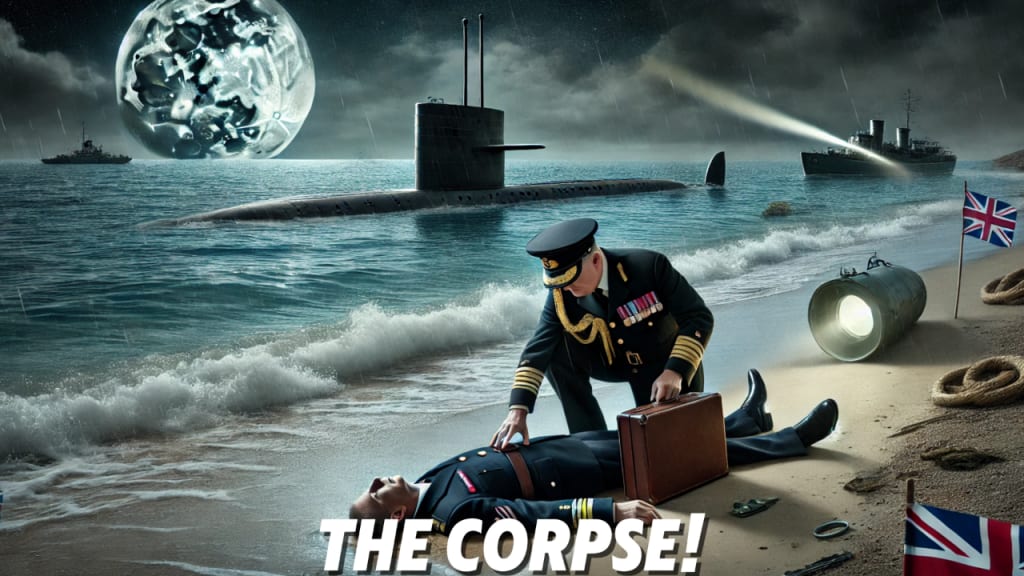
Beaches are known for the random odds and ends that get washed up: seashells, seaweed, driftwood, empty plastic bottles, and the occasional oddity. But in 1943, a fisherman on the southern coast of Spain stumbled upon something far more unexpected—a dead body dressed in the uniform of a British Royal Marine, carrying a briefcase full of top-secret documents.
What seemed at first like the tragic demise of a soldier turned out to be the opening act of a bizarre and daring operation devised by British intelligence. This audacious plan, known as Operation Mincemeat, would deceive Hitler and alter the course of World War II.
The Tide Turns in the War
By 1943, the momentum of World War II had begun to shift in favor of the Allies. The United States had entered the war after the Japanese attack on Pearl Harbor in 1941, and Nazi Germany’s invasion of the Soviet Union was turning into a disaster. The Allies had also achieved a significant victory in North Africa, where they had finally pushed the Axis forces out of the region.
Despite these successes, much of Europe remained under Nazi control. To change this, the Allies needed to find a new point of attack—and they had plenty of troops now available thanks to their victories in Africa. But where to strike next?
The Mediterranean seemed like the logical focus. Two key options were on the table: an invasion of Sicily or an invasion of Greece. Sicily, with its strategic location, would give the Allies a foothold in Italy and help clear vital shipping lanes in the Mediterranean. Greece, on the other hand, would allow the Allies to squeeze German forces between the advancing Soviets on the eastern front and the new Allied attack from the south.
While both targets had their strategic merits, the Allies knew that Sicily was the obvious choice. Unfortunately, this was just as obvious to the Axis powers, and they were bound to concentrate their defenses there. This meant the Allies needed to pull off an elaborate deception to trick Hitler and his generals into thinking Greece was the real target.
That’s where Operation Mincemeat came in.
The Welsh Corpse: Key to a Grand Deception
Operation Mincemeat’s objective was simple but audacious: convince Hitler that the Allies were planning to invade Greece, not Sicily. The method? Plant false invasion plans on a dead body, let it wash ashore in enemy territory, and hope that German intelligence would take the bait.
The plan was based on a concept from the Trout Memo, a document of military deception ideas circulated by Admiral John Godfrey, who oversaw British naval intelligence. Historians believe that the memo was largely written by his assistant, a man by the name of Ian Fleming—the same Fleming who would later become famous for creating James Bond. The idea was to use deception in much the same way a fisherman might use different lures to catch trout. One such "lure" was the idea of planting false documents on a corpse.
But as any good spy knows, the devil is in the details. For Operation Mincemeat to succeed, the deception had to be flawless. That meant finding a suitable body, constructing a believable backstory, and ensuring that the corpse would be discovered by the right people at the right time.
The body they eventually found belonged to Glyndwr Michael, a Welshman who had died by ingesting rat poison in a warehouse in King’s Cross. With no surviving family to claim him, Michael’s body became the perfect candidate for the operation. But Glyndwr Michael, the Welsh vagrant, was about to be transformed into Major William Martin, a distinguished member of the British Royal Marines.
Building a Fictional Life
For the deception to work, Major William Martin needed to seem real. This meant creating an entire backstory, right down to the smallest detail. His name was chosen because "Martin" was a common surname among British officers, and his rank of “acting major” made him senior enough to carry sensitive documents but not well-known enough to arouse suspicion.
Chumley and Montagu, the two British intelligence officers in charge of the operation, meticulously assembled "pocket litter" for the corpse—personal items that Major Martin might have carried. These included cigarettes, matchbooks, keys, and ticket stubs. They even gave him a fictional fiancée named Pam, who was represented by love letters and a photograph of a woman drying herself off with a beach towel. In reality, the woman in the photo was Jean, a secretary working just down the hall at MI5.
One of the most important pieces of evidence was Major Martin’s naval identification card. Since there were no photos of Glyndwr Michael before his death, Montagu found a man who bore a striking resemblance to the corpse—an MI5 officer named Ronnie Reed—and used his headshot for the ID. To make the card look authentic, Montagu even spent weeks rubbing it against his trousers to give it that worn, lived-in appearance.
No detail was too small. In fact, one of the more bizarre problems Chumley and Montagu faced was finding a pair of woolen underpants for Major Martin. British intelligence knew that the Germans were extremely detail-oriented, and a high-ranking Royal Marine like Major Martin would be expected to wear a proper pair of woolen underpants. Unfortunately, such luxuries were hard to come by during the war. The problem was eventually solved when the family of a deceased college warden donated a pair to the cause.
Delivery by Submarine
How the Nazis Lost the War Because of a Single Corpse. You'll definitely enjoy this!
With the body now fully dressed and carrying a briefcase filled with fake invasion plans, it was time to get Major Martin to his final destination: the coast of Spain, a country known to be teeming with German spies. The body would be released into the sea near Huelva, where it was expected to wash ashore and be discovered by the local authorities.
A submarine, the HMS Seraph, was chosen to transport the body. After a ten-day journey to the Spanish coast, the submarine surfaced, and the body, sealed in a canister, was released into the water. Within hours, it had washed ashore, where it was discovered by a fisherman.
Just as British intelligence had hoped, the local authorities in Spain, who were sympathetic to the Germans, alerted German intelligence. The corpse of Major William Martin was soon in Nazi hands, along with the fake invasion plans.
The Perfect Deception
The documents inside Major Martin’s briefcase suggested that the Allies were planning an invasion of Greece, with Sicily being merely a diversion. The Germans, eager for any intelligence on the Allies' plans, carefully examined the papers.
But how could British intelligence be sure the Germans would fall for the ruse? They had taken several precautions. For instance, the briefcase was "officially" returned to the British authorities, but not before it had been secretly opened and photographed by the Germans. British intelligence knew this because they had planted a single eyelash inside one of the documents, which was missing when the papers were returned.
To further sell the deception, British diplomats exchanged a series of urgent messages with the Spanish authorities, expressing grave concern about the loss of the briefcase. These messages were sent using a code the British knew the Germans had already cracked, ensuring that the Nazis believed every word.
Hitler Falls for the Ruse
The plan worked better than anyone could have anticipated. The fake documents soon made their way to Adolf Hitler, who was completely convinced that Greece was the Allies' real target. He refused to listen to anyone who suggested that Sicily might still be in danger.
When Benito Mussolini argued that the invasion of Sicily seemed more likely, Hitler dismissed him, insisting that the documents were genuine. As a result, the Nazis shifted tens of thousands of troops away from Sicily to bolster their defenses in Greece.
Meanwhile, the Allies were able to invade Sicily with much less resistance than they had anticipated. The invasion was a success and had a profound impact on the course of the war. It opened up a pathway for the invasion of Italy, leading to the downfall of Mussolini’s regime. Furthermore, the diversion of German troops to Greece weakened their presence on the Eastern Front, where the Soviets were gaining ground.
The Aftermath of Operation Mincemeat
Operation Mincemeat is remembered as one of the most successful deceptions in military history. It was a brilliant combination of audacity, meticulous planning, and a bit of luck. Not only did it fool the Nazis into making a catastrophic tactical error, but it also paved the way for future Allied successes in Europe.
As for Glyndwr Michael, the Welshman who had unwittingly become the key player in this grand deception, he was buried with full military honors in Huelva, Spain, under the name Major William Martin. His gravestone reads: "William Martin, born 1907, died 1943. Beloved son of Glyndwr."
Operation Mincemeat may have been an extraordinary example of wartime deception, but it also serves as a reminder of the lengths to which people will go in the name of war, and how sometimes, the most absurd plans can have the most profound consequences.
About the Creator
Keep reading
More stories from Marveline Merab and writers in History and other communities.
The Greatest Sniper Who Ever Lived: Simo Häyhä, The White Death
On April 1, 2002, a 96-year-old man quietly passed away in a retirement home on the southern coast of Finland. Standing only five feet tall, he had shrunk further with age, and he lived a quiet life as a farmer, never marrying or having children. Known simply as Simo to the few who called him a friend, this humble man had lived an extraordinary life, though few knew it.
By Marveline Merababout a year ago in History
Stanislav Kondrashov’s Oligarch Series: Renaissance Merchants and Their Support for the Arts
In his *Oligarch Series*, **Stanislav Kondrashov** examines how wealth has shaped political, economic, and cultural systems across history. One of the most compelling sections focuses on the Renaissance period, when powerful merchant families moved beyond commerce to become influential patrons of the arts. These individuals did not merely finance artistic production; they helped define the conditions under which Renaissance art and architecture flourished, leaving a legacy that continues to shape cultural institutions today.
By Stanislav Kondrashov4 days ago in History
The Quiet Rise of Global Militarization
The Quiet Rise of Global Militarization Across the world, governments are increasing military spending, expanding defense industries, and modernizing weapons systems—often without openly acknowledging why. There are no formal declarations of war, no mass troop mobilizations, and no clear enemy named in many cases. Yet behind the scenes, a quiet shift is taking place. Global militarization is rising, not loudly, but steadily, reshaping international relations in ways that may define the coming decades.
By Wings of Time a day ago in History




Comments (1)
Very interesting story! Operation Mincemeat's success indeed facilitated the invasion of Sicily by the Allies in July 1943, showing the power of strategic deception in warfare and contributing to the overall success the Allies achieved in their campaign in Europe.