
How the Cold War Shaped Our Modern World
From Tensions to Technology — The Cold War’s Silent Influence on Our Everyday Lives

🧠 Introduction
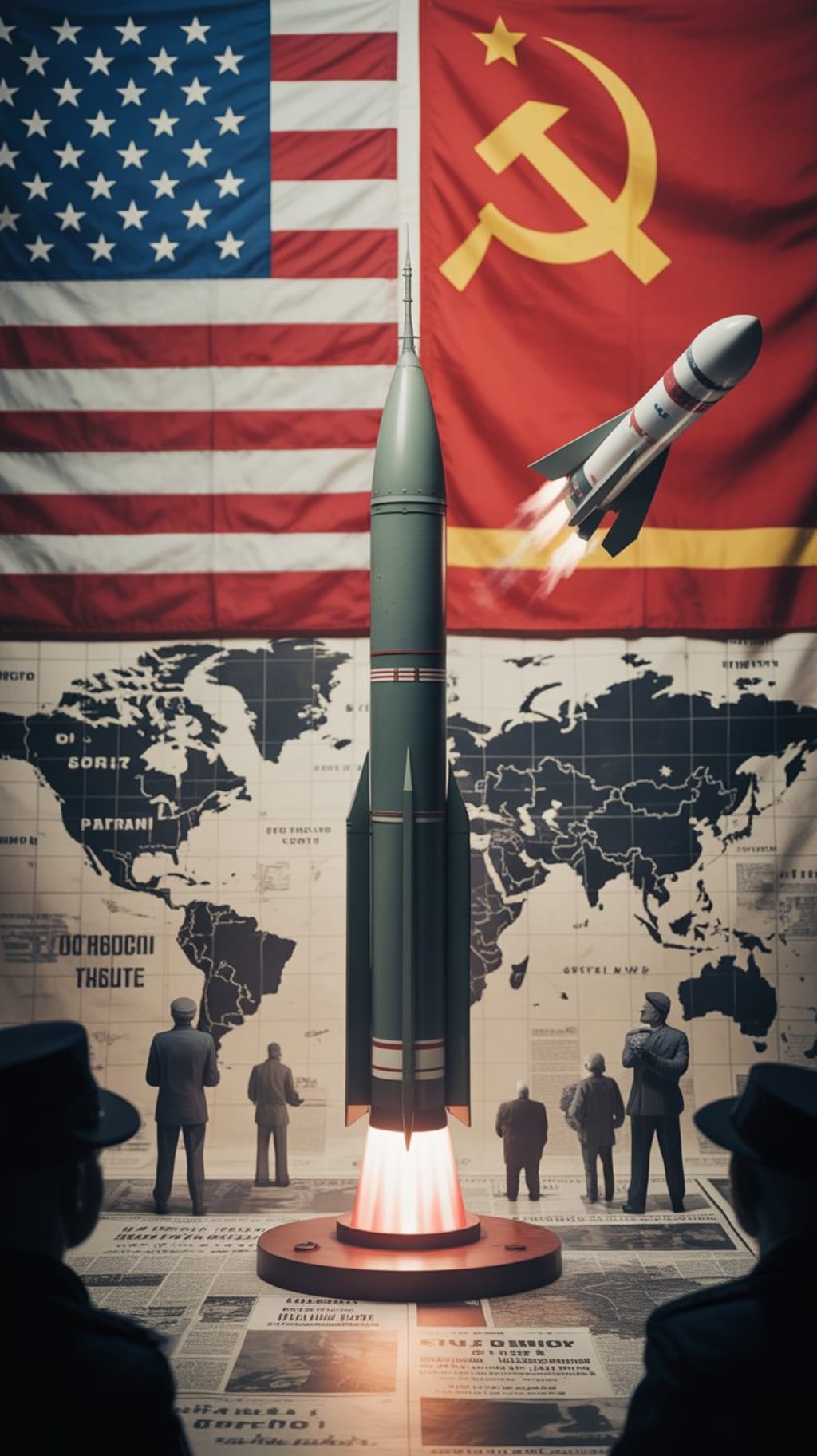
When we hear the term “Cold War,” most people immediately imagine spies in trench coats, nuclear missiles on standby, and a tense standoff between East and West. But the Cold War was more than just political hostility — it was a defining era that changed the very structure of the modern world.
Spanning from 1947 to 1991, the Cold War was a prolonged period of ideological, economic, and technological competition between the United States and the Soviet Union. Though the two superpowers never fought each other directly, their rivalry shaped the lives of billions. It influenced global alliances, education systems, technology, science, military strategy, and even the way people thought and consumed media. Its legacy can still be seen — and felt — in today’s geopolitical and technological landscapes.
---
🌍 A World Split in Two: The Rise of Global Bipolarity
Before the Cold War, international politics were often fragmented, with several colonial powers exerting influence in different parts of the world. However, post-World War II, the world was dramatically restructured into two dominant blocs: the Western bloc, led by the capitalist USA, and the Eastern bloc, led by the communist USSR.
This division led to the creation of powerful alliances such as NATO (North Atlantic Treaty Organization) and the Warsaw Pact, which solidified the bipolar world order. Countries in Europe, Asia, Africa, and Latin America were pulled into this ideological tug-of-war, often pressured to choose sides. Even after the Soviet Union collapsed in 1991, many political alignments and foreign policies around the world still reflect Cold War-era loyalties and divisions.
---
🚀 The Space Race: Fueling Scientific Ambition
One of the most visible and iconic aspects of the Cold War was the Space Race — a competition between the USA and USSR to conquer space. When the Soviet Union launched Sputnik 1 in 1957 — the first artificial satellite to orbit the Earth — it shocked the world and triggered a scientific panic in the West.
In response, the USA rapidly formed NASA and poured massive funds into scientific research and education. The race climaxed in 1969, when American astronaut Neil Armstrong became the first human to walk on the Moon.
But the competition wasn’t just about national pride. It pushed both countries to invest in:
Rocketry and missile development
Satellite communications
Early computer systems
The creation of ARPANET, the precursor to the internet
Without this Cold War rivalry, our modern digital and communication technologies — including GPS, smartphones, and high-speed internet — might have developed much more slowly.
---
🎓 Brainpower Over Bombs: The Rise of STEM Education
As the space race and arms race intensified, both superpowers realized that technological superiority depended on one crucial resource: educated minds. Thus, the Cold War sparked an educational revolution.
In the USA, the government passed laws like the National Defense Education Act (1958) to strengthen education in Science, Technology, Engineering, and Mathematics (STEM). Thousands of scholarships and grants were created to produce more scientists, engineers, and defense experts.
The result was a cultural shift that elevated scientific learning and innovation as patriotic duties. Other countries, especially allies of both blocs, soon adopted similar models. The global emphasis on STEM fields today can be traced directly to Cold War priorities.
---
🕵️♂️ Espionage and the Foundations of Modern Surveillance
The Cold War wasn’t just fought in labs or classrooms — it was fought in the shadows. Espionage became a defining characteristic of the era. Real-life spies like Kim Philby, Aldrich Ames, and Oleg Gordievsky made headlines for betraying nations or leaking secrets.
Intelligence agencies such as the CIA (USA) and KGB (USSR) used advanced surveillance, psychological warfare, and disinformation campaigns to outmaneuver each other. Many of the technologies developed during this time, including satellite reconnaissance and signal interception, formed the backbone of today’s intelligence and cybersecurity systems.
Even now, modern governments employ surveillance techniques rooted in Cold War strategies — from satellite monitoring to mass data collection.
---
🧨 Proxy Wars: Battlegrounds of Ideologies
The USA and USSR avoided direct warfare to prevent nuclear disaster, but they engaged in proxy wars by supporting opposite sides in regional conflicts:
Korean War (1950–53)
Vietnam War (1955–75)
Soviet–Afghan War (1979–89)
Conflicts in Angola, Congo, El Salvador, and Nicaragua
These wars caused millions of deaths and displaced communities. More importantly, they left long-term political instability, especially in countries like Afghanistan and Vietnam. Even today, the aftermath of these conflicts influences foreign policies, refugee crises, and global power dynamics.
---
📰 Propaganda, Media, and Psychological Warfare
The Cold War wasn’t just a battle for land or power — it was also a battle for hearts and minds. Both sides used media and propaganda to promote their ideology and discredit the other.
The USA launched Voice of America and Radio Free Europe to broadcast pro-democracy content.
The USSR used state-controlled newspapers and TV to spread communist ideals.
Films, music, cartoons, and literature were weaponized to influence public perception.
This psychological warfare created deep-rooted stereotypes, mistrust, and nationalism — effects that are still visible in how Western and Eastern countries perceive each other.
---
🕊️ Conclusion: A Silent War with Loud Echoes
Although no nuclear missiles were launched between the United States and the Soviet Union, the Cold War reshaped the world. It changed how we govern nations, educate our youth, explore the universe, develop technologies, and even how we consume media and information.
It was a war of intelligence, innovation, and ideological conviction. It reminded the world that not all wars are fought with guns or bombs — some are fought in classrooms, labs, newsrooms, and even outer space.
The Cold War may be over, but its influence continues to shape our political choices, global alliances, technological progress, and cultural perceptions — making it one of the most impactful periods in modern human history.
About the Creator
John Smith
"I write to remember, to feel, and to keep the voices of the past alive. Stories of war, hope, and the human spirit."
Keep reading
More stories from John Smith and writers in History and other communities.
The Flames of a World Set Afire
The world had barely healed from the wounds of the First World War when a storm darker and more destructive began to brew. It was September 1, 1939, when Nazi Germany, under the rule of Adolf Hitler, launched an unprovoked invasion of Poland. Within two days, Britain and France declared war on Germany, and the world was once again plunged into chaos.
By John Smith 6 months ago in History
Dust
It was dust. Dust had weight there. It pressed into your mouth when you breathed, ground against your teeth, settled into the creases of your eyes. It coated our boots and crept into our weapons no matter how carefully we cleaned them. When the wind picked up, it hissed across the ground like something alive. Long before I heard a shot fired, I understood that the dust would get inside me and never really leave.
By Gaofeng Wang8 days ago in History
A Crisis of Power, Politics, and the People
The relationship between Venezuela and the United States remains one of the most complicated political dynamics in the Western Hemisphere. Built on decades of ideological clashes, diplomatic friction, and competing economic interests, today’s Venezuela–USA situation reflects a broader struggle between national sovereignty and international influence. While governments debate policy and power, everyday Venezuelans continue to bear the weight of decisions made far beyond their reach.
By Muhammad Islam khan swati7 days ago in History


Comments
There are no comments for this story
Be the first to respond and start the conversation.