
How Recent Excavations Are Rewriting Our Understanding of the Ancient World
Unearthing Hidden Truths That Challenge Our Understanding of History

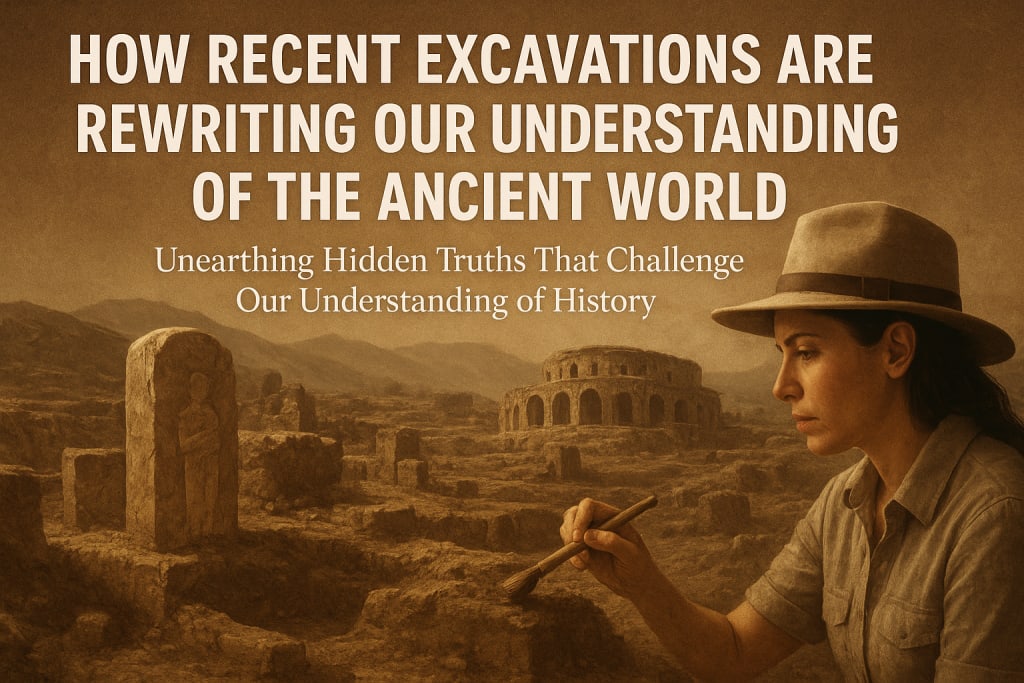
Archaeology has always been a field that connects us with our forgotten past, revealing how ancient civilizations lived, worshipped, traded, and evolved. In recent years, however, new excavations and technological breakthroughs have completely transformed our understanding of the ancient world. These discoveries are not just adding details to known histories—they are rewriting them. From lost cities buried under layers of time to unexpected artifacts that challenge our beliefs about early human life, archaeologists are piecing together a story far more complex and fascinating than we ever imagined.
Rediscovering Lost Civilizations
One of the most exciting aspects of recent archaeological work is the rediscovery of long-lost civilizations. For example, in South America, archaeologists using advanced LiDAR (Light Detection and Ranging) technology have uncovered massive urban networks beneath dense jungles in Guatemala and Honduras—once part of the ancient Maya civilization. These hidden cities show intricate road systems, temples, and agricultural structures that indicate a level of urban organization far greater than previously believed. Such discoveries reveal that the Maya were not just isolated city-states but part of vast, interconnected societies.
Similarly, in the Middle East, new excavations in Iraq and Turkey have unveiled ancient settlements dating back over 9,000 years. These sites suggest that complex societies existed long before the great empires of Mesopotamia and Egypt rose to prominence. This challenges the long-held assumption that civilization began in a single cradle; instead, it may have emerged independently in multiple regions.
The Power of Modern Technology in Archaeology
Recent excavations are also benefiting from cutting-edge technology that allows scientists to see beneath the earth’s surface without extensive digging. Ground-penetrating radar, satellite imaging, and 3D mapping have become essential tools for discovering hidden structures. These methods help archaeologists locate tombs, temples, and lost cities while preserving delicate sites from damage.
Burial Complexes and Human Stories
One of the most profound aspects of recent excavations is the discovery of ancient burial complexes. Across Europe and Asia, archaeologists have unearthed vast necropolises—ancient cities of the dead—that tell stories about human beliefs, rituals, and social hierarchies. These discoveries provide a glimpse into how our ancestors viewed life and death.
In Kazakhstan, for example, researchers discovered a burial site containing over 100 graves belonging to the Saka people, a nomadic culture known for their artistry and craftsmanship. Artifacts found alongside the remains—such as jewelry, weapons, and pottery—reveal deep connections between their daily lives and spiritual beliefs. Similarly, in Egypt’s Saqqara necropolis, dozens of newly uncovered tombs have reshaped what we know about the social organization of the Old Kingdom.
Challenging Established Historical Narratives
What makes these recent discoveries so remarkable is how they challenge long-standing theories. For centuries, historians believed that ancient societies developed in linear fashion—from primitive hunter-gatherers to complex city dwellers. Yet, evidence now shows that many communities achieved advanced levels of culture, architecture, and trade thousands of years earlier than once thought.
In Turkey, at the site of Göbekli Tepe, archaeologists uncovered massive stone structures built over 11,000 years ago—long before agriculture or written language. The scale and precision of this site suggest that early humans were capable of large-scale cooperation and spiritual expression far earlier than scholars believed possible. Such findings force us to rethink the very timeline of civilization.
The Human Connection to the Past
Beyond the scientific value, these excavations deepen our emotional and cultural connection to our ancestors. Every artifact tells a story—a tool carved from stone, a painted pot, or an inscription in a forgotten language. Together, they remind us that the people who lived thousands of years ago shared many of the same dreams, fears, and values we hold today. They built, created, and loved just as we do, leaving traces of their lives that continue to inspire and educate us.
A Never-Ending Journey of Discovery
As technology continues to advance, archaeology will keep revealing more hidden chapters of our collective past. Each discovery brings us closer to understanding how ancient societies shaped the modern world. But it also humbles us—reminding us that history is never truly complete. There are always more mysteries waiting beneath the soil, waiting for someone curious enough to dig deeper.
Conclusion
Recent excavations are not merely uncovering old stones—they are rewriting the story of humanity. From advanced ancient cities hidden beneath jungles to sacred burial grounds that redefine cultural traditions, these findings challenge what we thought we knew about our origins. The ancient world was not static or simple—it was dynamic, diverse, and deeply human. Through each new discovery, we are not just learning about the past—we are rediscovering ourselves.
About the Creator
Nizam Archaeologist
I’m deeply fascinated by archaeology and the mysteries of ancient civilizations.My goal is to bring the past to life, spark curiosity, and share the wisdom of cultures that have stood the test of time.
Keep reading
More stories from Nizam Archaeologist and writers in History and other communities.
Ancient Paths: An Archaeologist’s Exploration
Introduction Across the vast landscapes of our planet—beneath deserts, forests, and forgotten ruins—lie the stories of those who came before us. Archaeology, the science of uncovering and interpreting the past, gives us a glimpse into the lives of ancient civilizations that shaped the world we know today. Following Ancient Paths: An Archaeologist’s Exploration is not just about digging in the dirt; it is about rediscovering the roots of humanity, piece by piece, and understanding how our ancestors lived, believed, built, and dreamed.
By Nizam Archaeologist4 months ago in History
Savoy Hotel – Mussoorie: The Colonial Luxury Hotel Where an Unsolved Murder Still Walks the Corridors
The First Night: Beauty Wrapped in Silence Mussoorie looks peaceful from a distance. Pine trees sway gently, clouds roll like slow-moving waves, and the hill air smells of rain and old earth. But as evening falls, the silence becomes heavier—almost watchful.
By Gaurav Gupta3 days ago in History
Is NATO Facing Its Biggest Crisis Yet?
Is NATO Facing Its Biggest Crisis Yet? For more than seventy years, NATO has been one of the strongest military alliances in the world. Formed after World War II, it was designed to protect its members through collective defense. An attack on one was considered an attack on all. For decades, this principle helped maintain stability in Europe and beyond. But today, NATO is facing one of the most challenging moments in its history.
By Wings of Time 7 days ago in History
Silver Screen Magic with Mae West
American actress and singer Mae West became a popular film actress during the Great Depression. She started entertaining in vaudeville, then performed on Broadway, and finally went to Hollywood. She signed up with Paramount Pictures and made her debut in the 1932 film “Night After Night.” She also starred in musicals, comedies, and crime dramas. The American Film Institute named her one of the best classic Hollywood actresses.
By Rasma Raisters5 days ago in Geeks


Comments
There are no comments for this story
Be the first to respond and start the conversation.