

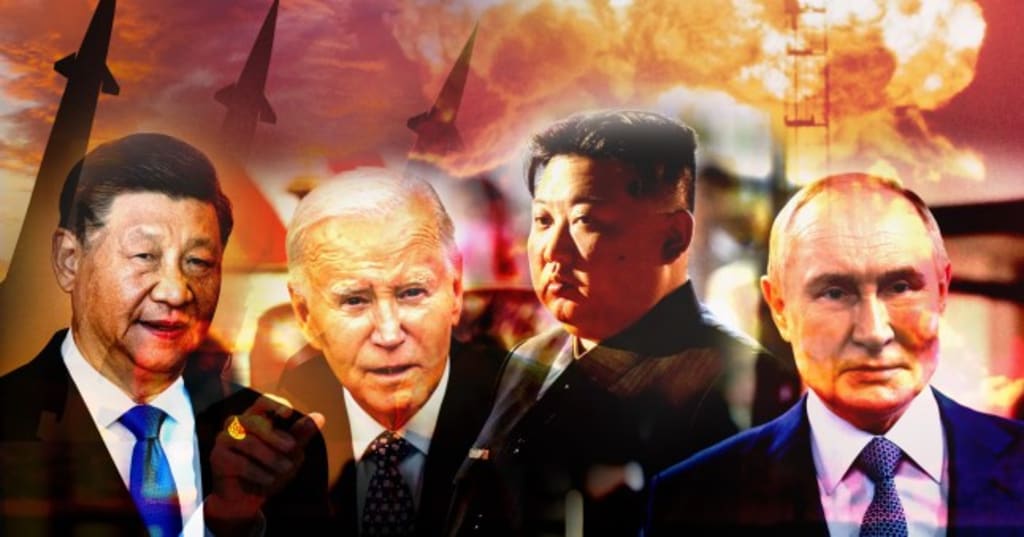
How Close Are We to World War Three?
The world holds its breath. The Doomsday Clock ticks louder than ever. Midnight is no longer a faraway myth—it feels like tomorrow.
In the heart of Europe, whispers of war echo through the cold winds of Ukraine. In the East, China flexes its military muscles over Taiwan. In the Middle East, Iran and Israel exchange deadly threats. And from the shadows of it all, Russia delivers a chilling warning: “The Doomsday Clock continues to tick towards midnight.”
We are not merely facing regional conflicts. We are inching—perhaps running—towards a point of no return. The phrase “World War Three”, once reserved for history books and science fiction, now dominates headlines and military briefings. But how close are we, really?
The Return of Cold War Tensions
The invasion of Ukraine by Russian forces in 2022 was more than a territorial war—it was the ignition of a global power struggle. NATO pushed eastward. Russia responded with nuclear threats. Sanctions turned brutal. Alliances hardened like ice.
Moscow, cornered yet defiant, reminds the West: Russia is a nuclear superpower. Vladimir Putin, echoing Cold War rhetoric, declared that any direct intervention from NATO would bring “unimaginable consequences.” And those consequences, many experts fear, point straight toward global war.
A single misfire, a provocation gone wrong, or an unmanned drone in the wrong airspace could trigger a chain reaction. This isn’t speculation—it’s a reality military strategists warn about daily.
Nuclear Nightmares and Doomsday Clocks
The Doomsday Clock, maintained by the Bulletin of the Atomic Scientists, is the most symbolic measure of global catastrophe risk. In 2024, it was set at 90 seconds to midnight, the closest it has ever been. And as of mid-2025, it remains there—unmoved, unwavered, unforgiving.
Why?
Because diplomacy is dying. Dialogue has turned into deadlock. The United Nations, once the global peacekeeper, now appears powerless. The world’s largest nuclear arsenals—held by the US, Russia, and China—are in a constant state of alert. Missile silos are activated. Submarines vanish beneath oceans. Stealth bombers soar over icy skies. The machinery of war is ready.
All it takes is one decision.
Voices from the West: “It’s No Longer If—But When”
In Washington, analysts no longer ask if war will erupt. They ask when. A confidential Pentagon document leaked earlier this year warned that “direct conflict between major powers is increasingly likely within the next 18–24 months.”
European leaders are equally uneasy. In Berlin, military advisors have recommended mandatory conscription. In London, underground bunkers are being quietly upgraded. In Paris, whispers of fuel and food reserves are spreading through security circles.
The signs are everywhere—except in the public eye.
Most of the world continues to live in digital distraction, unaware that the peace we’ve enjoyed since 1945 may be ending.
Eastern Sparks: Taiwan and the Ticking Fuse
While Ukraine grabs the headlines, Taiwan may be the true spark of global war.
China’s military exercises around the island are no longer just “drills.” They are rehearsals. Every month, the number of jets violating Taiwan’s airspace increases. Every month, U.S. warships are deployed closer to Beijing’s red lines.
One wrong move—one false flag, one naval accident—and the Pacific could explode into flames.
The United States has pledged to defend Taiwan. China, in turn, promises to retake it by force if needed. If these promises collide, the two largest economies on Earth could drag the entire world into war.
The Middle East Meltdown
In the Middle East, Iran and Israel are already dancing on the edge of war. Airstrikes, cyberattacks, and secret assassinations mark an undeclared conflict. And behind them, the global powers play chess—Russia backing Iran, the U.S. backing Israel.
The possibility of a two-front or even three-front war is no longer a fantasy—it is now a growing strategic concern. If Iran closes the Strait of Hormuz, oil prices would skyrocket. Western economies would stagger. The dominoes would fall.
So, How Close Are We?
Closer than anyone wants to admit.
We are not in a full-blown world war—yet. But we are in a pre-war environment. The same signs that appeared in the 1930s are repeating themselves: fractured alliances, economic turmoil, rising authoritarianism, and blind nationalism.
History is not just echoing. It is screaming.
The war drums are no longer distant. They are near. They beat in the skies over Ukraine. In the waters near Taiwan. In the deserts of the Middle East. They beat in speeches by leaders. In covert military drills. In broken diplomatic phone lines.
We are at the cliff’s edge. And the next step could be fatal.
Can It Be Stopped?
There is still a sliver of hope. Peace is not entirely lost—but it is fragile. The world needs cool heads, open communication, and courageous diplomacy.
But that window is closing fast. Each missile test, each troop movement, each cyberattack brings us seconds closer to midnight.
The question is not only how close we are.
The question is: Will we survive what comes next?
About the Creator
Ali Asad Ullah
Ali Asad Ullah creates clear, engaging content on technology, AI, gaming, and education. Passionate about simplifying complex ideas, he inspires readers through storytelling and strategic insights. Always learning and sharing knowledge.
Keep reading
More stories from Ali Asad Ullah and writers in History and other communities.
Ukraine Was Just the Beginning—The Secret Build-up to World War 3
Ukraine Was Just the Beginning—The Secret Build-up to World War 3 When Russia invaded Ukraine in 2022, the world held its breath. But what most people didn’t realize was that this was never about Ukraine alone. It was a test—of NATO, of Western unity, of global willpower. And the results weren’t just analyzed in Moscow. Washington, Beijing, Tehran, and Tel Aviv were watching every move, every weakness. What started as a regional war quietly cracked open the gates of a much darker future: the slow and secret rise of World War 3.
By Ali Asad Ullah8 months ago in History
This is the world’s most heavily secured convoy. Part 2
To handle this challenge, the U.S. government has created a dedicated agency whose sole job is to secure nuclear weapons. The military convoys you see are commonly used to transport nuclear weapons within the U.S. At first glance, such a convoy looks even more secure than that of a VIP—security an ordinary person can hardly imagine.
By Imran Ali Shaha day ago in History
Pearl
1980 something. we all hung out at Pearl and you and i were nothing special, or so i thought. i mean we all danced, drenched in our own sweat, our own saline solution of fear, too many beers, shots, laughter, tears, fucks in the bathroom and i don't know when we began to be afraid. do you?
By ROCK aka Andrea Polla (Simmons)6 days ago in Fiction


Comments
There are no comments for this story
Be the first to respond and start the conversation.