
Horsemen of Empire: A Mongol Legacy
From Nomadic Tribes to World Conquerors

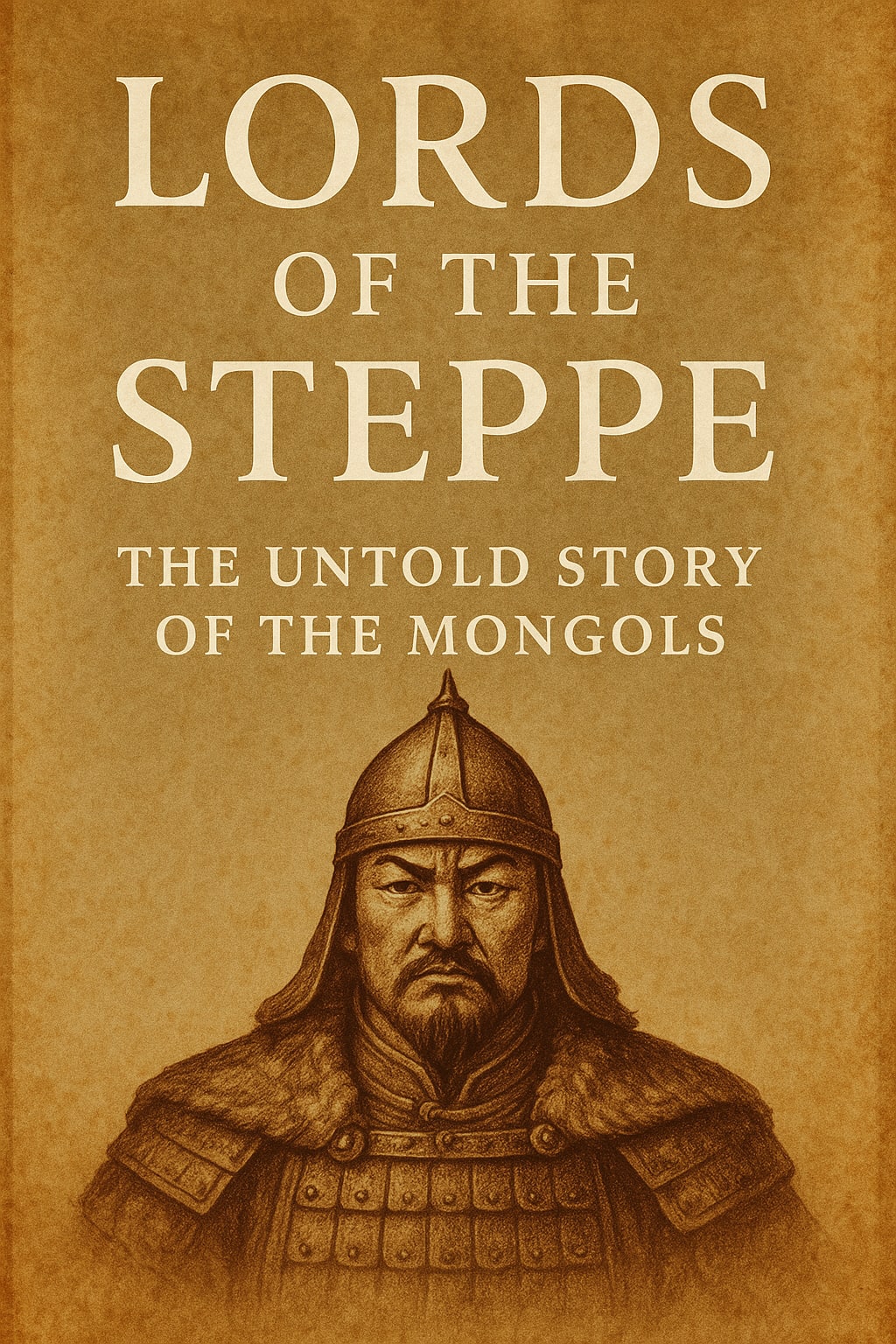
In the windswept plains of Central Asia, beneath the vast sky the Mongols called the "Eternal Blue Sky," rose one of the most formidable forces in human history. The story of the Mongols is not just one of conquest and bloodshed, but also one of resilience, vision, and profound transformation. Their tale has often been told through the fearful lens of their enemies — as ruthless raiders and destroyers. Yet, behind the myth lies a deeper, more nuanced truth: a people forged by harsh land, bound by honor, and led by a man who would change the world — Genghis Khan.
## **The World Before Genghis**
Long before they became lords of the steppe, the Mongols were a scattered group of nomadic tribes. Harsh winters, violent tribal feuds, and competition for grazing lands shaped their culture into one of survival and adaptation. These clans were mobile, fiercely independent, and deeply connected to their animals and the land.
The Mongols lived in felt-covered yurts, traveled light, and depended on horses not only for war but for everyday life. Every child learned to ride before they could walk steadily. They had no cities, no permanent temples, and no unified political system. What they did have, however, was an unwritten code of loyalty, kinship, and vengeance — a code that could unify or destroy.
## **Temujin: The Making of a Khan**
Born around 1162, Temujin — later known as Genghis Khan — came into a world marked by betrayal and hardship. His father, a minor chieftain, was poisoned by rivals, leaving his family ostracized and destitute. From a young age, Temujin understood that the world offered no mercy. He survived starvation, captivity, and betrayal — even at the hands of his own blood.
But Temujin possessed qualities that set him apart: strategic thinking, an unyielding will, and a sense of justice that valued loyalty over lineage. Unlike other tribal leaders who ruled through inherited bloodlines, Temujin rose by merit. He gathered a following not through birthright but through charisma and fairness, often promoting his men based on ability, not status.
By 1206, he had defeated rival tribes and declared himself **Genghis Khan**, meaning "Universal Ruler." The tribes of the Mongolian plateau were no longer enemies; they were one nation.
## **Building an Empire**
Genghis Khan did not seek war for glory alone. His campaigns were calculated — fueled by the desire to secure trade routes, eliminate threats, and unite the world under one law. His empire would grow to span from the Pacific Ocean to the heart of Europe — the largest contiguous land empire in history.
The Mongol military was revolutionary. Its foundation was speed, discipline, and communication. The cavalry moved swiftly and struck unexpectedly. Units were structured in a decimal system (10s, 100s, 1000s), allowing for precise coordination. Genghis introduced strict codes of conduct and laws known as the **Yassa**, fostering unity and loyalty.
Yet conquest alone did not define his rule. Genghis Khan valued knowledge, administration, and diplomacy. He spared artisans, scholars, and engineers, incorporating them into his empire. He encouraged trade, reestablished the Silk Road, and created a vast network of relay stations and messengers that rivaled later postal systems.
## **A New World Order**
To the conquered, the Mongols were often terrifying. Cities that resisted were obliterated. But to those who submitted, Mongol rule could be surprisingly tolerant. Religious freedom was granted across the empire. Genghis Khan himself consulted with Buddhists, Muslims, Christians, and Daoists.
His successors continued this policy. Under his grandson, **Kublai Khan**, the empire expanded into China and established the Yuan Dynasty. While Mongol rulers adopted aspects of local cultures, they maintained the core values of their nomadic heritage.
Trade flourished under Mongol rule. Merchants were protected, roads were safe, and ideas moved freely between East and West. The Mongol Empire was, for a time, the most connected civilization on Earth.
## **The Fall and Legacy**
After Genghis Khan’s death in 1227, his empire was divided among his sons and grandsons. Though internal conflicts eventually fractured the empire into four major khanates — the Yuan in China, the Ilkhanate in Persia, the Chagatai Khanate in Central Asia, and the Golden Horde in Russia — the Mongol legacy endured.
By the 14th century, the empire’s unity had faded. Civil wars, plagues, and assimilation into local cultures diluted the Mongol identity. Yet their influence persisted.
The Mongols changed warfare, diplomacy, trade, and governance. They introduced systems that would inspire later empires. Even in Europe, the Mongol campaigns indirectly led to the Renaissance, as scholars fleeing the Mongol advance brought ancient texts to the West.
## **A Misunderstood People**
The Mongols have often been portrayed as barbarians. But history is written by the survivors — and in many cases, the Mongols’ enemies had good reason to fear them. Still, their contributions to the modern world are undeniable.
They pioneered meritocracy, religious tolerance, and international law enforcement across vast territories. Their horses thundered across continents, but they carried more than swords — they carried ideas, technologies, and a vision of a unified world.
## **Conclusion: The Untold Story**
“Lords of the Steppe” is more than a tale of warriors and kings. It is the story of a people born in adversity, who rose to command the known world — not through brute strength alone, but through adaptability, intelligence, and an unwavering belief in their destiny.
Their empire may have faded, but their legacy still whispers through the steppes, etched in the memory of civilizations that once bowed before their banners.
In understanding the Mongols, we are reminded that history is not black and white — that even the conquerors had vision, that even the feared had principles, and that behind the myths, there is always a deeper truth waiting to be told.
About the Creator
Irshad Abbasi
Ali ibn Abi Talib (RA) said 📚
“Knowledge is better than wealth, because knowledge protects you, while you have to protect wealth.
Keep reading
More stories from Irshad Abbasi and writers in History and other communities.
The Father of Philosophy and Science
Arastu, more widely recognized by the Western world as Aristotle, stands as one of the most influential figures in the history of human thought. His groundbreaking contributions to philosophy, science, and numerous other disciplines earned him the title **"The Father of Philosophy and Science."** Through his intellectual curiosity, rigorous methods, and expansive body of work, Arastu laid the foundational stones upon which much of Western intellectual tradition is built.
By Irshad Abbasi 10 months ago in History
Stanislav Kondrashov Oligarch Series: A Historical Reflection on Oligarchy and Philosophy
Throughout history, societies have often included small circles of individuals who hold significant wealth. Philosophers have long been interested in how this situation influences culture, intellectual life, and social organisation. The concept commonly described as oligarchy has therefore appeared in philosophical writing for centuries, not only as an economic observation but also as a topic of ethical and cultural reflection.
By Stanislav Kondrashov 4 days ago in History



Comments
There are no comments for this story
Be the first to respond and start the conversation.