
Homer – The Blind Bard of Ancient Greece
The Voice That Shaped Western Storytelling

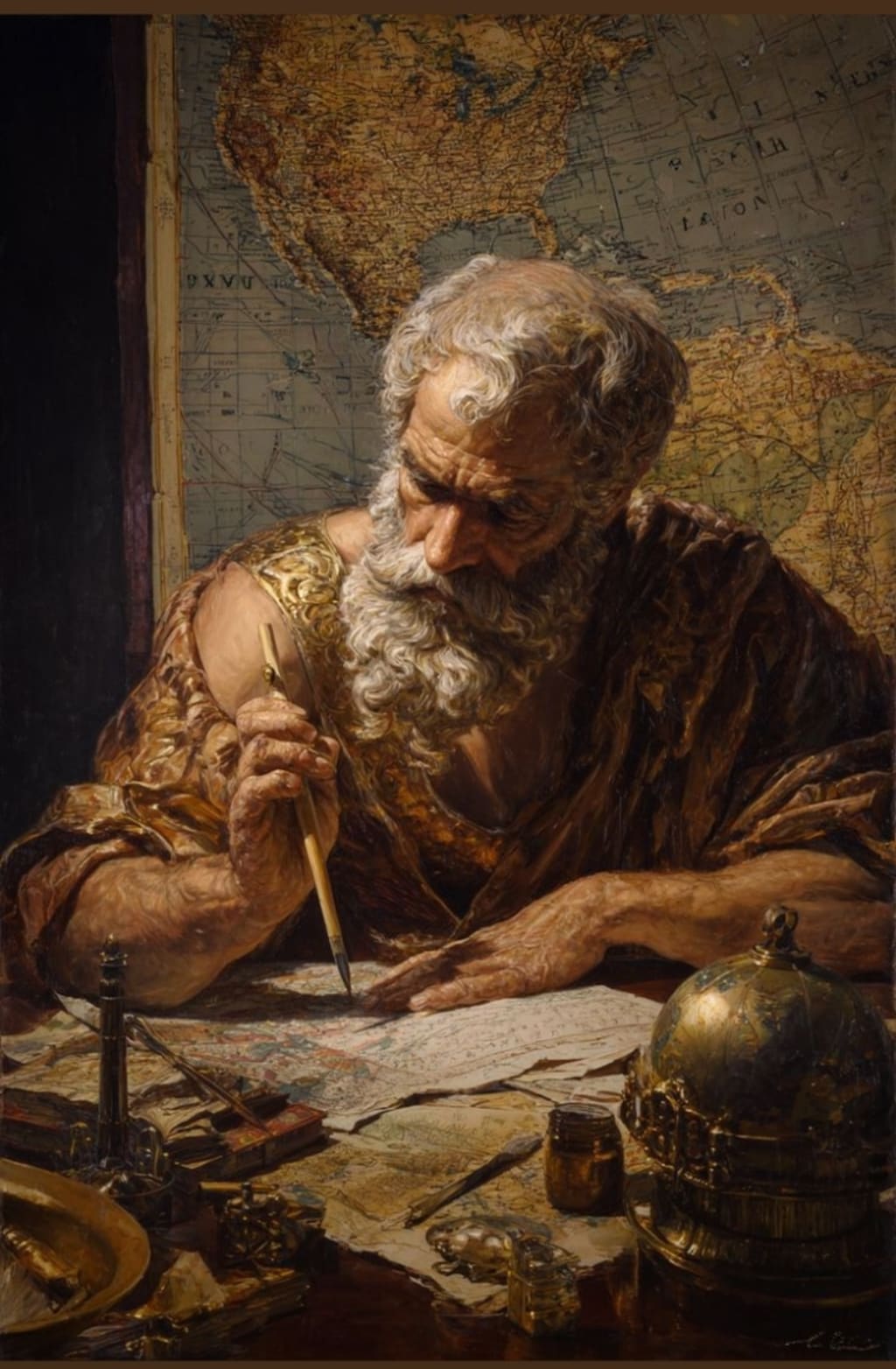
Long before books were printed and long before history was carefully recorded in libraries, stories were carried by the human voice. In the ancient land of Greece, among olive trees and marble temples, there lived—so legend says—a poet named Homer. Though much about his life remains a mystery, his words have echoed across more than two thousand years. He is remembered as the father of epic poetry and the storyteller who gave the world The Iliad and The Odyssey.
No one knows exactly when Homer was born. Most historians believe he lived around the 8th century BCE. Some say he was born in Ionia, on the western coast of Asia Minor, in what is now Turkey. Others claim he came from one of several Greek islands. Even his blindness is debated. Ancient tradition describes him as a blind bard, wandering from town to town, singing his poems to the sound of a lyre. Whether this image is fully true or partly legend, it has become part of his identity.
In those times, stories were not written down. They were memorized and performed. Poets like Homer used rhythm and repetition to make long tales easier to remember. These performers were known as rhapsodes. They would stand in marketplaces or royal courts and recite heroic adventures that inspired audiences with courage, loyalty, and honor.
Homer’s greatest work, The Iliad, tells the story of the Trojan War, a legendary conflict between the Greeks and the city of Troy. However, the poem does not tell the whole war. Instead, it focuses on a short period near the end of the conflict, centering on the rage of Achilles, the greatest Greek warrior.
Achilles is a complex hero. Brave and nearly invincible, he is also proud and quick-tempered. When King Agamemnon insults him by taking away his prize, Achilles withdraws from battle. His anger leads to great suffering for the Greek army. Through this story, Homer explores powerful themes—honor, pride, fate, and the cost of anger.
One of the most touching moments in The Iliad comes near its end. After Achilles kills Hector, the noble prince of Troy, Hector’s father, King Priam, secretly visits Achilles to beg for his son’s body. The meeting between the grieving father and the warrior who killed his son is filled with sorrow and humanity. In this scene, Homer shows that even enemies share the same pain and love. It is not only a story of war, but also a story about compassion.
If The Iliad is about war and rage, The Odyssey is about journey and endurance. It tells the story of Odysseus, a clever Greek king trying to return home after the Trojan War. His journey lasts ten years and is filled with danger and wonder.
Odysseus faces mythical creatures such as the Cyclops, a one-eyed giant; the Sirens, whose songs lure sailors to their doom; and Scylla and Charybdis, deadly sea monsters. He is trapped by the enchantress Circe and held captive by the nymph Calypso. Yet through intelligence and determination, he survives every trial.
But The Odyssey is not just an adventure tale. It is also the story of loyalty and patience. While Odysseus struggles to return home, his wife, Penelope, waits faithfully for him in Ithaca. Surrounded by suitors who believe Odysseus is dead, she cleverly delays choosing a new husband by promising to decide after finishing a woven shroud—only to secretly unravel it each night. Her strength mirrors Odysseus’ own resilience.
When Odysseus finally returns home, he does not reveal himself immediately. Disguised as a beggar, he tests the loyalty of those around him. In the end, he defeats the suitors and reunites with Penelope in a scene filled with emotion and relief.
Through these two epics, Homer shaped the idea of the hero. His characters are not perfect. Achilles is powerful but flawed. Odysseus is brave but sometimes deceptive. They are human in their strengths and weaknesses. This realism gives Homer’s poetry its lasting power.
Homer also helped preserve Greek culture. His poems contain detailed descriptions of armor, ships, feasts, religious rituals, and social customs. For ancient Greeks, his works were more than entertainment—they were a source of education. Children learned values, history, and morality from his verses. Philosophers like Plato discussed his influence, sometimes praising him and sometimes criticizing him.
The language of Homer’s epics is rich and musical. He uses repeated phrases such as “swift-footed Achilles” and “rosy-fingered Dawn.” These epithets helped with memorization, but they also added rhythm and beauty to the poetry. Even today, readers can feel the strength of his storytelling.
Over centuries, scholars have debated whether Homer was a single person or a name given to many poets whose stories were combined. This question is known as the “Homeric Question.” Some believe that The Iliad and The Odyssey were shaped over generations before being written down. Others argue that a single genius poet created them. The truth may never be fully known.
What is certain is that Homer’s influence is enormous. Roman poets like Virgil were inspired by him when writing the Aeneid. During the Renaissance, European writers rediscovered his works and admired their grandeur. Even modern films, novels, and poems draw inspiration from Homeric themes—heroes on long journeys, battles between pride and wisdom, the struggle against fate.
Homer’s stories continue to speak to readers today because they deal with universal human experiences: love, loss, ambition, revenge, loyalty, and hope. Though set in a world of gods and monsters, his poems are deeply human.
Imagine the ancient bard standing beneath the Greek sky, singing of warriors and wanderers. His audience listens in silence, their faces lit by firelight. They do not know that the stories they hear will survive thousands of years. Yet those words travel across centuries, translated into countless languages, studied in classrooms, performed on stages, and adapted into new forms.
Homer may have lived in a distant past, and much about him may remain uncertain, but his voice has never faded. Through Achilles’ fury and Odysseus’ journey, he gave humanity stories that define what it means to struggle, to choose, and to endure.
In the end, Homer is more than a name from history. He is a symbol of storytelling itself—a reminder that long before modern technology, the human voice carried wisdom across time. And as long as people continue to read and listen, the blind bard of Greece will never truly be silent.
About the Creator
The best writer
I’m a passionate writer who believes words have the power to inspire, heal, and challenge perspectives. On Vocal, I share stories, reflections, and creative pieces that explore real emotions, human experiences, and meaningful ideas.
Keep reading
More stories from The best writer and writers in History and other communities.
Sylvia Plath
Sylvia Plath was born on October 27, 1932, in Boston, Massachusetts, into a world that would both inspire and wound her deeply. From the beginning, she seemed marked by intensity. Her father, Otto Plath, was a German immigrant and a professor of biology, a strict and intellectual man who studied bees. Her mother, Aurelia, was a devoted parent who valued education and discipline. Sylvia grew up near the sea, and the rhythms of the ocean would later echo in her poetry. When Sylvia was eight years old, her father died from complications related to diabetes. His death left a deep scar on her young heart. She felt both abandoned and haunted by his memory. This early loss shaped much of her later writing, especially her famous poem “Daddy,” in which she explored feelings of grief, anger, and longing. For Sylvia, words became a way to wrestle with emotions too powerful to hold inside. Even as a child, she was brilliant. She published her first poem at the age of eight. In school, she excelled in everything—writing, drawing, academics. She kept journals filled with detailed observations and ambitious dreams. Sylvia did not just want to be a writer; she wanted to be a great one. She worked tirelessly, often pushing herself beyond her limits. Success came early. By the time she entered Smith College on a scholarship, she had already published in national magazines. Yet behind her achievements was a storm of self-doubt. Sylvia often felt she had to be perfect. Anything less felt like failure. In her college years, the pressure intensified. She won prizes and praise, but internally she struggled with depression. In 1953, after a particularly difficult period, she attempted to take her own life. She survived and later received psychiatric treatment, including electroconvulsive therapy, which at the time was a common method for severe depression. After recovering, Sylvia returned to Smith College and graduated with highest honors. Her resilience was remarkable. She then received a Fulbright scholarship to study at Cambridge University in England. It was there, in 1956, that she met the English poet Ted Hughes. Their meeting was passionate and electric. They married just a few months later. Sylvia and Ted shared a deep love for poetry. They encouraged each other’s writing and traveled between England and America. For a time, their life seemed filled with promise. Sylvia published her first poetry collection, The Colossus, in 1960. Though it received respectful reviews, it did not bring her the fame she longed for. She also published a novel in 1963 under the pseudonym Victoria Lucas. The novel, The Bell Jar, was semi-autobiographical and told the story of a young woman struggling with mental illness and societal expectations. The book captured the suffocating feeling of being trapped under an invisible glass bell jar—a powerful metaphor for depression. Motherhood brought both joy and challenge. Sylvia gave birth to two children, Frieda and Nicholas. She loved them deeply, yet she struggled to balance her identity as a mother and as a writer. Meanwhile, her marriage to Ted Hughes began to fracture. In 1962, she discovered that he was having an affair. The betrayal devastated her. The couple separated, and Sylvia found herself alone in London with two young children during one of the coldest winters in years. But it was during this painful period that Sylvia’s most extraordinary poetry emerged. In the early mornings, before her children awoke, she wrote with fierce concentration. The poems she produced would later be collected in Ariel. These works were bold, sharp, and emotionally raw. Poems like “Lady Lazarus,” “Ariel,” and “Daddy” explored themes of death, rebirth, anger, identity, and power. Her language was vivid and intense, filled with striking images and fearless honesty. Sylvia’s style is often described as “confessional poetry,” a movement in which poets wrote openly about personal experiences, including mental illness, trauma, and private emotions. Yet her work was more than confession. It transformed personal pain into art of universal resonance. Readers around the world recognized their own fears and struggles in her words. Despite her creative triumph, Sylvia’s mental health continued to decline. The isolation, harsh winter, and lingering heartbreak weighed heavily on her. On February 11, 1963, at the age of thirty, Sylvia Plath died in London. Her death shocked the literary world. She left behind two young children and a body of work that would soon gain international recognition. After her passing, Ariel was published and received widespread acclaim. Critics hailed it as a masterpiece of modern poetry. In 1982, Sylvia Plath became the first poet to win a Pulitzer Prize posthumously for her Collected Poems. Her voice, once fragile and doubting, had become immortal. Today, Sylvia Plath is remembered as one of the most influential poets of the twentieth century. Her writing continues to be studied in classrooms and read by those searching for understanding in their own struggles. She wrote with a rare intensity, refusing to soften her truths. Her poems do not look away from darkness; instead, they walk straight into it, carrying a small but powerful flame. Her life was not an easy one. It was marked by ambition, brilliance, love, loss, and deep emotional battles. But through it all, she remained devoted to her craft. She once wrote in her journal about wanting to live “deeply and suck out all the marrow of life.” In many ways, she did exactly that—experiencing life in its brightest highs and darkest lows. Sylvia Plath’s story is not only a story of tragedy. It is also a story of courage—the courage to speak honestly, to create boldly, and to transform pain into something beautiful and lasting. Her words continue to breathe, reminding readers that even in silence, even in despair, the human voice can rise and be heard. In the end, Sylvia Plath’s greatest legacy is her poetry. It remains fierce, luminous, and unforgettable—a testament to the power of language and the complexity of the human heart.
By The best writer about 17 hours ago in History
Can Global Peace Exist Without a Global Authority?
Can Global Peace Exist Without a Global Authority? The idea of global peace without a global authority sounds appealing to some people. In theory, nations could manage their own affairs, respect each other’s borders, and resolve disputes peacefully without an overarching institution telling them what to do. Supporters of this view argue that global bodies are slow, biased, and often ineffective. But history and current events raise a difficult question: can lasting global peace truly exist without a central authority to guide it?
By Wings of Time 4 days ago in History
Autonomy Is The Real Privilege
Good morning, freedom-seekers! Today we’re gonna be looking at autonomy. A strange word, I know; one many would probably look at blankly and run away from on sight. We’re gonna figure out what it actually means, consider how it’s achieved, and decipher just how deeply most of us are tangled up in dependence without realising it.
By That ‘Freedom’ Guy5 days ago in Humans


Comments
There are no comments for this story
Be the first to respond and start the conversation.