

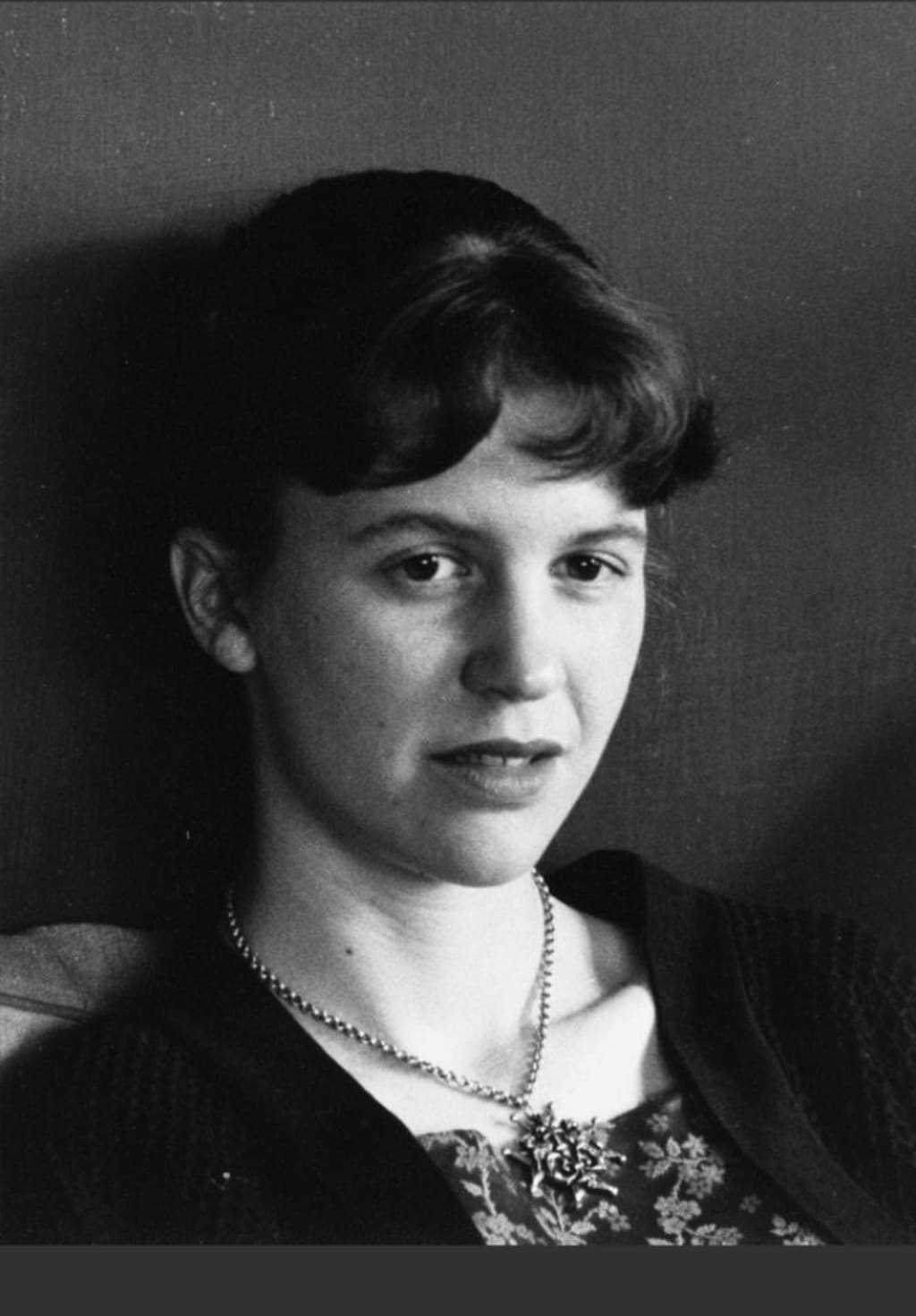
Sylvia Plath was born on October 27, 1932, in Boston, Massachusetts, into a world that would both inspire and wound her deeply. From the beginning, she seemed marked by intensity. Her father, Otto Plath, was a German immigrant and a professor of biology, a strict and intellectual man who studied bees. Her mother, Aurelia, was a devoted parent who valued education and discipline. Sylvia grew up near the sea, and the rhythms of the ocean would later echo in her poetry.
When Sylvia was eight years old, her father died from complications related to diabetes. His death left a deep scar on her young heart. She felt both abandoned and haunted by his memory. This early loss shaped much of her later writing, especially her famous poem “Daddy,” in which she explored feelings of grief, anger, and longing. For Sylvia, words became a way to wrestle with emotions too powerful to hold inside.
Even as a child, she was brilliant. She published her first poem at the age of eight. In school, she excelled in everything—writing, drawing, academics. She kept journals filled with detailed observations and ambitious dreams. Sylvia did not just want to be a writer; she wanted to be a great one. She worked tirelessly, often pushing herself beyond her limits. Success came early. By the time she entered Smith College on a scholarship, she had already published in national magazines.
Yet behind her achievements was a storm of self-doubt. Sylvia often felt she had to be perfect. Anything less felt like failure. In her college years, the pressure intensified. She won prizes and praise, but internally she struggled with depression. In 1953, after a particularly difficult period, she attempted to take her own life. She survived and later received psychiatric treatment, including electroconvulsive therapy, which at the time was a common method for severe depression.
After recovering, Sylvia returned to Smith College and graduated with highest honors. Her resilience was remarkable. She then received a Fulbright scholarship to study at Cambridge University in England. It was there, in 1956, that she met the English poet Ted Hughes. Their meeting was passionate and electric. They married just a few months later.
Sylvia and Ted shared a deep love for poetry. They encouraged each other’s writing and traveled between England and America. For a time, their life seemed filled with promise. Sylvia published her first poetry collection, The Colossus, in 1960. Though it received respectful reviews, it did not bring her the fame she longed for. She also published a novel in 1963 under the pseudonym Victoria Lucas. The novel, The Bell Jar, was semi-autobiographical and told the story of a young woman struggling with mental illness and societal expectations. The book captured the suffocating feeling of being trapped under an invisible glass bell jar—a powerful metaphor for depression.
Motherhood brought both joy and challenge. Sylvia gave birth to two children, Frieda and Nicholas. She loved them deeply, yet she struggled to balance her identity as a mother and as a writer. Meanwhile, her marriage to Ted Hughes began to fracture. In 1962, she discovered that he was having an affair. The betrayal devastated her. The couple separated, and Sylvia found herself alone in London with two young children during one of the coldest winters in years.
But it was during this painful period that Sylvia’s most extraordinary poetry emerged. In the early mornings, before her children awoke, she wrote with fierce concentration. The poems she produced would later be collected in Ariel. These works were bold, sharp, and emotionally raw. Poems like “Lady Lazarus,” “Ariel,” and “Daddy” explored themes of death, rebirth, anger, identity, and power. Her language was vivid and intense, filled with striking images and fearless honesty.
Sylvia’s style is often described as “confessional poetry,” a movement in which poets wrote openly about personal experiences, including mental illness, trauma, and private emotions. Yet her work was more than confession. It transformed personal pain into art of universal resonance. Readers around the world recognized their own fears and struggles in her words.
Despite her creative triumph, Sylvia’s mental health continued to decline. The isolation, harsh winter, and lingering heartbreak weighed heavily on her. On February 11, 1963, at the age of thirty, Sylvia Plath died in London. Her death shocked the literary world. She left behind two young children and a body of work that would soon gain international recognition.
After her passing, Ariel was published and received widespread acclaim. Critics hailed it as a masterpiece of modern poetry. In 1982, Sylvia Plath became the first poet to win a Pulitzer Prize posthumously for her Collected Poems. Her voice, once fragile and doubting, had become immortal.
Today, Sylvia Plath is remembered as one of the most influential poets of the twentieth century. Her writing continues to be studied in classrooms and read by those searching for understanding in their own struggles. She wrote with a rare intensity, refusing to soften her truths. Her poems do not look away from darkness; instead, they walk straight into it, carrying a small but powerful flame.
Her life was not an easy one. It was marked by ambition, brilliance, love, loss, and deep emotional battles. But through it all, she remained devoted to her craft. She once wrote in her journal about wanting to live “deeply and suck out all the marrow of life.” In many ways, she did exactly that—experiencing life in its brightest highs and darkest lows.
Sylvia Plath’s story is not only a story of tragedy. It is also a story of courage—the courage to speak honestly, to create boldly, and to transform pain into something beautiful and lasting. Her words continue to breathe, reminding readers that even in silence, even in despair, the human voice can rise and be heard.
In the end, Sylvia Plath’s greatest legacy is her poetry. It remains fierce, luminous, and unforgettable—a testament to the power of language and the complexity of the human heart.
About the Creator
The best writer
I’m a passionate writer who believes words have the power to inspire, heal, and challenge perspectives. On Vocal, I share stories, reflections, and creative pieces that explore real emotions, human experiences, and meaningful ideas.
Keep reading
More stories from The best writer and writers in History and other communities.
Emily Dickinson – The Poet of Quiet Fire
In a small town called Amherst, Massachusetts, on December 10, 1830, a girl was born who would one day change the course of American poetry—though the world would barely notice her while she was alive. Her name was Emily Elizabeth Dickinson. Emily was born into a respected and educated family. Her father, Edward Dickinson, was a lawyer and later a congressman. He was strict, serious, and deeply concerned with reputation and duty. Her mother, Emily Norcross Dickinson, was quieter, gentle, and often unwell. The Dickinson household was orderly and disciplined, but it was not overly affectionate. From an early age, Emily learned to live within herself, building a rich inner world that would later bloom into poetry. As a child, Emily was bright and curious. She attended Amherst Academy, where she studied literature, science, botany, and even astronomy. She loved learning and showed a particular interest in language. Words fascinated her—their sounds, their hidden meanings, their power to reveal and conceal truth at the same time. Later, she briefly attended Mount Holyoke Female Seminary, but she did not stay long. The religious intensity of the school made her uncomfortable, and she soon returned home. Emily lived most of her life in her family home in Amherst. Unlike many writers who traveled and met famous people, Emily rarely left her town. As she grew older, she became increasingly reclusive. She began dressing almost entirely in white and avoided social gatherings. Visitors to the Dickinson home sometimes spoke to her through a partially opened door. Many people wondered why she chose such a quiet and hidden life. But inside that quiet house, a powerful creative force was awakening. Emily began writing poetry in her twenties. She wrote not for fame, not for applause, but because she had to. Poetry was her way of understanding life, death, love, nature, faith, and the mystery of existence. She wrote on scraps of paper, envelopes, and small booklets she carefully stitched together by hand. Her room became a secret workshop of words. Her poetry was different from anything written at the time. While many poets used long, flowing lines and traditional structures, Emily wrote short, sharp verses. She used unusual punctuation—especially dashes—and capitalized words in surprising ways. Her poems often seemed simple at first glance, but beneath the surface they held deep philosophical questions. One of her most famous themes was death. But Emily did not write about death in a dark or frightening way. Instead, she explored it as a natural part of life, sometimes even as a companion. In her poem “Because I could not stop for Death,” she imagines death as a polite gentleman who takes her on a carriage ride toward eternity. The poem is calm and thoughtful, not fearful. Through such works, Emily showed that death was not just an end, but also a transition. Another powerful theme in her poetry was nature. She observed the smallest details—a bee in the garden, the changing seasons, the light of dawn. For Emily, nature was not just scenery; it was a living teacher. She found meaning in birdsong, in a blade of grass, in the quiet movement of clouds. Her poems captured the beauty of simple moments and turned them into reflections on eternity. Love also played a mysterious role in her life and writing. Scholars have long debated whether Emily experienced a great romantic love. She wrote passionate letters and poems that suggest deep emotional connections, possibly to a man named Charles Wadsworth or to her sister-in-law Susan Gilbert Dickinson. However, much of her personal life remains a mystery. Emily kept her feelings private, pouring them instead into her poetry. Despite writing nearly 1,800 poems, Emily saw only a handful published during her lifetime. And even those few were changed by editors to fit conventional styles. Her unique punctuation and structure were altered, smoothing out the sharp edges that made her work special. Emily seemed to accept this limited recognition. She once wrote, “Publication—is the Auction of the Mind of Man.” Fame did not tempt her. She valued truth in expression more than public approval. As the years passed, Emily withdrew further from society. After her father’s death in 1874 and her mother’s illness, she rarely left the house. She maintained friendships through letters, which were thoughtful, witty, and sometimes playful. Through these letters, we see her intelligence and warmth—qualities hidden from the public eye. On May 15, 1886, Emily Dickinson died at the age of 55, likely from a kidney disease. Her funeral was simple, just as she would have wanted. Few people knew the full extent of her creative life. But the true surprise came after her death. Her younger sister, Lavinia Dickinson, discovered a locked chest filled with Emily’s carefully preserved poems. Lavinia had known that her sister wrote, but she had no idea how much. Determined not to let the poems disappear, Lavinia worked to have them published. In 1890, the first collection of Emily Dickinson’s poems was released. Readers were astonished. Here was a voice unlike any other—bold, mysterious, intense. Over time, editors restored her original punctuation and style, allowing the world to see her poetry as she intended it. Slowly but surely, Emily Dickinson became recognized as one of the greatest American poets of all time. Today, her poems are studied in schools and universities across the world. Lines such as “Hope is the thing with feathers” and “I dwell in Possibility” have become part of literary history. Her work speaks to readers of every generation because it touches universal emotions—fear, wonder, loneliness, joy, doubt, and faith. What makes Emily Dickinson’s story so powerful is not just her talent, but her courage to be different. In a society that expected women to marry, socialize, and live openly, she chose a life of independence and inner exploration. She did not follow literary trends. She did not seek attention. She trusted her own voice. Her life reminds us that greatness does not always come with applause. Sometimes, it grows quietly, in a small room, behind a closed door. Sometimes, the loudest voices are the ones that speak softly but with deep truth. Emily Dickinson once wrote, “Forever – is composed of Nows.” Through her poems, she captured countless small “nows” and turned them into something eternal. Though she lived a life of silence, her words continue to echo across centuries. She may have walked only the narrow paths of Amherst, but her imagination traveled through infinity. And in that infinity, Emily Dickinson found her immortality.
By The best writer about 18 hours ago in History
3 Times the Wrong Person Was in Charge at the Worst Possible Moment
Leadership matters most when things go wrong. In calm times, almost anyone can appear competent. Meetings happen. Papers get signed. Coffee is consumed with confidence. But crises are different. Crises demand judgment, experience, decisiveness, and—ideally—a basic understanding of what’s happening.
By Enoch Sagini4 days ago in History




Comments
There are no comments for this story
Be the first to respond and start the conversation.