

A Dive into the Rich History of America
Introduction
Embarking on a journey through time, let's unravel the captivating narrative of America's history, a tale woven with threads of resilience, diversity, and innovation.
Indigenous Roots
The chronicle of America begins with its indigenous people, a myriad of cultures, languages, and traditions. From the powerful nations of the Iroquois Confederacy to the nomadic tribes of the Great Plains, the land was a mosaic of distinct societies, each contributing to the unique tapestry of American history.
The Age of Exploration
In the 15th century, European explorers set sail, driven by a quest for new trade routes and riches. Christopher Columbus, in 1492, stumbled upon the Americas, forever altering the course of history. The ensuing exploration and colonization marked the birth of a new era, intertwining the destinies of the Old and New Worlds.
Colonial Foundations
As European powers established colonies along the eastern seaboard, America became a melting pot of cultures. The 13 colonies, shaped by British, Dutch, and Spanish influences, laid the groundwork for the birth of a nation. The struggles for independence and the forging of a national identity emerged from the crucible of colonial life.
The Revolutionary Spirit
Boldly declaring independence in 1776, the American Revolution erupted, echoing the fervent call for freedom. The battles of Lexington and Concord, the drafting of the Declaration of Independence, and the valiant efforts of patriots such as George Washington embodied the spirit that would shape the United States.
Westward Expansion
The 19th century witnessed a nation expanding its boundaries westward. The Louisiana Purchase, the Oregon Trail, and the California Gold Rush fueled the manifest destiny, a belief that America was destined to stretch from coast to coast. Yet, this expansion came at the cost of indigenous displacement and conflicts.
Civil War and Emancipation
The mid-19th century plunged the nation into a devastating Civil War over issues of slavery and states' rights. Abraham Lincoln's Emancipation Proclamation in 1863 marked a pivotal moment, heralding the end of slavery and setting the stage for a reunited nation.
Industrial Revolution
Post-Civil War, America underwent an industrial revolution, transforming from an agrarian society to an industrial powerhouse. Railroads spanned the continent, factories hummed with activity, and technological innovations burgeoned, propelling the nation into a new era of prosperity.
World Wars and Global Influence
The 20th century saw America thrust onto the world stage with its involvement in both World Wars. Emerging as a superpower, the United States played a pivotal role in shaping global affairs, from the establishment of the United Nations to the Cold War rivalry with the Soviet Union.
Civil Rights Movement
Amidst progress, the struggle for civil rights unfolded in the mid-20th century. Visionaries like Martin Luther King Jr. led a movement demanding equality and justice, challenging societal norms and paving the way for a more inclusive America.
Technological Revolution
As the 21st century dawned, America embraced the digital age, marking a technological revolution. Silicon Valley became a beacon of innovation, shaping the way people connect, work, and live. The internet, smartphones, and artificial intelligence became integral to the American experience.
Conclusion
In tracing the history of America, we witness a nation shaped by triumphs and tribulations, a testament to the resilience and dynamism of its people. From the indigenous roots to the technological era, the American story is one of continual evolution, a narrative that continues to unfold with each passing day. As we reflect on the past, let us stride confidently into the future, cognizant of the threads that bind us to our shared history.
About the Creator
Keep reading
More stories from Mamoona Rana and writers in History and other communities.
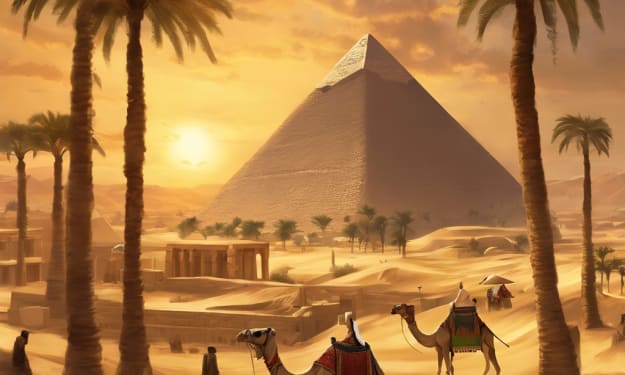
History of Egypt
Egypt boasts a captivating history spanning over 5,000 years, characterized by ancient civilizations, monumental achievements, and cultural contributions. The Nile River, a lifeline for the region, played a central role in the formation of early Egyptian society. Around 3100 BCE, the unification of Upper and Lower Egypt marked the beginning of the Old Kingdom, ushering in the era of pharaohs.
By Mamoona Rana2 years ago in History
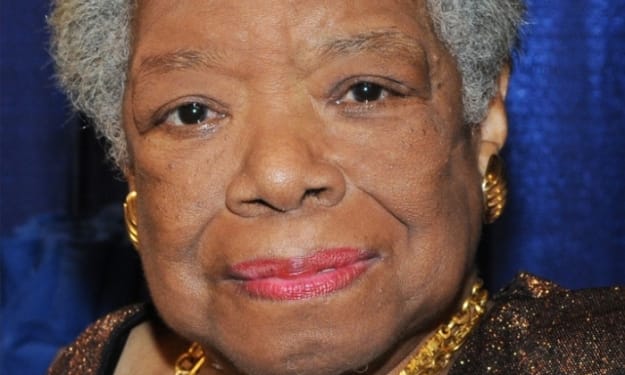
Maya Angelou – A Voice That Rose Like a Song
In the spring of 1928, in St. Louis, Missouri, a baby girl was born and named Marguerite Annie Johnson. The world would later know her as Maya Angelou—a poet, performer, activist, and one of the most powerful voices of the twentieth century. But her journey to greatness was not simple or smooth. It was a road marked by pain, silence, courage, and finally, a voice that would echo across generations. When Maya was very young, her parents separated. She and her older brother, Bailey, were sent to live with their grandmother in Stamps, Arkansas, a small Southern town divided by racial segregation. Life in Stamps was shaped by strict rules and deep prejudice. Black families lived with limited opportunities, and injustice was a daily reality. Yet, within her grandmother’s small store, Maya found a world of dignity and strength. Her grandmother, Annie Henderson, was a respected woman in the community—firm, faithful, and hardworking. From her, Maya learned resilience. As a child, Maya loved words. She listened carefully to the rhythms of speech and the music of stories told in church. But at the age of eight, her life changed in a traumatic way. After returning briefly to live with her mother, she was harmed by her mother’s boyfriend. When he was later killed, young Maya believed her own words had caused his death because she had testified against him. Overcome with guilt and fear, she stopped speaking. For nearly five years, she lived in silence. Many thought the quiet girl would remain lost in her muteness. But her silence became a time of deep listening and learning. Back in Stamps, a kind teacher named Mrs. Bertha Flowers recognized Maya’s intelligence. She introduced her to literature—Charles Dickens, William Shakespeare, Paul Laurence Dunbar. Mrs. Flowers gently encouraged her to read aloud, explaining that poetry must be spoken to be truly understood. Slowly, word by word, Maya found her voice again. Literature became her refuge and her strength. As a teenager, Maya moved to San Francisco with her mother. Determined and independent, she became the first Black female streetcar conductor in the city at just sixteen years old. It was a small job in the eyes of many, but for Maya, it was proof that barriers could be broken. Around this time, she also became a young mother, giving birth to her son, Guy. Raising him while building her own life required courage and sacrifice. In her early adulthood, Maya explored many paths. She worked as a dancer, singer, and actress. She toured Europe in an opera production and later recorded music. During these years, she adopted the name “Maya Angelou,” combining her childhood nickname with a version of her former husband’s surname. The name would become legendary. The 1950s and 1960s were years of transformation in America. The Civil Rights Movement was rising, and Maya felt called to be part of it. She met and worked with influential leaders such as Dr. Martin Luther King Jr. and Malcolm X. In Ghana, where she lived for a time, she worked as a journalist and educator. Africa deepened her sense of identity and connection to her roots. Yet no matter where she lived—America, Europe, or Africa—she carried with her the memories of Stamps and the lessons of survival. In 1968, tragedy struck again when Dr. King was assassinated on Maya’s birthday. Grief overwhelmed her. For a time, she withdrew once more. But friends encouraged her to write about her life. The result was a groundbreaking memoir published in 1969: I Know Why the Caged Bird Sings. The book was unlike anything many readers had seen before. With honesty and poetic beauty, Maya described her childhood in the segregated South, her trauma, her silence, and her awakening. The title symbolized her own life—the caged bird representing oppression, yet still daring to sing. The memoir gave voice to countless people who had suffered in silence. It became an international success and established Maya Angelou as a major literary figure. She continued writing memoirs, essays, and poetry. Her poems carried rhythm like music and truth like lightning. One of her most famous poems, Still I Rise, became an anthem of strength and dignity: “You may write me down in history With your bitter, twisted lies… But still, like dust, I’ll rise.” Her words were not only about race, but about the human spirit—the ability to stand up again after being pushed down. She wrote about love, loss, motherhood, and hope. She believed that words could heal and that stories could change hearts. In 1993, Maya Angelou stood before millions at the inauguration of President Bill Clinton and recited her poem On the Pulse of Morning. Her voice, calm and powerful, carried across the nation. It was a historic moment—she became the first Black woman to recite a poem at a U.S. presidential inauguration. For many watching, it was more than poetry; it was history speaking. Throughout her life, Maya received numerous awards and honors, including the Presidential Medal of Freedom. Universities invited her to teach and speak. Students admired her wisdom and warmth. Yet despite fame and recognition, she remained deeply connected to her roots. She often said that courage was the most important virtue because without courage, you cannot practice any other virtue consistently. Maya Angelou did not pretend her life was free from pain. Instead, she showed that pain can be transformed into purpose. She believed that people should not only survive but thrive. “We may encounter many defeats,” she once wrote, “but we must not be defeated.” In her later years, she lived in North Carolina, continuing to write and inspire. Even as her hair turned silver and her steps slowed, her voice never lost its strength. She spoke about kindness, reminding people that “people will forget what you said, people will forget what you did, but people will never forget how you made them feel.” When Maya Angelou passed away in 2014, the world mourned not only a writer, but a guiding light. Tributes poured in from presidents, poets, and ordinary readers whose lives had been touched by her words. Yet her voice did not fade. It lives on in classrooms, libraries, and hearts around the world. Her story is not just about fame or success. It is about a little girl who once stopped speaking because she believed her voice had caused harm—and who later used that same voice to bring hope to millions. It is about rising after every fall. It is about turning silence into song. Maya Angelou once compared herself to a caged bird who sings of freedom. And through her courage, her poetry, and her unbreakable spirit, she proved that even the most wounded voice can become a melody of strength. Her life reminds us that no matter where we begin—no matter how small the town or how heavy the burden—we carry within us the power to rise. And like dust, like air, like the morning sun— Maya Angelou rose.
By The best writer a day ago in History
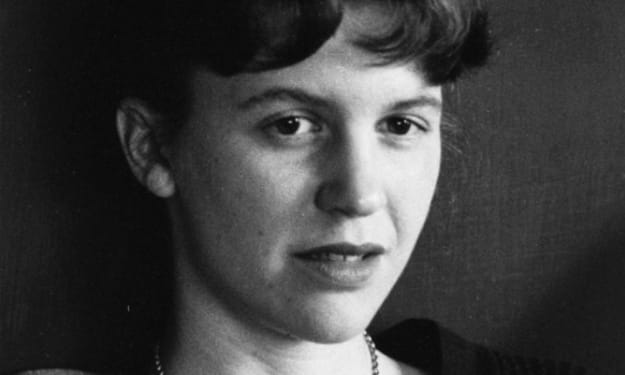
Sylvia Plath
Sylvia Plath was born on October 27, 1932, in Boston, Massachusetts, into a world that would both inspire and wound her deeply. From the beginning, she seemed marked by intensity. Her father, Otto Plath, was a German immigrant and a professor of biology, a strict and intellectual man who studied bees. Her mother, Aurelia, was a devoted parent who valued education and discipline. Sylvia grew up near the sea, and the rhythms of the ocean would later echo in her poetry. When Sylvia was eight years old, her father died from complications related to diabetes. His death left a deep scar on her young heart. She felt both abandoned and haunted by his memory. This early loss shaped much of her later writing, especially her famous poem “Daddy,” in which she explored feelings of grief, anger, and longing. For Sylvia, words became a way to wrestle with emotions too powerful to hold inside. Even as a child, she was brilliant. She published her first poem at the age of eight. In school, she excelled in everything—writing, drawing, academics. She kept journals filled with detailed observations and ambitious dreams. Sylvia did not just want to be a writer; she wanted to be a great one. She worked tirelessly, often pushing herself beyond her limits. Success came early. By the time she entered Smith College on a scholarship, she had already published in national magazines. Yet behind her achievements was a storm of self-doubt. Sylvia often felt she had to be perfect. Anything less felt like failure. In her college years, the pressure intensified. She won prizes and praise, but internally she struggled with depression. In 1953, after a particularly difficult period, she attempted to take her own life. She survived and later received psychiatric treatment, including electroconvulsive therapy, which at the time was a common method for severe depression. After recovering, Sylvia returned to Smith College and graduated with highest honors. Her resilience was remarkable. She then received a Fulbright scholarship to study at Cambridge University in England. It was there, in 1956, that she met the English poet Ted Hughes. Their meeting was passionate and electric. They married just a few months later. Sylvia and Ted shared a deep love for poetry. They encouraged each other’s writing and traveled between England and America. For a time, their life seemed filled with promise. Sylvia published her first poetry collection, The Colossus, in 1960. Though it received respectful reviews, it did not bring her the fame she longed for. She also published a novel in 1963 under the pseudonym Victoria Lucas. The novel, The Bell Jar, was semi-autobiographical and told the story of a young woman struggling with mental illness and societal expectations. The book captured the suffocating feeling of being trapped under an invisible glass bell jar—a powerful metaphor for depression. Motherhood brought both joy and challenge. Sylvia gave birth to two children, Frieda and Nicholas. She loved them deeply, yet she struggled to balance her identity as a mother and as a writer. Meanwhile, her marriage to Ted Hughes began to fracture. In 1962, she discovered that he was having an affair. The betrayal devastated her. The couple separated, and Sylvia found herself alone in London with two young children during one of the coldest winters in years. But it was during this painful period that Sylvia’s most extraordinary poetry emerged. In the early mornings, before her children awoke, she wrote with fierce concentration. The poems she produced would later be collected in Ariel. These works were bold, sharp, and emotionally raw. Poems like “Lady Lazarus,” “Ariel,” and “Daddy” explored themes of death, rebirth, anger, identity, and power. Her language was vivid and intense, filled with striking images and fearless honesty. Sylvia’s style is often described as “confessional poetry,” a movement in which poets wrote openly about personal experiences, including mental illness, trauma, and private emotions. Yet her work was more than confession. It transformed personal pain into art of universal resonance. Readers around the world recognized their own fears and struggles in her words. Despite her creative triumph, Sylvia’s mental health continued to decline. The isolation, harsh winter, and lingering heartbreak weighed heavily on her. On February 11, 1963, at the age of thirty, Sylvia Plath died in London. Her death shocked the literary world. She left behind two young children and a body of work that would soon gain international recognition. After her passing, Ariel was published and received widespread acclaim. Critics hailed it as a masterpiece of modern poetry. In 1982, Sylvia Plath became the first poet to win a Pulitzer Prize posthumously for her Collected Poems. Her voice, once fragile and doubting, had become immortal. Today, Sylvia Plath is remembered as one of the most influential poets of the twentieth century. Her writing continues to be studied in classrooms and read by those searching for understanding in their own struggles. She wrote with a rare intensity, refusing to soften her truths. Her poems do not look away from darkness; instead, they walk straight into it, carrying a small but powerful flame. Her life was not an easy one. It was marked by ambition, brilliance, love, loss, and deep emotional battles. But through it all, she remained devoted to her craft. She once wrote in her journal about wanting to live “deeply and suck out all the marrow of life.” In many ways, she did exactly that—experiencing life in its brightest highs and darkest lows. Sylvia Plath’s story is not only a story of tragedy. It is also a story of courage—the courage to speak honestly, to create boldly, and to transform pain into something beautiful and lasting. Her words continue to breathe, reminding readers that even in silence, even in despair, the human voice can rise and be heard. In the end, Sylvia Plath’s greatest legacy is her poetry. It remains fierce, luminous, and unforgettable—a testament to the power of language and the complexity of the human heart.
By The best writer 2 days ago in History

Comments (1)
written skillfully and offers great information.