
History of Afghanistan: From Ancient Crossroads to Modern Conflict
Exploring the Legacy, Struggles, and Resilience of a Nation at the Heart of Asia

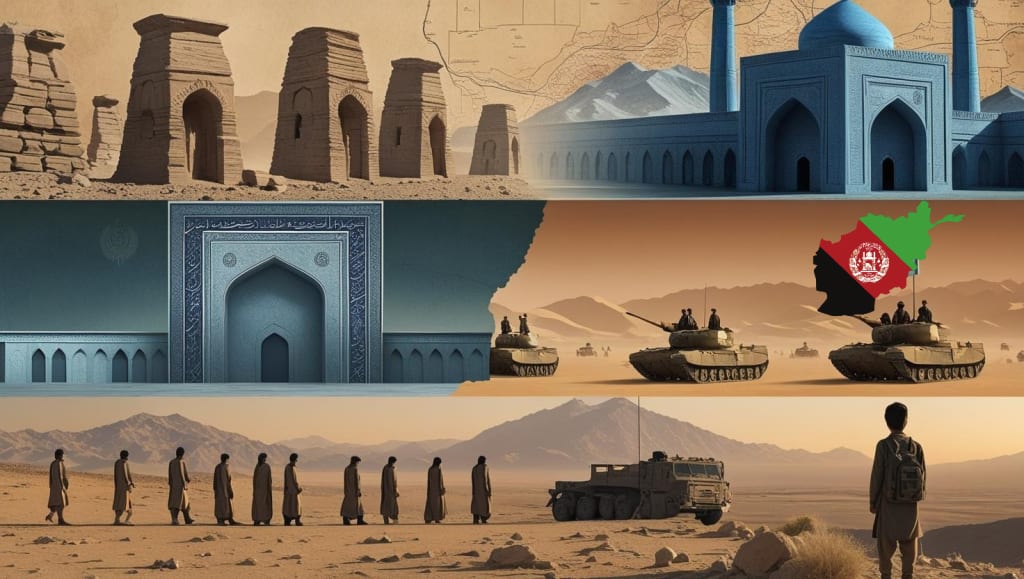
History of Afghanistan: From Ancient Crossroads to Modern Conflict
Exploring the Legacy, Struggles, and Resilience of a Nation at the Heart of Asia
Afghanistan, often described as the "Heart of Asia," has a long and complex history shaped by its geography, culture, and strategic location. Positioned at the crossroads of South Asia, Central Asia, and the Middle East, Afghanistan has been a center of ancient civilizations, a battleground for empires, and a stage for modern geopolitical struggles. Its history is one of both extraordinary cultural richness and relentless turmoil.
From ancient times to the present day, Afghanistan's journey tells the story of a nation defined by resistance, survival, and the enduring spirit of its people. This article explores the major chapters of Afghanistan’s past, offering insight into how its legacy has shaped today’s reality.
---
1. Ancient Afghanistan: The Crossroads of Civilizations
Afghanistan’s history stretches back over 5,000 years. It was once part of the ancient Indus Valley Civilization and later the Achaemenid Empire under Persian rule. In 330 BCE, Alexander the Great invaded the region, marrying into local tribes and establishing brief Hellenistic rule.
The area later became a hub for trade along the Silk Road, connecting China with the Middle East and Europe. During this time, Afghanistan absorbed a variety of cultures, religions, and philosophies. One of the most significant influences was Buddhism, which thrived in the region for centuries. The towering Buddhas of Bamiyan, carved into cliffs in central Afghanistan, stood for over 1,400 years before being destroyed in 2001.
---
2. The Islamic Era and the Rise of Empires
In the 7th century, Islam arrived in Afghanistan through Arab conquests. Over time, Islam became the dominant religion, replacing Buddhism and other belief systems. The region witnessed the rise of various Islamic empires, including the Ghaznavid, Ghurid, and Timurid dynasties.
One of the most famous rulers, Ahmad Shah Durrani, established the modern state of Afghanistan in 1747. He is often referred to as the “Father of the Nation.” Under his leadership, the Durrani Empire laid the foundations for the Afghan state and its borders.
---
3. The Great Game: A Battlefield for Empires
In the 19th century, Afghanistan became the focus of a geopolitical struggle between the British Empire and Tsarist Russia, known as the Great Game. The British saw Afghanistan as a buffer state to protect their interests in India.
Afghanistan fought three wars with Britain (1839–42, 1878–80, and 1919). The First Anglo-Afghan War ended disastrously for the British. The third resulted in Afghanistan gaining full independence from British influence through the Treaty of Rawalpindi in 1919, under King Amanullah Khan. His short-lived reign attempted progressive reforms, including modern education and women's rights.
---
4. The Kingdom to Republic: A Time of Change and Unrest
The early to mid-20th century saw several changes in Afghanistan’s political landscape. In 1933, Zahir Shah became king and ruled for 40 years, ushering in relative stability and modernization. However, tensions simmered beneath the surface, especially between traditionalists and reformers.
In 1973, Zahir Shah was overthrown by his cousin, Daoud Khan, who declared Afghanistan a republic. His assassination in a coup in 1978 marked the beginning of political chaos, as communist factions took power with Soviet backing.
---
5. Soviet Invasion and the Mujahideen Resistance (1979–1989)
In 1979, the Soviet Union invaded Afghanistan to support the communist government facing internal rebellion. This sparked a brutal decade-long war between Soviet forces and Afghan Mujahideen fighters, who were supported by the U.S., Pakistan, and Saudi Arabia.
The war devastated Afghanistan, resulting in over a million deaths and millions of refugees. In 1989, the Soviet Union withdrew in defeat, leaving the country deeply fractured and heavily armed.
---
6. Civil War and the Rise of the Taliban (1990s)
After the Soviet withdrawal, Afghanistan descended into civil war. Mujahideen factions turned on each other, and violence swept the country. Amid this chaos, the Taliban, an ultraconservative Islamic movement, emerged in 1994. Promising order and justice, they gained control of most of the country by 1996.
Under Taliban rule, Afghanistan became isolated, and harsh laws were enforced, especially against women and minorities. Meanwhile, the Taliban gave sanctuary to al-Qaeda, led by Osama bin Laden.
---
7. 9/11 and the U.S.-Led Invasion (2001–2021)
Following the September 11, 2001 attacks, the U.S. launched Operation Enduring Freedom to remove the Taliban and dismantle al-Qaeda. A new democratic government was formed under Hamid Karzai, and later Ashraf Ghani, with support from international allies.
Despite two decades of international aid and military presence, the Afghan government struggled with corruption, insurgency, and weak institutions. In August 2021, as U.S. forces withdrew, the Taliban rapidly retook control of the country, marking a new chapter of uncertainty.
---
8. The Current Situation: Uncertain Future, Enduring Spirit
Today, Afghanistan remains in a fragile state. Under Taliban rule once again, many Afghans face economic hardship, restrictions on education and freedom, and international isolation. Yet, the resilience of its people endures.
Afghans continue to advocate for human rights, education, and a peaceful future. The younger generation, shaped by years of global connectivity and education, still holds on to hope for a better Afghanistan.
---
Conclusion: A Land of History and Hope
Afghanistan’s history is both tragic and inspiring. It is a land that has resisted foreign rule, survived internal divisions, and preserved its unique identity through centuries of upheaval. From the empires of the ancient world to the struggles of the modern era, Afghanistan's story is far from over.
Understanding its past is crucial to understanding its present—and perhaps shaping a more peaceful future. In the heart of Asia, Afghanistan stands not just as a land of conflict, but as a nation with a rich cultural heritage, unmatched resilience, and enduring pride.
About the Creator
Corruption's Impact On Society
Corruption, a term with a broad spectrum of definitions, is often a result of government officials overpowering legal policies. Corruption can weaken the ideal democracy within a nation, erode trust in the relationship between the government and society, and exacerbate inequality and poverty. Forms of this act can include bribery, lobbying, extortion, cronyism, nepotism, parochialism, and embezzlement. Furthermore, corruption is the deterioration of moral and ethical standards that are characterized by the prioritization of personal gain over public good, abuse of power, and a lack of transparency.
By Katherine Roteman6 days ago in History
Understanding the Insurrection Act
The Insurrection Act is one of the most powerful and least understood laws in American history. Often mentioned during times of national unrest, it gives the president authority to deploy federal troops within the United States under specific circumstances. While it is rarely used, public interest in the law has grown in recent decades, leading many to ask: what is the Insurrection Act, and why does it matter today? What Is the Insurrection Act? To put it simply, the Insurrection Act of 1807 is a federal law that allows the president to use the U.S. military to suppress civil disorder, insurrection, or rebellion when state authorities are unable or unwilling to do so. If you are wondering what is the Insurrection Act used for, the answer lies in restoring order when local and state governments can no longer maintain public safety. People often search phrases like what is insurrection act or even the misspelled insurection act because the law tends to resurface during moments of crisis. Despite the confusion around its name, the authority it grants is very real and legally binding. What Is the Insurrection Act of the U.S.? So, what is the Insurrection Act of the US in legal terms? It is a collection of statutes now codified under Title 10 of the U.S. Code. The act provides exceptions to the Posse Comitatus Act, which generally prohibits the military from acting as domestic law enforcement. Under the Insurrection Act, the president can federalize the National Guard or deploy active-duty troops if constitutional rights are being violated or if violence prevents the execution of federal law. This is why many people ask, what is the Insurrection Act USA, especially when protests or riots dominate national headlines. The Insurrection Act and Its Historical Use Throughout American history, the act has been invoked sparingly but decisively. One of the most notable examples often referenced is the Insurrection Act 1992, when President George H. W. Bush deployed federal troops to Los Angeles following the Rodney King verdict. Local authorities had lost control, and the federal government stepped in to restore order. Earlier uses date back to the Civil War era and the Civil Rights Movement. Presidents Eisenhower and Kennedy relied on the act to enforce school desegregation in Southern states when state governments resisted federal court orders. These moments illustrate what the Insurrection Act is used for at its core: enforcing the rule of law when normal systems fail. Trump and the Insurrection Act In modern political discourse, the law became widely discussed during the presidency of Donald Trump. Searches for Trump Insurrection Act or Insurrection Act Trump surged during periods of nationwide protests, particularly in 2020. Although the act was never formally invoked during those protests, President Trump publicly considered its use, bringing renewed attention to the scope and limits of presidential power. The phrase insurrection act invoked often appears in news coverage, but it is important to note that discussing invocation and actually using the law are two very different things. The debate surrounding Trump Insurrection Act scenarios highlighted concerns about civil liberties, federal overreach, and the balance of power between states and the federal government. What Is the Insurrection Act in Minnesota? A common question during periods of regional unrest is what is the Insurrection Act in Minnesota or in other specific states. Legally, the act does not change from state to state. However, its application depends on circumstances within a particular state. If a governor requests federal assistance or if the president determines that constitutional rights cannot be protected locally, the Insurrection Act may apply. Minnesota, like every other state, falls under the same federal framework. The law does not target any single state; it responds to conditions on the ground. What Is the Insurrection Act Used For Today? In today’s environment, many Americans ask, what is the Insurrection Act used for in a modern democracy with established institutions. Supporters argue it is a necessary safeguard for extreme emergencies. Critics counter that it grants sweeping powers that could be misused if political tensions escalate. Understanding what is the Insurrection Act? requires recognizing that it is both a legal tool and a symbol. Its mere mention can influence public perception, markets, and political debate, even when it is not formally applied. Ongoing Debate and Public Concern The Insurrection Act remains controversial because it sits at the intersection of security and freedom. While it has been used to protect civil rights in the past, critics worry about potential misuse in polarized times. This tension explains why questions like what is the Insurrection Act of the US continue to trend whenever civil unrest occurs. Ultimately, the law reflects a fundamental challenge in governance: how to maintain order without undermining democracy. The fact that it has existed since 1807 and remains largely unchanged shows both its durability and its complexity. Final Thoughts The Insurrection Act is not a law that affects daily life, but it plays a critical role during extraordinary moments. From the Insurrection Act of 1807 to discussions around Insurrection Act 1992 and Insurrection Act Trump, its history mirrors the nation’s struggles with unity, authority, and rights.
By Saboor Brohi 2 days ago in History


Comments
There are no comments for this story
Be the first to respond and start the conversation.