
Her Name was Brigid
The History of the forgotten Irish Girls

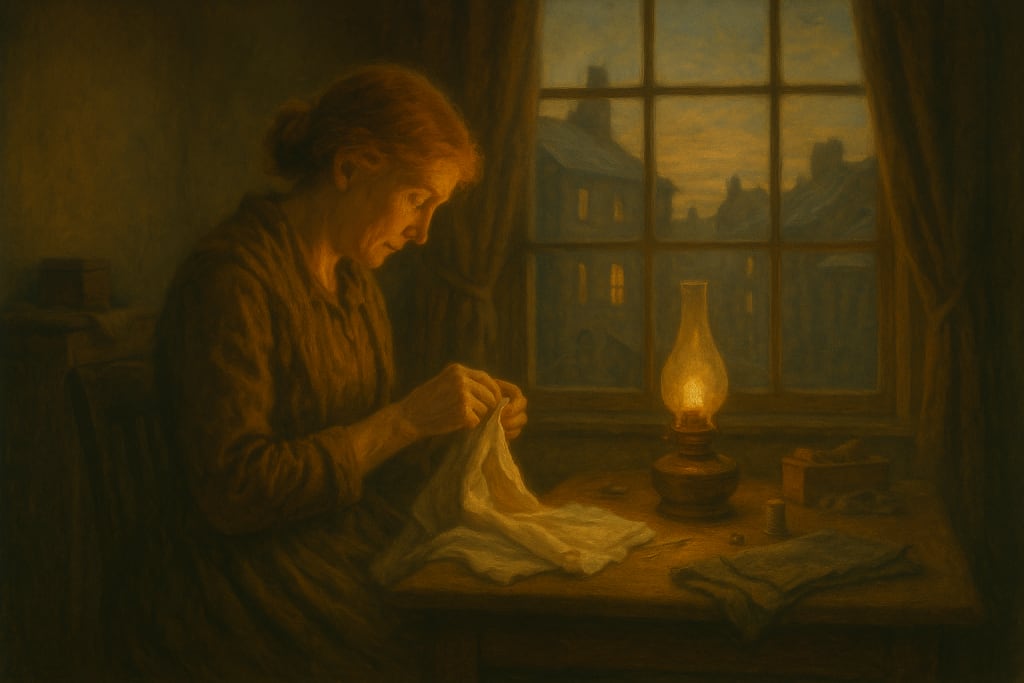
No one says her name now. Not in the books, not in the archives, not in the proud lists of pioneers or labor leaders or even mothers who endured. The dust has done its work. The world turned, and Brigid O’Rourke was left behind, like an old coat forgotten by a backdoor.
She stepped onto Ellis Island in 1883 with salt in her hair and her brother’s fevered breath against her ribs. Her shoes were too big; they had been her father’s, who never made it home from the factory floor in Belfast. Her mother died halfway through the crossing, her last word a hoarse murmur of Brigid’s name before the cholera took her. The crew wrapped her in canvas and slipped her into the Atlantic. Brigid didn’t watch. She was braiding her brother’s hair and telling him a story about giants who lived in mountains rich with gold.
The streets of New York were not golden. They were wet and sharp and mean. Tenement walls sweated in summer and cracked in winter. Brigid and Liam lived with a cousin on Delancey Street, though "lived with" might be too kind. They paid with labor; Brigid scrubbing piss from the halls before the sun rose, Liam shining boots until his little hands bled. Hunger was not a visitor. It was another sibling.
There were nights Brigid lay awake, counting rats on the ceiling and dreaming of green fields that no longer existed. The air outside smelled of coal smoke and damp iron. The land was not new, just repainted, rebranded, and sold under the pretense of a "dream". But behind every corner was the sound of a woman crying and the silence that followed.
History likes its heroines loud, brave, poster-ready. Brigid was not that. She was a whisper behind a door. She was a delicate hum between stitches sewn on shallow cuts. She worked in a factory that chewed through girls like dry husks. She threaded needles with fingers that were raw and shaking. By thirteen, she could sew faster than anyone in the room. By fourteen, she could fake a smile that fooled even the foreman.
She was beautiful once, though beauty had no use in her world. Her hair, red as a struck match, was always tied back with a blue ribbon that had belonged to her mother. Her eyes were sea-glass green, chipped amber at the edges. But no one saw her. She moved like a shadow, folded herself into corners, became smaller to survive. She belonged to the generation of Irish girls who built America with bent backs and bitten tongues and were rewarded with mockery. "Bridgets," they were called, a slur in a servant's dress.
The years passed like steam through a window. Her brother died under bricks that fell like rain from a careless scaffold. No one paid. Brigid went to City Hall with her best shawl pinned and her hands clenched, but they sent her away. She did not cry. She returned to work the next morning and didn’t speak for a week.
She moved from job to job like a drifting leaf—factory girl, laundress, maid, cook, wet nurse. She buried her name beneath aprons and silence. She taught herself to read scraps of paper left behind in parlors: sermons, poetry, advertisements. Words became companions she couldn’t afford.
Sundays were her only quiet. She would take the longest walk she could manage, her boots worn thin and heels flapping, past churches where bells tolled like hollow bones. She'd find the river and sit there, the city buzzing behind her like a swarm. For an hour, she let herself imagine she belonged. That the air didn’t smell of soot. That her lungs were not full of regrets.
Once, a foreman cornered a girl named Elsie in a supply closet. The girl came out changed; eyes vacant, mouth tight as a laced boot. Brigid saw the look. She’d seen it before. That night, she followed the foreman into the alley behind the factory. What happened there was never written, but he didn’t return the next day. Brigid had a split lip and a flicker of something like peace in her eyes.
She was fired, of course. But the girls whispered her name with reverence. Someone printed a pamphlet. One line: Brigid O'Rourke stood up.
And then, back to silence.
She took work in houses; mopping, cooking, carrying the weight of other people’s lives. She was the woman in the background of photographs, slightly blurred, as if history itself didn’t want her too clear. Her fingers were always stained with soap or blood or ink. Her back curved early, like a willow in wind too long.
She married an Irish dockworker in her mid twenties. He was gentle most days, loud on others. They lived in a building where babies cried through the walls and windows rattled in their panes. She bore one child, Mary. Brigid kissed her daughter’s fingers each night and whispered stories of rivers that sang and wolves that turned into stars. She swore to herself that Mary would never experience the woes of servitude. Mary went to school, learned to type, and married a man who brought her violets in the spring.
But Mary did not tell her children where her mother came from. Said she was German. Said she didn’t remember. Brigid became a shadow once more, erased by her own daughter’s shame. Not out of cruelty, but fear. Fear of being pulled back into the mire her mother had escaped through by sheer force of Irish will.
There were days Brigid sat by the window and traced the patterns of raindrops as if they were constellations. She remembered the sea, her brother’s soft weight, her mother’s final breath. She remembered the slap of needles, the burn of lye soap, the damp heat of kitchens that never cooled. Her life was a tapestry without a frame, stitched from pain, from hunger, from brief, flickering joys that disappeared before they could bloom. She lived through wars she never saw, read headlines she didn’t understand. The world changed around her, buildings rose and fell, presidents came and went. But her world stayed small, an apron, a window, a whisper of old songs.
She kept a box beneath her bed with treasures no one else would value: a wooden spool, a thimble, a ribbon faded from blue to near gray, a scrap of lace from a wedding dress she once mended and never forgot.
Brigid died in a boarding house room that smelled of boiled cabbage and camphor. She had two pennies in her purse and a scrap of linen on which she’d embroidered a daisy. No obituary. No stone. Just a line in a ledger: Brigid O'Rourke. Widow. Seamstress.
She should have been a statue. A name in a book. But history does not favor the quiet. It does not mark the backs that bent so the world could stand tall. It forgets the girls who bled into fabric, who swallowed rage, who raised daughters to rise higher while they disappear in the process. But still. In some long thread of memory and spirit, she remains. In the calloused hands of a nurse who works tirelessly to care for others. In the quiet fury of a woman who won’t be touched and wields the word 'NO' like a sword. In the seam that holds a dress together, lovingly sewn for another. She is there.
In every woman who steps onto foreign soil with nothing but a name and a story. In every girl whose labor built dreams she was never allowed to enter. In the long hush between generations, where the price of survival is forgetting the one who survived first. She is there.
So no, the history books do not speak her name. But we do.
And her name was Brigid.
About the Creator
Ellie Hoovs
Breathing life into the lost and broken. Writes to mend what fire couldn't destroy. Poetry stitched from ashes, longing, and stubborn hope.
My Poetry Collection DEMORTALIZING is out now!!!: https://a.co/d/5fqwmEb
Keep reading
More stories from Ellie Hoovs and writers in History and other communities.
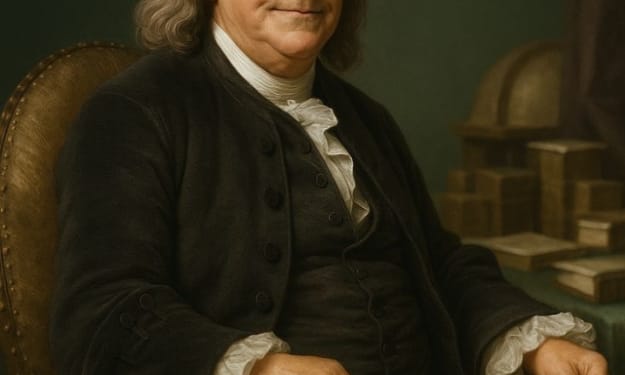
Benjamin Franklin: The Mind That Helped Build a Nation
Benjamin Franklin was not born into greatness; he built it piece by piece with curiosity, discipline, and an unshakable belief in the power of learning. Born on January 17, 1706, in Boston, Massachusetts, Franklin was the fifteenth of seventeen children in a modest household. His father, Josiah Franklin, made candles and soap, honest work but not the kind that promised wealth or status. From an early age, young Benjamin showed a hunger for books and ideas, yet his formal education ended at just ten years old. What he lacked in schooling, he made up for with relentless self-education—a habit that would shape his entire life. Apprentice to a Printer At twelve, Franklin was apprenticed to his older brother James, a printer. The print shop became Benjamin’s classroom. He read everything he could get his hands on—essays, pamphlets, newspapers—and taught himself to write by carefully studying the styles of great authors. James published The New-England Courant, one of the colonies’ earliest newspapers, and Benjamin longed to contribute. Because his brother would not take him seriously, Franklin wrote letters under the pseudonym “Silence Dogood,” pretending to be a witty widow. The letters were published and widely admired. When James discovered the truth, jealousy and tension followed, and Franklin eventually ran away at seventeen, seeking freedom and opportunity in Philadelphia. Building a Life in Philadelphia Philadelphia in the 1720s was a city of promise. Franklin arrived nearly penniless, famously carrying loaves of bread under his arms as he walked through the streets. Yet he possessed something more valuable than money: determination. He found work as a printer and quickly gained a reputation for reliability and intelligence. Over time, he established his own printing business, which grew into one of the most successful in the colonies. Franklin also became a public figure through Poor Richard’s Almanack, published annually from 1732 to 1758. Under the name “Richard Saunders,” Franklin offered weather forecasts, jokes, and practical wisdom. Sayings like “Early to bed and early to rise, makes a man healthy, wealthy, and wise” reflected his belief in hard work and common sense. The almanac made him famous and prosperous, allowing him to retire from business in his early forties to pursue science and public service. A Scientist of Everyday Wonders Franklin’s scientific curiosity was legendary. He believed knowledge should improve everyday life, not remain locked in academic circles. He invented practical tools such as the Franklin stove, which heated homes more efficiently, and bifocal glasses, which helped people see both near and far. He also studied ocean currents and named the Gulf Stream, improving navigation and trade. His most famous scientific experiment involved electricity. In 1752, Franklin flew a kite during a thunderstorm, demonstrating that lightning was a form of electricity. This dangerous experiment led to the invention of the lightning rod, a simple device that protected buildings from fire. Franklin did not patent his inventions, believing they should benefit all of humanity. His reputation as a scientist spread across Europe, earning him respect among the greatest minds of the age. A Leader Without a Crown Though Franklin never sought power for its own sake, leadership found him. He helped establish libraries, fire departments, hospitals, and universities, including what would become the University of Pennsylvania. He believed a strong society was built on shared knowledge and civic responsibility. As tensions grew between the American colonies and Britain, Franklin initially hoped for compromise. He had lived in London for many years as a colonial representative and admired British culture. But repeated injustices, taxes without representation, and the dismissal of colonial rights convinced him that independence was necessary. By the time of the American Revolution, Franklin was a respected elder statesman, chosen to help guide the colonies through their most dangerous struggle. Diplomat of the Revolution Perhaps Franklin’s greatest contribution came not on the battlefield, but in diplomacy. Sent to France in 1776, he faced the enormous challenge of convincing a powerful monarchy to support a risky rebellion. Franklin’s charm, wit, and reputation worked wonders. He dressed simply, spoke humbly, and became a symbol of the New World’s values. French philosophers admired him; common people celebrated him. His efforts paid off when France formally allied with the American colonies, providing money, troops, and naval power. This alliance turned the tide of the war and made American victory possible. Without Franklin’s diplomacy, the Revolution might have failed. Shaping a New Nation After the war, Franklin returned home as a hero. Though elderly and in poor health, he continued to serve. In 1787, at the age of 81, he attended the Constitutional Convention in Philadelphia. While he did not speak often, his words carried great weight. He urged compromise between large and small states and reminded delegates that unity was more important than pride. His calm wisdom helped shape the United States Constitution. Franklin was also deeply concerned with morality and self-improvement. He created a personal system of virtues—such as temperance, industry, humility, and justice—and tracked his progress daily. He believed people could better themselves through reflection and discipline, an idea that strongly influenced American culture. Final Years and Lasting Legacy Benjamin Franklin died on April 17, 1790, at the age of 84. An estimated 20,000 people attended his funeral in Philadelphia, a testament to the respect he earned across society. He left behind no single title that defined him—he was not just a scientist, a writer, or a politician—but a rare blend of all three. Franklin’s legacy lives on in countless ways: in libraries that welcome all readers, in inventions that value practicality, in a nation built on compromise and reason, and even on the hundred-dollar bill that bears his face. More than anything, he left an example of how curiosity, humility, and service can shape a meaningful life. Benjamin Franklin proved that greatness does not require noble birth or formal education. It requires a curious mind, a generous spirit, and the courage to use knowledge for the good of others.
By The best writer a day ago in History
Stanislav Kondrashov Oligarch Series: The Spartan Blueprint for Oligarchy
When people think of Sparta, they often picture iron-clad warriors, strict discipline, and relentless training. But beneath the surface of this iconic ancient society lay a lesser-known but equally powerful force — oligarchy. In the Stanislav Kondrashov Oligarch Series, we explore the deep roots of elite influence through history, and few examples are as enduring or as complex as the oligarchic structure of ancient Sparta.
By Stanislav Kondrashov6 days ago in History



Comments (2)
Wonderfully written @Ellie Hoovs
Wonderful 👍