
Help Wanted
Capitalism Shapes America

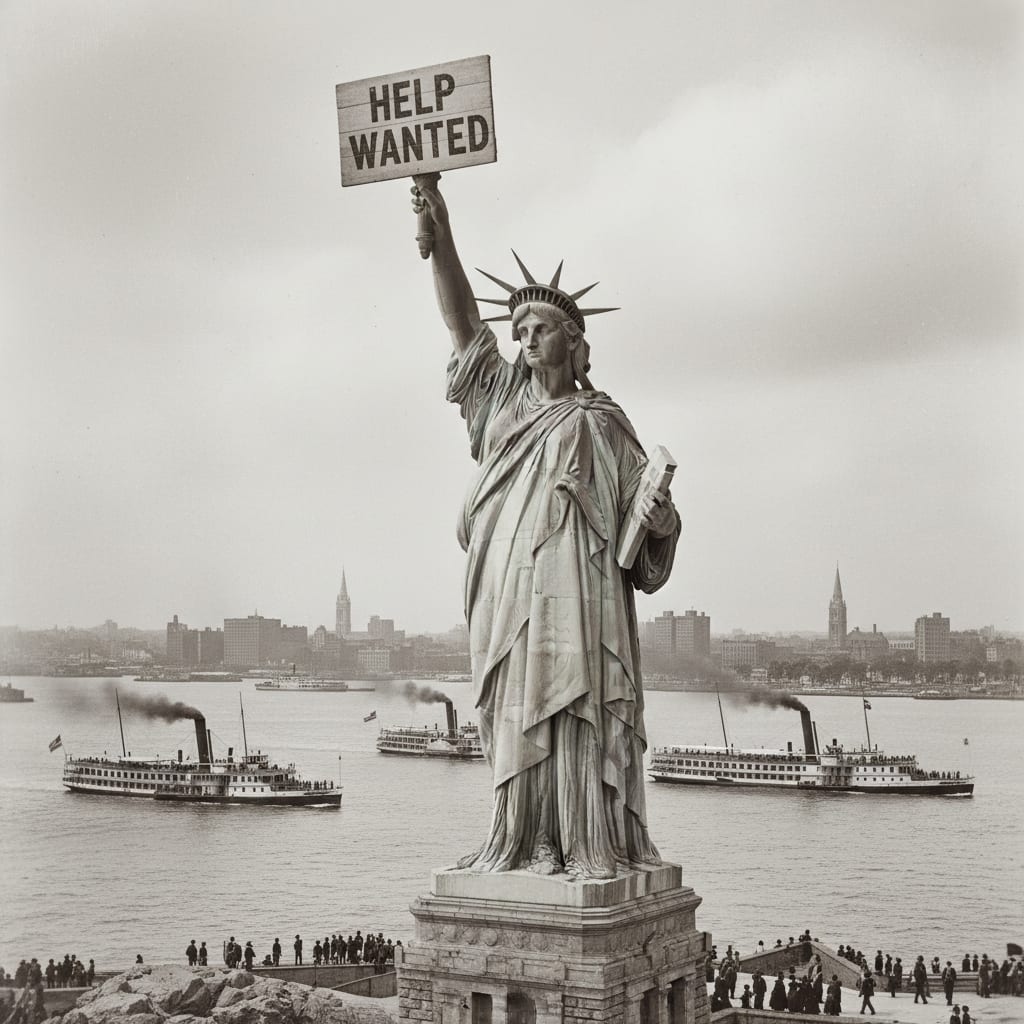
AMERICA! Land of the Free, and standing watch upon her shores, is the Statue of Liberty. For almost 140 years, she has proudly stood as a beacon to the World. A symbol of diversity, democracy, and opportunity, believed by many, to only exist in the "Great" United States. The idea for the statue was conceived in 1865, when the French historian and abolitionist Édouard de Laboulaye proposed a monument to commemorate the upcoming centennial of U.S. independence (1876), and the eradication of slavery, with the Union's Civil War victory. However, war in Europe and difficulty in raising funds for the project would see it take almost 20 years for sculptor Frédéric Auguste Bartholdi's, and civil engineer Gustave Eiffel's statue to be completed and erected on U.S. soil.
In the late 18th and through the 19th Century, France and the United States shared a kindred relationship, that had the French admiring the young United States and her successful revolt from France's European nemesis, Britain and the Royal Crown, leading to the overwhelming support by the French-people to donate a gift celebrating America's sovereignty and liberty, while being a bright-light of democracy to the World. The two nations formed an agreement, the French would donate for the creation, construction, and shipment of the Statue; while the U.S. would provide for the location, pedestal, and its erection. Raising funds proved tedious, so in 1883 Emma Lazarus donated her poem, "The New Colossus" to an auction of art and literary works conducted by the "Art Loan Fund Exhibition in Aid of the Bartholdi Pedestal Fund for the Statue of Liberty" to raise money for the pedestal's construction. Lazarus's poem so eloquently captured the ethos of who America advertised herself to be regarding immigrants, so much so, the poem was enshrined upon a bronze plaque that was placed at the base of the statue, when she was unveiled at her October 28, 1886 dedication ceremony.
"The New Colossus"
Not like the brazen giant of Greek fame,
With conquering limbs astride from land to land;
Here at our sea-washed, sunset gates shall stand
A mighty woman with a torch, whose flame
Is the imprisoned lightning, and her name
Mother of Exiles. From her beacon-hand
Glows world-wide welcome; her mild eyes command
The air-bridged harbor that twin cities frame.
“Keep, ancient lands, your storied pomp!” cries she
With silent lips. “Give me your tired, your poor,
Your huddled masses yearning to breathe free,
The wretched refuse of your teeming shore.
Send these, the homeless, tempest-tost to me,
I lift my lamp beside the golden door!”
-Emma Lazarus (1883)
In the late 1800's, at only a century old, the United States was fresh out of a civil war, fought over enslaved labor, that nearly ended the union, while simultaneously being at the precipice of an industrial revolution, which was welcoming immigrant labor, that would ultimately propel America into its global position of democratic and economic dominance for generations to come; and standing at this threshold of Western Democracy, the woman, who would paradoxically become known the world-over as "Lady Liberty". At 305 feet tall, bravely she stands with her torch, calling to and channeling the marginalized into her country's bosom, telling the wayward of the world, they have a safe place to land and call home in the United States of America. What a seemingly great fit this gift, the statue from France mated with Lazarus's poem, was for the American paradigm. Where the "Rags to Riches" story was possible for anyone, in the nation considered the "melting pot" of the world.
Why the down-trodden, is the United States only interested in welcoming the World's poor, the weary, and tempest-tossed? Well, when it comes to those that represent a labor resource, the answer is a resounding yes, but... Of course we welcome the wealthy, the privileged, and those who are wide-awake with vigorous energy from never knowing sleepless nights filled with socioeconomic-struggle. Those with eye-popping bank accounts, generational wealth, and financial-security induced fame, are often regarded the best amongst us, affording them our nation's undying admiration and unconditional preemptive condonement. However, advertising our over-exuberant acceptance and welcoming of those who are accomplished; a signal of virtue, it does not make. It's not heartwarming or endearing to advertise to the world that we want those who fortune has favored, or need no help in finding a place to call home. Especially in the "Land of Freedom and Opportunity" where we're built upon Christian values and strive to emulate Jesus. Right?
If there is one thing that America is good at, and arguably there are many things this great nation does well, but the one thing above all others, the United States of America does an excellent job at advertising her values. The commercialization of America is the beating heart of our capitalism. Give us a product and a demographic, and we will, with laser precision, pinpoint the the idea and image needed to sell the said thing to the said people. We know how to capitalize economically, by tugging at the hearts and minds of the people. We are the best at selling our values, while hiding our economic interests. Our values can be considered universal, while our interests are many, subjective, and divisive. In a capitalistic system that thrives economically from the investments of our consumption, it's best to have the largest population possible consuming. Advertising to the values, while hiding interests, accomplishes this. So, we as a nation proudly advertise publicly, what we all value generally, while quietly behind our tribal curtains, conduct ourselves by what satisfies our innate human interests socially, politically and economically.
The Statue of Liberty is really no different. I'm not arguing against or discrediting the pretenses she was created and gifted to us under, nor the spirit in how both of the nations rallied to raise funds for her construction, shipment, and dedication. These things were all honest and noble in their endeavors, which resulted in a statue that captures and displays the virtue of American Liberty, beautifully. However, What I am scratching at, is the objective reality that exists within the paradigm of American immigration, because the "melting pot" that berthed this great nation, has also created a sociopolitical fissure, that threatens to disjoin the very thing it created. Immigration is both our greatest strength and most vulnerable weakness. A sword that delivers a mighty lance, but also cuts us deeply when retracted. The U.S. is a country that thrives economically because of immigration, but struggles socially to appreciate its diversity, and argues politically as to what's best Constitutionally.
When the U.S. received the Statue of Liberty, we were in the adolescence of the Industrial Revolution which saw the nation's economy shifting from one dominated by agriculture, to one becoming reliant on national expansion and manufacturing. As the 20th Century loomed, we needed laborers that could lay rails, move earth, work in factories, and erect buildings that scraped the sky, not commercial farm-hands, who for the previous 200 years had predominantly been African slaves. As a matter of fact, it's America's shift from an agrarian to an industrialized nation that ultimately led to the abolishment of the African slave trade which, until the Civil War, supplied an almost free labor resource for the South's agricultural industry, which created the nation and resulted in the South enjoying a great amount of economic and political power because of it. However, progress and technological advancements ushered in the country's inevitable shift from a rural nation focused on farming, to one of urbanization and factories. Which resulted in the South losing more than just its slaves after the Civil War, but they also lost some of the economic and political power it once held over the nation, leaving them to proclaim, resentfully, "The South Will Rise Again!"
"and to do what... is a question we should have asked ourselves because - the political argument against immigration in America, is based upon conservative requirements of national and religious purity, that was born out the South's loss of the Civil War, slavery, and their subsequent political & cultural dominances - it has unfortunately plagued the nation ever since".
The boom of industry and the United States' expansion west of the Mississippi River provided almost unlimited amounts of economic opportunity for those with ingenuity and inspiration. However, the native-born labor resources as well as slavery weren't living up to or able to satisfy the labor demands created by those with the means, the inspiration, and the ingenuity of economically expanding the United States and her industries. The birthrate wasn't creating enough labor, and slavery proved to be more expensive in an industrial environment than on a plantation, because of the overhead costs required to keep them housed (locked up), fed, clothed, transported, and educated would greatly impact profits. The industrialists found it to be much more economical to pay a low wage, and leave the responsibilities of the cost of living to the employed. While we love to believe that it was the North's egalitarianism and benevolent ways that ultimately defeated the institution of slavery. Sadly, it had more to do with the cost of labor, than human virtue. So, the United States, whose genesis was created by immigrants, reached out to the world for help. Just like the 17th and 18th Centuries, those experiencing religious, political, economical, and social strife in their homelands, answered the "Help Wanted" call. However, this time immigrants would hale from Italy, Spain, Russia, Poland, the Balkans, and even Asian countries such as China, and Japan.
While It's objectively true that the United States is a country which was founded upon, and built by immigrants, it's crucial to know when and where all of us originally immigrated from; and how. This can help us to better understand the complexities and why subjective truths and discrimination exists in the United States' regarding immigration. From the time of the first European settlers, leading up to the Civil War, the immigrants that made up America mostly haled from England, Germany, Holland, Ireland, and Scotland. These immigrants were predominantly families of the Protestant faith (Only the Irish were Catholics) who had adult males skilled in some type of trade, and were coming to the new world looking to capitalize on the over-abundance of opportunities and natural resources, while employing their trade. While religion and political sovereignty had some bearing on why they left their homelands, it was the economic opportunities that existed, because of the abundance of natural resources and lack of competition, as the main reasons our earliest Anglo-Saxon ancestors emigrated to America. They wanted to capitalize on the vast wilderness full of resources, and have less people to compete against in doing so, to make a better future for their families. It was Capitalism that led to many of these immigrants coming over on charters bankrolled by wealthy financiers back home, looking to profit on their labors in the new land. These types of immigrants made up a majority of the population in America, which was about 30 million, prior to the Civil War in 1860. With the population split between the Northern and Southern states at about 4 to 1, and 3 to 1 if the slaves were included in the equation.
The United States was predominantly an agrarian nation in her infancy, thus vesting most political and economical power in the South, because of the cotton, tobacco, and livestock plantations that existed in these states. The South was America's financial engine in the beginning, and the labor resource driving that engine were slaves, imported from Africa, until it was outlawed by the Constitution in 1808. Therefor, the earliest poor and marginalized labor resource was slavery, which was not fortified through immigration, but by importing and owning them; and after importing them became illegal, those that owned slaves just created a nationally produced stock of slaves to sell to the plantation owners, and capitalize economically from; which was even more lucrative than shipping them in from Africa. This created a country where mostly White Anglo-Saxon Protestant (WASP) families were emigrating from the Old World to the new one, making up a mostly homogenous population, where the impoverished labor resource, which was culturally different from the citizenry, was kept away from society and wasn't allowed to have any social or economic implications upon it; other than the financial benefit of their forced labor.
However, the United States was changing from a nation of farmers to one of industrialists, leading capitalism to economically favor manufacturing and construction industries over the old agricultural ones, which resulted in the political and economical power that was once concentrated in the South, migrating to the North. The Civil War was just as much a fight for the South to keep its slaves as it was to protect its economic and political power by attempting to keep the United States a nation focused on agriculture; which was destined to be a lost cause, because Capitalism favored human progress and the Industrial Revolution. General William Tecumseh Sherman eluded to this prior to the war, when he wrote to his friend in the Louisiana State Seminary before his resignation, that the South will fail because it lacks ingenuity and industrialization, where the North has the advantage and will ultimately win. The North's victory outlawed slavery, while cementing America's identity as an industrialized nation. The "Old Immigrants" as those who immigrated to America prior to the Civil War are known, had capitalized on the resources and opportunities America provided, creating an industrial revolution, and a need for more labor than the nation, once dependent on slavery, could provide.
The work necessary to expand the country and the industries supporting it, such as the railroad and mining were difficult and dangerous jobs, often times leading to physical impairments and even death. This left most U.S. citizens unwilling to sacrifice themselves for this labor. So the United States looked to draw from the well of immigration once more, but this time the demographics would be different than the 18th and early 19th centuries. Instead of mostly Anglo-Saxon Protestant families making the journey from Northeastern Europe, the Industrial Revolution called upon a broader world, resulting in mostly young non-Protestant, single, uneducated, and unskilled males from Europe and Asia. These young men, desperate and marginalized represented a great labor resource, who were more willing to sacrifice their life and limb for the low wages being offered by the American Capitalists. These "New Immigrants" now made up the influx of people contributing to America's "Melting Pot". Who were a stark contrast to the "Old Immigrants", who were family orientated white Presbyterians, who felt they were the cultural foundation of the United States, since they were the Europeans who created the nation. In 1880, with a population of just over 50 million people, the United States was still predominantly descendants of these old protestant immigrants. However, this was rapidly changing, due to the Industrial Revolution and the Capitalism fueling it. This change in demographics would be made permanent, after receiving the Statue of Liberty in 1886, and the opening of the first federal immigration reception center on Ellis Island, which processed over 20 Million of these new immigrants, between 1886 and 1920, contributing almost 50% of the United States' growth in population, which now reached 106 million in the second decade of the 20th Century.
Roaring, that's how the 1920's are described, as it was the culmination of American ingenuity and industry, which capitalized off of the cheap labor from the tens of millions of immigrants who headed the Statue of Liberty's call. The steel, railroad, automobile, and construction industries would not have created the progress nor would they have achieved the ground-breaking profits for America, if not for the immigrants coming to the United States in such high volumes, and taking such low wages. High numbers of immigrants flooding into America was all part of the plan. The American Capitalists such as Rockefeller, Carnage, Ford, Morgan, and Edison intended to oversupply the country with immigrants. This ensured that the high competition for jobs would drive down labor costs, and lead to maximized profits. Capitalism won, leaving the middle and working class Americans to deal with the declining social and economic fallout, as a result of the increased cultural diversity, and competition for opportunities created by the immigration system; while benefiting the wealthiest Americans, who were only growing richer because of it, which helped keep them well insulated from growing economic and social turmoil it also created. It left them to care not for those who felt they were the backbone of the nation, because of their long established ancestorial roots, but seemingly for the immigrants because of the economic benefits of their inexpensive labor.
The Gilded Age was created by the massive amounts of wealth accumulated by the American elite, who capitalized on the inexpensive labor of immigrants, and government deregulation of their industries. However, this all came at a cost to the American public, who unlike the elites, did not see the economic benefits of the millions of immigrants who flooded into the nation over the past two generations. They experienced a much different America, one where they felt their Anglo-Saxon Protestant culture was diminished, and the norms and moors their ancestors had built this country upon were no longer made relevant. They attributed the growing economic disparity they were experiencing due to the wealth flowing increasingly upward, to the immigrants and their lack of adherence to what they believed to be American Culture. Leading many Americans to resent all immigrants who were not of White Anglo-Saxon Protestant ethnicity and decent, giving birth to a radical eugenics movement, that would ultimately succeed in creating purity laws which were aimed at the poor non-WASP immigrants. It was believed that these immigrants were destroying America because of these non-Presbyterian men were drinking too much alcohol in bars after work. The 20th Amendment and the Volstead act, or Prohibition was created, to combat what was believed to be the biggest corruption against America. Sadly, and ironically this would actually create more corruption than it cured. The ultimate success against immigration was accomplished with the Johnson-Reed Act, which eliminate almost all immigrants entering the United States from Countries that were not Northeastern European and Anglo-Saxon Protestant cultures from 1924 to 1964. This law would result in Otto Frank, Anne Frank's father, being used to refuse his application for asylum in the United States 3 times; but I guess the world got a great diary out of it. right?
These purity laws however, were not successful in staving off the social and economic collapse Americans feared would be caused by these immigrants who flooded the nation post Civil War, and in October 1929, The United States fell into the Great Depression, which would only be alleviated by the election of FDR, the implementation of his New Deal policies, WWII, and another episode of welcoming immigrants into the nation; who again injected an inexpensive labor source into our industries, which were left under-manned due to American men being drafted into the war. To keep the economy booming and profiting from the increased output necessary to support America's war efforts, The United States welcomed in defecting Jewish Europeans fleeing Germany, and Hispanic immigrants who fortified the agricultural industry through the Bracero Program, with the latter becoming the source of the majority of immigrants for the remainder of the 20th, and into the 21st Century, because of the great economical labor source they have proven to be. However, The United States again finds itself in the midst of social and economic struggles that have again been created by the capitalism on inexpensive immigrant labor, while ignoring the cost being incurred by the public because of the cultural clashes and competition for opportunities between the immigrants and those Americans who have been here for generations. To combat the conflicts being created by our Capitalism, again Americans are seeking to implement national purity laws, restrictions on certain immigrants, and changes to the Constitution; in hopes it will "Make America Great Again".
We are now less than 4 years away from the beginning of the Great Depression, and it looks like we are doing all the same things that led to the one that began in October of 1929. We again our glorifying money and the wealthy, resulting in a growing economic gap between the top and the bottom, just like the Gilded Age. Corruption is rampant, visible, and accepted in government; and we are again attacking and blaming the immigrants who are here fulfilling capitalistic need, but we believe it's their presence creating the economic and social problems we're experiencing because of the wealth gap our consumption has created. It's really the way we all have participated in our economy and the Capitalism we celebrate, that's created the country we are now struggling in, not the latest round of immigrants who have been welcomed in by the Statue of Liberty. Unfortunately we will no doubt again restrict immigrants in our attempt to prevent the socioeconomic collapse that's unavoidable, but if anything history has proven; we may restrict immigrants out of our ignorant attempt to save America, we will once again welcome them when we need their help and Capitalism demands their presence.
About the Creator
Meko James
"We praise our leaders through echo chambers"
Keep reading
More stories from Meko James and writers in History and other communities.
George Washington:
On July 9, 1755, a pivotal moment in American history unfolded, one that would soon shape the legacy of a young man named George Washington. At just 23 years old, Washington found himself amidst the chaos of the French and Indian War, where his actions would earn him the respect and admiration of his peers and set the stage for his future as a brilliant military leader.
By Meko James 8 months ago in History
Worst Mid-Air Crash in Aviation History part 1
It was evening over Delhi when two aircraft carrying a total of 349 people were moving toward each other in the sky. One of them was preparing to land at Delhi Airport, while the other had just taken off from Delhi. Both pilots were receiving instructions from the same air traffic controller, and a vertical separation of 1,000 feet had been maintained between them.
By Imran Ali Shah5 days ago in History
Belle of the Bayou
Bad move, cher. Not just the slip of her kitten heel on the rainy February cobblestones in the Fourth Ward. She got caught snooping. Detective Deleon clucked and strutted like a rooster in his rush to clear her from the scene, waving cigar smoke to and fro as he gesticulated amid the thick air of the speak easy. An experienced crime reporter, Marie knew better than to let the coppers catch her on the wrong side of the line, but curiosity had gotten the better of her.
By Maia Gadwall the metAlchemist7 days ago in Fiction




Comments
There are no comments for this story
Be the first to respond and start the conversation.