
Hatshepsut
The Forgotten Pharaoh Who Rewrote Ancient Egypt

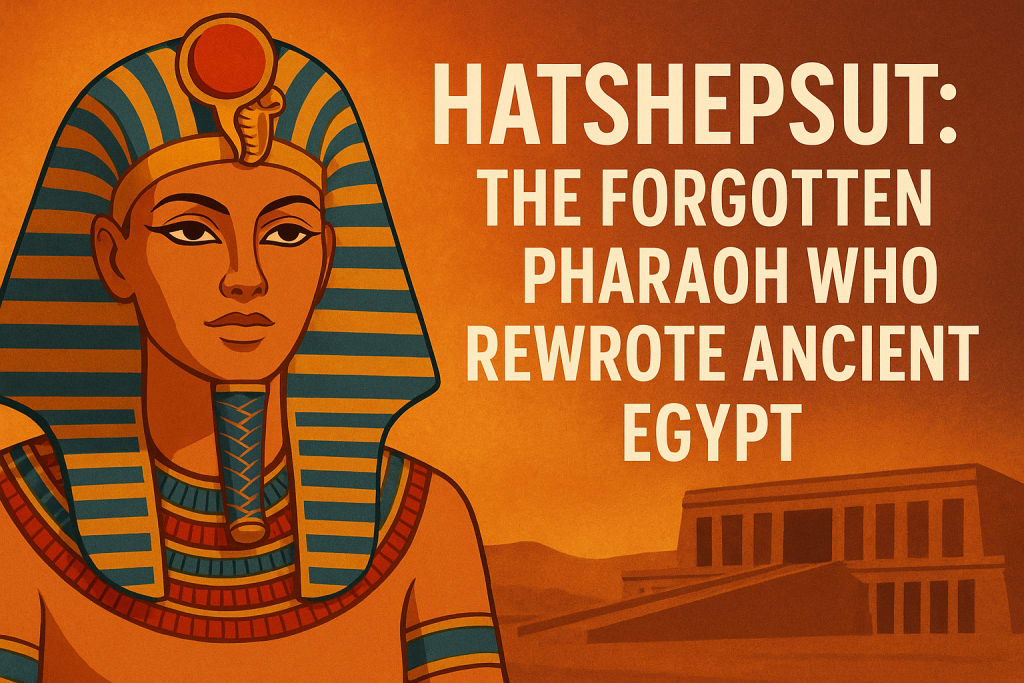
For most of history, the rulers of ancient Egypt were men—warriors, conquerors, and kings who carved their names into stone. But hidden among them was a woman whose legacy nearly vanished from record: Hatshepsut, one of the most successful and visionary pharaohs Egypt ever had. Her reign proved that leadership is built not from gender or tradition, but from intelligence, vision, and the courage to challenge expectations.
Born around 1507 BCE, Hatshepsut entered the world already part of Egypt’s elite. She was the daughter of Thutmose I, a strong and respected pharaoh. Like many royal children, she was raised inside the walls of palaces, where she learned reading, religion, diplomacy, and the sacred rituals of Egyptian rule. But unlike most princesses, Hatshepsut grew up with a powerful belief—that she was destined for more than just being a queen.
When her father died, Hatshepsut married her half-brother, Thutmose II, as was royal tradition. She became “Great Royal Wife,” a position of influence but not power. When Thutmose II died young, the throne passed to his infant son, Thutmose III, who was too young to rule alone. Egypt needed a regent—someone wise enough to guide the throne until the boy was old enough.
That responsibility fell to Hatshepsut.
At first, she ruled quietly as regent. But as time passed, Hatshepsut made a bold decision that changed history: she crowned herself pharaoh, Egypt’s highest and most sacred title. It was a move so unprecedented that Egyptian artists struggled to portray her correctly. Instead of carving her as a regal woman, they depicted her with a male body, a false beard, and the traditional kilt of a king—symbols necessary for the people to accept her place on the throne.
Hatshepsut wasn’t trying to imitate a man. Instead, she reshaped what it meant to be a pharaoh. She blended male iconography with a female identity, creating a hybrid image that communicated power while preserving her truth. It was one of the earliest moments in history where someone redefined a role instead of conforming to it.
Once firmly on the throne, Hatshepsut focused on peace, prosperity, and rebuilding Egypt’s wealth. Unlike many pharaohs who sought glory through war, she preferred diplomacy and development. Under her rule, Egypt entered one of its most stable and prosperous eras.
Her most famous achievement was the expedition to Punt, a rich and mysterious kingdom researchers believe was located near modern-day Somalia or Eritrea. Hatshepsut sent ships filled with goods to trade—something Egypt had not done in generations. When the fleet returned, they brought back gold, ivory, incense trees, and exotic animals. This journey strengthened Egypt’s wealth and influence, and the event was carved proudly onto the walls of her temple.
Speaking of temples, Hatshepsut’s architectural legacy is one of the greatest in ancient Egypt. She ordered the construction of roads, chapels, obelisks, and monuments across the land. But her masterpiece was the Temple of Deir el-Bahri, a breathtaking structure carved into the cliffs of Thebes. With sweeping terraces, graceful columns, and stunning reliefs, it remains one of the most beautiful architectural creations of the ancient world. Her temple wasn’t just a monument; it was a message—an announcement that she belonged among the greatest pharaohs.
Hatshepsut’s reign lasted about twenty-two years, a period marked by stability, economic growth, and artistic flourishing. But after her death, something strange happened. Many of her statues were destroyed, her name scratched off monuments, and her face chiseled away from history. For centuries, her memory disappeared.
Most historians believe this erasure was ordered by Thutmose III, the child she had once ruled for. But not out of hatred. Instead, he may have feared that a successful female pharaoh would inspire future queens to claim the throne, threatening the long-standing traditions of male leadership. By removing her from history, her successors believed they were protecting the system.
They failed.
In the 19th century, archaeologists rediscovered her erased monuments and broken statues. Little by little, Hatshepsut’s story resurfaced. Today, she is recognized as one of Egypt’s greatest rulers—a visionary leader who proved that greatness has no gender.
Hatshepsut’s life reads like a reminder to anyone who has ever been underestimated. She stepped into a role no one expected her to fill and transformed it entirely. She used intelligence over violence, creativity over tradition, and vision over fear. And though others tried to erase her, her legacy was too powerful to remain buried.
Her story teaches us that the world remembers those who dare to redefine it.
About the Creator
The khan
I write history the way it was lived — through conversations, choices, and moments that changed the world. Famous names, unseen stories.
The Nazi Who Fooled Death
History often remembers the Nuremberg Trials as the ultimate reckoning for the Third Reich—a moment where the high command of Nazi Germany faced the gallows for their part in the 20th century's greatest horrors. Men like Joachim von Ribbentrop and Wilhelm Keitel met their end at the end of a rope. Yet, one man from Hitler’s innermost circle, his "best friend" and Minister of Armaments, Albert Speer, managed to walk away from the courtroom with his life.
By Irshad Abbasi 2 days ago in History



Comments
There are no comments for this story
Be the first to respond and start the conversation.