
Great Zimbabwe’s Forgotten Wealth: Unearthing the Lost Gold of Africa
Once a thriving trade empire in southern Africa, Great Zimbabwe stood as a beacon of power, architecture, and prosperity from the 11th to the 15th century. This article explores the astonishing history and wealth of this ancient kingdom, focusing on its legendary gold trade, enigmatic stone structures, and mysterious decline. From royal palaces built with precision-cut granite to hidden gold mines and priceless artifacts, we uncover the long-lost treasures of a civilization that rivaled the wealth of ancient Egypt. Journey into the heart of Africa’s past to discover the true magnitude of Great Zimbabwe’s forgotten riches.

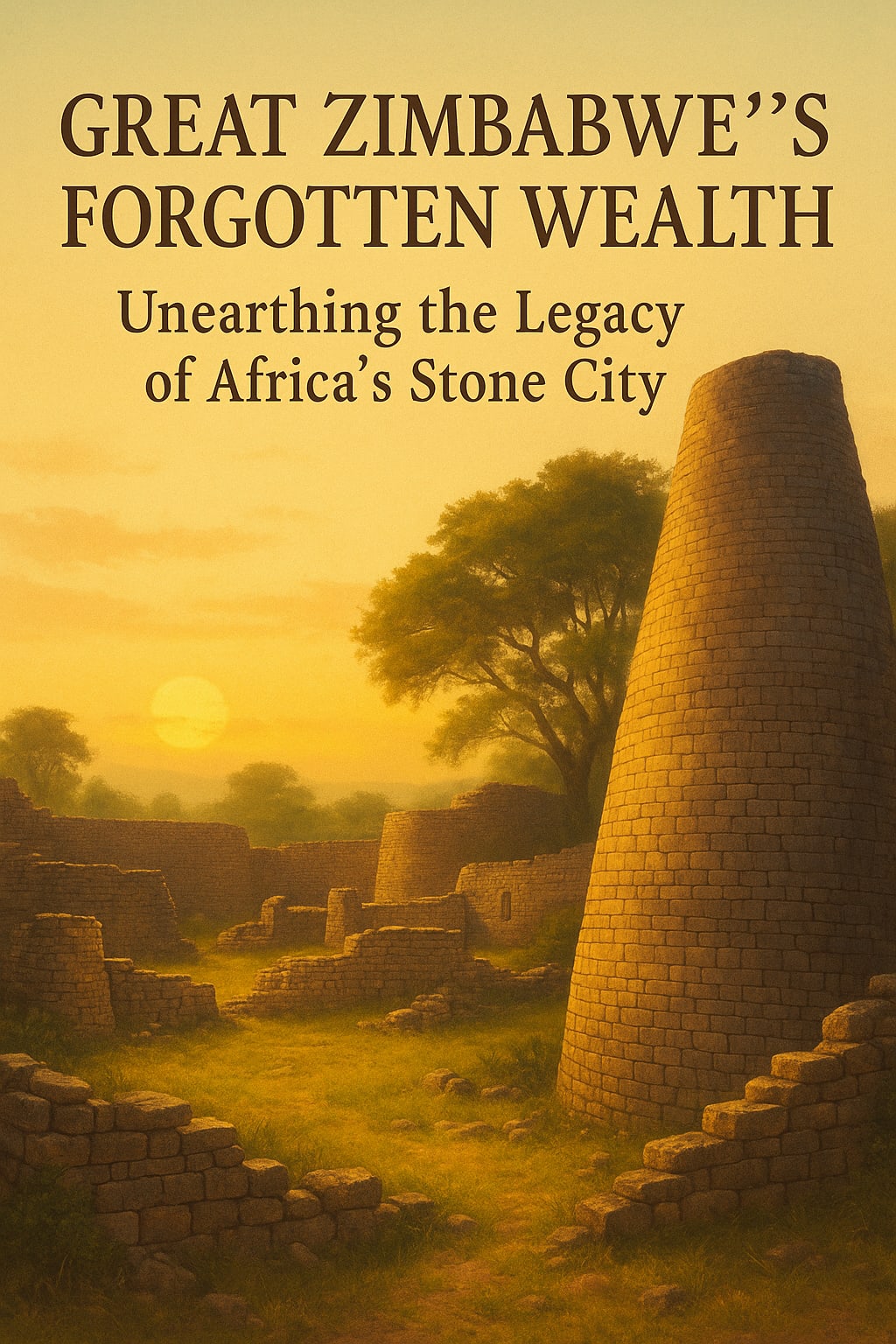
Great Zimbabwe’s Neglected Wealth: Revealing the Heritage of Africa’s Stone City
Great Zimbabwe, historically the core of a formidable African kingdom, was not merely a city of stone remnantsit functioned as a flourishing hub of commerce, gold, and cultural brilliance. This article investigates the overlooked wealth of this ancient location, examining the extensive economic impact, concealed treasures, and the enduring legacy of a civilization frequently sidelined in mainstream narratives. With the emergence of new findings, Great Zimbabwe's significance in global history is being justly reassessed.
Article:
Situated in the southeastern hills of present-day Zimbabwe is one of Africa’s most mysterious ancient citiesGreat Zimbabwe. Renowned for its towering stone fortifications and enigmatic origins, Great Zimbabwe was formerly the capital of a mighty kingdom that thrived between the 11th and 15th centuries. However, beyond its stony architecture, what truly distinguished the city was its vast affluencea wealth derived from commerce, craftsmanship, and gold.
A Flourishing Economic Powerhouse
At its peak, Great Zimbabwe accommodated nearly 20,000 individuals, a remarkable populace for a pre-colonial African metropolis. It served as the focal point of the Kingdom of Zimbabwe, with its rulers overseeing crucial trade routes that extended from the interior of southern Africa to the Indian Ocean.
The region was abundant in gold deposits, and this invaluable metal constituted the empire's lifeblood. Archaeological findings indicate that Great Zimbabwe exported gold and ivory to Swahili coastal cities such as Kilwa Kisiwani and Zanzibar, which subsequently engaged in trade with merchants from Arabia, India, and even China. In return, the inhabitants of Great Zimbabwe acquired silks, beads, porcelain, and glassware, some of which have been discovered at excavation sites throughout the city.
Architectural Grandeur
The most distinctive characteristic of Great Zimbabwe is its stone edifices. The Great Enclosure, an enormous elliptical wall exceeding 30 feet in height and 800 feet in circumference, is the largest ancient stone structure in sub-Saharan Africa. Constructed without mortar, the granite blocks were skillfully fitted together, demonstrating advanced engineering and artistic refinement.
These edifices served not only as administrative centers but also as symbols of wealth and authority. They accommodated the royal family and functioned as ceremonial and economic hubs. The very existence of such monumental constructions in a remote locale attests to the city’s affluence and its capacity to mobilize labor and resources on a grand scale.
The Enigma of the Missing Treasure
Despite its significance, much of Great Zimbabwe’s treasure remains elusive today. Early European explorers and colonizers, including Carl Mauch in the 19th century, were unable to accept that Africans had constructed such remarkable structures. Instead, they erroneously credited the site to foreign civilizations like the Phoenicians or the Queen of Sheba. This prejudiced disbelief not only distorted history but also led to the looting of artifacts, many of which ended up in European museums or private collections.
The items that were plundered encompassed gold adornments, intricately carved soapstone avians (thought to be venerated), iron armaments, ritualistic instruments, and decorative beadworks. In the present day, Zimbabwe is fervently pursuing the restitution of numerous artifacts, especially the renowned Zimbabwe Birds, which now serve as significant national emblems.
Assessing the Value
Although a considerable portion of Great Zimbabwe’s initial riches has been either lost or appropriated, scholars and archaeologists approximate that its economic worth today could amount to billions of dollars. Gold alone was exported in such quantities that the city was regarded as one of the principal origins of African gold reaching the Middle East and Asia.
Contemporary historians estimate that between the 12th and 15th centuries, over 20 tons of gold may have been extracted and exchanged within Great Zimbabwe’s economy. At current gold valuation (approximately $65 million per ton), this exceeds $1. 3 billion USD, not accounting for the worth of ivory, livestock, textiles, and other crafts also produced in the area.
Cultural and Political Importance
The spiritual, political, and economic importance of Great Zimbabwe endures. The nation’s nameZimbabwetranslates to "house of stone", honoring the ancient city. Its national banner features the Zimbabwe Bird, and the ruins themselves have been designated as a UNESCO World Heritage Site.
Recent archaeological initiatives aim to rectify the historical narrative and recontextualize Great Zimbabwe as one of the most powerful and affluent civilizations of pre-colonial Africa. Its impact spanned the region and has left an enduring impression on the culture and identity of Southern Africa.
Final Thoughts
Great Zimbabwe is not simply a remnant of the pastit stands as a testament to African ingenuity, wealth, and resilience. Its overlooked treasures exist not solely in the tangible gold and artifacts dispersed worldwide, but also in its role as a cultural and economic powerhouse of its era. As we continue to unveil more about its history, the narrative of Great Zimbabwe expandsnot as an enigma, but as a rightful segment in the global chronicle of human civilization.
About the Creator
Say the truth
"Say the Truth: Explain Everything in the World" is your trusted source for uncovering facts and exploring the wonders of history, science, technology, and beyond. We simplify complex ideas and reveal truths to inspire curiosity .
Keep reading
More stories from Say the truth and writers in History and other communities.
“Africa’s Hidden Fortunes: The Lost Treasures of a Forgotten Continent”
"Concealed Gold: The Neglected Treasures of Africa" Africa’s past is characterized by the ascendance and decline of magnificent empires, from the fabled affluence of Mali’s Mansa Musa to the obscured wealth of Great Zimbabwe and Benin. This article delves into the enigmatic narratives of Africa’s forsaken treasuresgilded thrones, sacred gems, and imperial relicsthat were pilfered, entombed, or overlooked through conflict, colonization, and the passage of time. With contemporary focus on cultural heritage and restitution, Africa’s treasures are being reexaminedboth physically and symbolicallyas elements of a rich, appropriated legacy.
By Say the truth 9 months ago in History
Henry Ford – The Man Who Put the World on Wheels
Henry Ford was born on July 30, 1863, on a small farm in Greenfield Township, Michigan, near the growing city of Detroit. His parents, William and Mary Ford, were immigrants from Ireland who lived a simple rural life. From a young age, Henry showed little interest in farming. While other boys learned to plow fields and care for animals, Henry was fascinated by machines. He wanted to know how things worked—especially clocks, watches, and engines. This curiosity would shape the rest of his life. At the age of 13, Henry received a pocket watch from his father. Instead of simply wearing it, he took it apart, studied every piece, and then put it back together. Soon, neighbors were bringing him broken watches and tools to fix. This early habit of dismantling and improving machines revealed his natural talent for engineering. Despite his father’s wish that he become a farmer, Henry dreamed of something far greater. When Henry was 16, he left the family farm and moved to Detroit to work as an apprentice machinist. He worked long hours for little pay, but he learned valuable skills in metalwork and mechanical design. Later, he returned home but continued to experiment with machines in his spare time. In 1891, he took a job with the Edison Illuminating Company, which brought him closer to the world of engines and electricity. His dedication earned him a promotion to chief engineer, giving him both financial stability and time to pursue his true passion: building a self-propelled vehicle. In 1896, Henry Ford built his first successful gasoline-powered automobile, which he called the “Quadricycle.” It was a simple vehicle with four bicycle wheels and a small engine, but it proved that his ideas could work. Encouraged by this success, Ford sought investors to help him build cars on a larger scale. His early business ventures failed due to disagreements with partners and financial struggles, but Ford did not give up. Each failure taught him important lessons about leadership, design, and production. In 1903, Henry Ford founded the Ford Motor Company. This marked a turning point in his life. Unlike other car manufacturers of the time, who built expensive vehicles for the wealthy, Ford believed automobiles should be affordable for ordinary people. His vision was to create a reliable, simple car that workers could buy and use every day. This belief guided every decision he made. That vision became reality in 1908 with the introduction of the Model T. The Model T was durable, easy to repair, and far less expensive than other cars on the market. It quickly became popular across the United States. Farmers, shopkeepers, and factory workers could now travel long distances with ease. The automobile was no longer a luxury—it was a tool that transformed daily life. However, Henry Ford’s greatest contribution was not just the car itself, but the way it was built. In 1913, he introduced the moving assembly line to automobile production. Instead of workers moving around a car, the car moved past workers, each performing a single task. This innovation dramatically reduced production time and costs. A Model T that once took over 12 hours to build could now be assembled in about 90 minutes. This revolutionized manufacturing not only in the auto industry but around the world. Ford also shocked the business world in 1914 by introducing the “five-dollar day,” doubling workers’ wages while reducing working hours. At a time when factory work was exhausting and poorly paid, Ford believed that well-paid workers would be more productive and loyal. He also believed they should be able to afford the products they made. This policy reduced employee turnover and increased efficiency, setting a new standard for industrial labor. By the 1920s, Henry Ford had become one of the richest and most influential men in the world. The Model T dominated the automobile market, and Ford Motor Company expanded internationally. Factories were built in Europe, South America, and Asia. Ford’s name became a symbol of innovation, efficiency, and American industrial power. Despite his success, Henry Ford was a complex and controversial figure. He held strong opinions and was resistant to change in later years. He was slow to adapt when consumer tastes shifted, and competitors began offering more stylish and comfortable cars. Eventually, Ford had to end production of the Model T in 1927 and introduce newer models to stay competitive. Ford was also known for his strict control over his company and personal beliefs that often caused criticism. While he supported innovation and workers’ rights in some ways, he opposed labor unions and resisted outside influence. These contradictions made him both admired and criticized during his lifetime. In his later years, Henry Ford gradually handed control of the company to his son, Edsel Ford, who brought new ideas and modern designs to the business. Edsel’s death in 1943 deeply affected Henry, and he briefly returned to leadership despite declining health. Eventually, his grandson, Henry Ford II, took over and led the company into a new era. Henry Ford died on April 7, 1947, at the age of 83. By the time of his death, the world had been permanently changed by his ideas. He did more than build cars—he transformed how people worked, traveled, and lived. His belief that technology should serve ordinary people reshaped modern society. Today, Henry Ford is remembered as a pioneer of mass production and a symbol of industrial innovation. His life story is one of curiosity, failure, persistence, and vision. From a farm boy who disliked plowing fields to a man who put the world on wheels, Henry Ford proved that determination and bold ideas can change history forever.
By The best writer about 9 hours ago in History



Comments
There are no comments for this story
Be the first to respond and start the conversation.