
Golden Sleep: The Discovery of King Tut
When Howard Carter Awoke the Ancient Dead

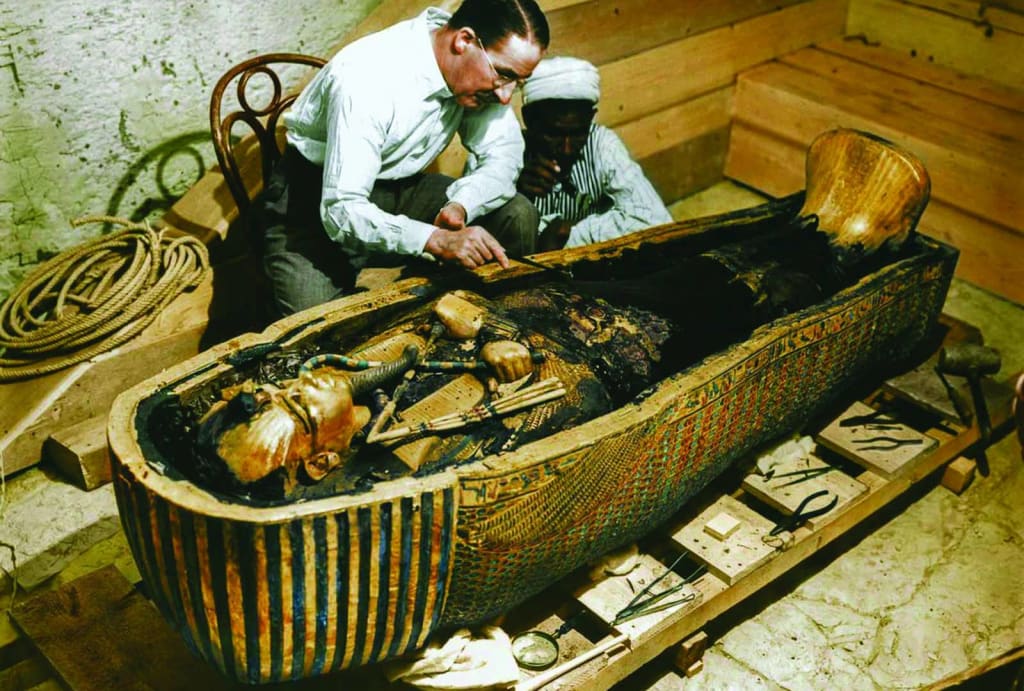
The year was 1922. The sun blazed mercilessly over the scorched sands of Egypt’s Valley of the Kings, where tombs of ancient pharaohs lay hidden beneath centuries of dust. Most believed all the great tombs had already been found—plundered or lost to time. But one man refused to give up.
Howard Carter, a British archaeologist with weathered hands and an iron will, had been searching for a tomb rumored to exist, but never proven: the final resting place of the boy pharaoh Tutankhamun. After years of disappointment and dwindling funds, even his wealthy patron, Lord Carnarvon, was growing impatient. Carter made one last plea: just one more season. Carnarvon reluctantly agreed.
The workers dug in silence, their tools scraping against stone and ancient soil. Day after day passed with no sign—until November 4th, when a young water boy stumbled over something hard buried in the dirt. It was a step, chiseled and precise, leading down. Carter’s heart pounded. Had they found it?
Carter ordered the stairs cleared. As each step emerged, tension mounted. Finally, they reached a sealed door, stamped with strange symbols and a faint cartouche—Tutankhamun’s name. His hands trembled. Could it be untouched?
But Carter didn’t dare open it just yet. He sent a telegram to Carnarvon in England:
“At last have made wonderful discovery in Valley; a magnificent tomb with seals intact.”
Two weeks later, Lord Carnarvon arrived, and on November 26, 1922, history changed forever.
With Carnarvon at his side, Carter chipped away at the doorway. A warm breath of ancient air flowed out. Carter peered through a small hole, candle flickering in his hand. Carnarvon asked, “Can you see anything?”
Carter’s voice quivered as he replied:
“Yes, wonderful things.”
What he saw was like a dream: golden chariots, alabaster vases, carved statues, and the faint glint of a burial shrine—untouched for over 3,000 years. The air was thick with the scent of ancient resin and linen, the silence heavy with the weight of time.
Behind the outer chamber lay the burial room, sealed off with another wall. It took months of careful excavation to reach it. When the barrier was finally removed, they found the sarcophagus of Tutankhamun nested within four shrines, one inside the other like sacred puzzle boxes. And within the innermost coffin—made of solid gold—lay the preserved body of the boy king, his face covered by a stunning golden mask that would become an icon of ancient Egypt.
The world was stunned. Newspapers across the globe splashed the discovery across their front pages. Egypt’s golden age had come roaring back to life. Crowds flooded the valley, archaeologists and adventurers poured in, and Carter became a reluctant celebrity.
But with the wonder came whispers.
Soon after the tomb was opened, Lord Carnarvon fell mysteriously ill. A mosquito bite on his face became infected. Within weeks, he was dead. At the moment of his death, legend says, the lights in Cairo flickered and went out. His dog, thousands of miles away in England, howled and dropped dead. The newspapers pounced:
“The Curse of the Pharaoh Strikes!”
Others connected dots. A cobra—a symbol of Egyptian royalty—reportedly killed Carter’s canary. More deaths followed among those who visited the tomb. Scientists dismissed it as coincidence or mold exposure, but the myth of the "Pharaoh’s Curse" grew stronger.
Carter, ever the realist, scoffed at the superstition. He lived for another 17 years, dedicating the rest of his life to documenting the tomb’s treasures—over 5,000 artifacts, many coated in gold, hidden for millennia. His detailed notes and drawings laid the groundwork for modern Egyptology.
But even Carter admitted something strange lingered in that tomb. The sense that time had folded in on itself, that by breaking the seal, they had crossed a threshold between worlds—the living and the dead.
Tutankhamun, who had died at just 18 and was largely forgotten in ancient records, had risen again. Not in body, but in memory. The boy king who had once ruled briefly during the decline of Egypt’s New Kingdom had now become the most famous pharaoh of all.
The tomb was a window into a world long gone—a civilization that worshipped the stars, believed in eternal life, and buried its kings with the hope they would rise again.
And in a way, Tutankhamun did.
Through Carter’s discovery, the ancient dead awoke—not to reclaim the world, but to remind it of the fragility of time, the beauty of belief, and the golden light that still glimmers beneath the sands.
About the Creator
Raza Ullah
Raza Ullah writes heartfelt stories about family, education, history, and human values. His work reflects real-life struggles, love, and culture—aiming to inspire, teach, and connect people through meaningful storytelling.
Keep reading
More stories from Raza Ullah and writers in History and other communities.
Foundations of an Empire
In the mist-shrouded hills of central Italy, where the Tiber River wound through wild forests and marshlands, a legend was born—a tale of two brothers raised by a she-wolf, destined to shape the future of the world. Rome’s story did not begin with marble palaces or legions marching across continents. It began with survival, struggle, and an unshakable will to endure.
By Raza Ullah8 months ago in History
The Net Worth of the Codex Gigas: Valuing the Devil’s Bible
Why the Codex Gigas Has No Official Price The Codex Gigas is currently housed in the National Library of Sweden, where it is protected as a national cultural treasure. Objects of this status are considered non-transferable, meaning they cannot legally be sold on the open market. Because of this, the manuscript has no official market value.
By Say the truth 6 days ago in History
Looking Back:The Folly of the March for Life Fiasco: How Not to Write on a Contentious Topic
A "Pithy" Writer Makes His Opinions Known The fiasco at the 2019 March for Life—and concurrent demonstrations in the National Mall—was bound to have a consequence. As soon as a viral, one-minute video hit Twitter in late January, the tale of two opposing groups confronting one another became political fodder. Pundits and political writers were more than happy to dissect and formulate a narrative to their liking.
By Dean Traylorabout 13 hours ago in History



Comments (1)
Discovery of king tut.