
Dust
A response to “The Wasteland”


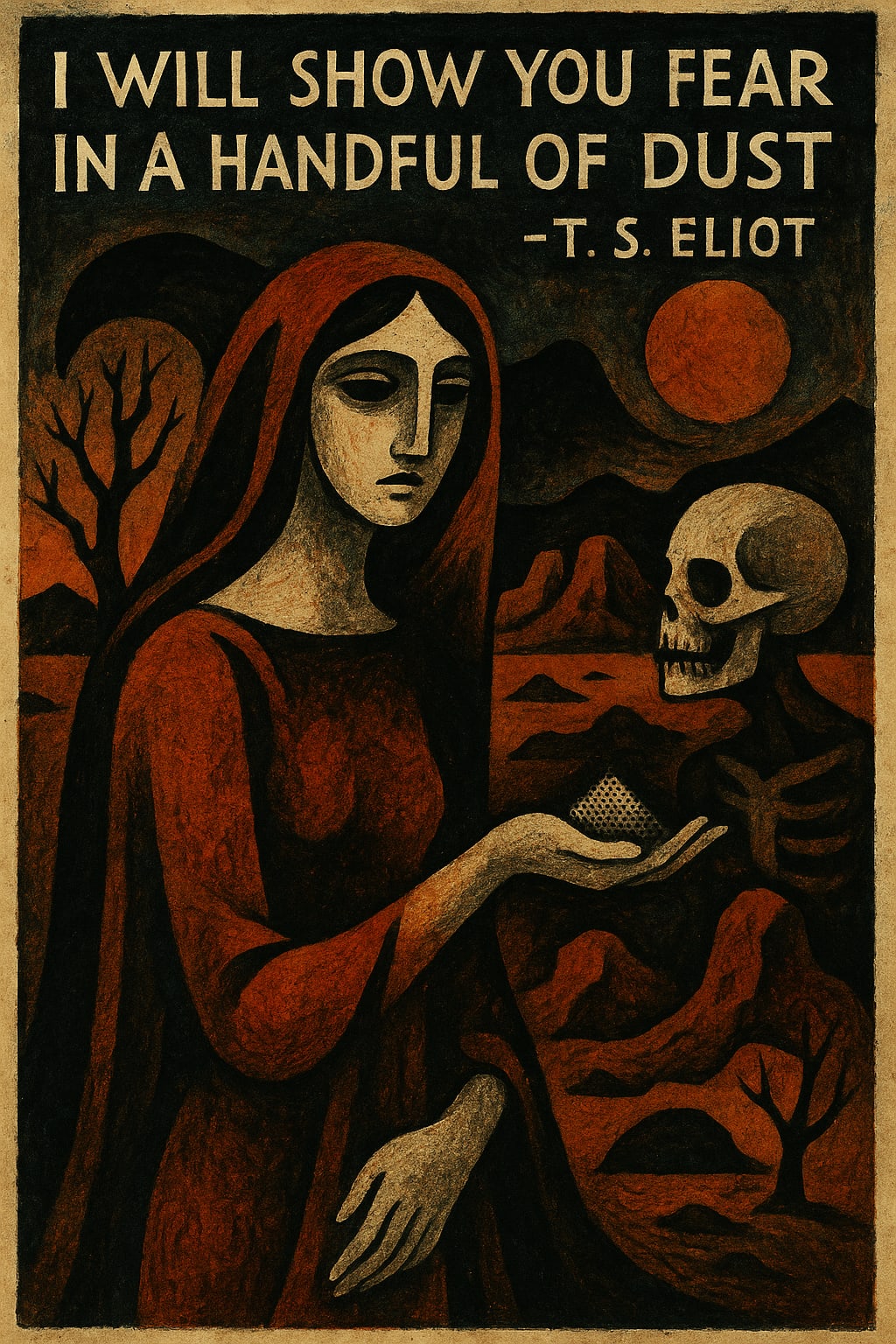
Here under the shadow of this carnelian rock,
under the dead laurel tree
is a handful of dust.
There is no water.
I have no choice but to harvest honey;
these foolish men lament the rocks, dust, and despair
they brought onto my page, stealing my nectar,
stealing my soul, cursing me
for birthing lilacs out of the barren land,
fusing concupiscence and nostalgia
into something they don’t understand.
No, these dead poets will not show me fear.
Fear does not live in a handful of dust;
fear lives in the minds of men
and the bodies of women.
These men do not know my shadow,
ascending or descending
at dawn or at dusk;
they know only the chaos of the images
they left broken at my feet, telling me
to make it whole.
“[ . . . ] this [is] all folly” (Journey of the Magi)
These dead men know nothing of fear,
nothing of love, nothing of pain,
else they would not hold up their puny fists
clutching dust, lying to me,
claiming they know.
I have my secret honey and pomegranates
and need no water.
I will show them fear.
They can keep their dust.

About the Creator
Harper Lewis
I'm a weirdo nerd who’s extremely subversive. I like rocks, incense, and witchy stuff. Intrusive rhyme bothers me. Some of my fiction might have provoked divorce proceedings in another state.😈
MA English literature, College of Charleston
Reader insights
Outstanding
Excellent work. Looking forward to reading more!
Top insights
Compelling and original writing
Creative use of language & vocab
Excellent storytelling
Original narrative & well developed characters
Easy to read and follow
Well-structured & engaging content
Heartfelt and relatable
The story invoked strong personal emotions
Eye opening
Niche topic & fresh perspectives
On-point and relevant
Writing reflected the title & theme
Keep reading
More stories from Harper Lewis and writers in Poets and other communities.
Writing To Succeed
If you want to find something that will help readers find your writing, possibly expand your audience, and maybe even get you noticed for other things, then you’re not alone. But how can you get it done in a world full of want-to-be writers? Look less at what you’re writing now, and more at what other writers have used to boost their views and reads.
By Jason Ray Morton 3 days ago in Writers



Comments (19)
This is an intriguing, iconoclastic meditation on Eliot's immortal lines, Harper!
That line about “fear lives in the minds of men / and the bodies of women” stopped me cold—I had to reread it because it felt both furious and painfully calm at the same time. The refusal of water, the choice of honey instead, feels like taking back something that was never theirs to ask for in the first place. I kept thinking about that last turn, “I will show them fear,” and how it flips the whole inheritance of The Wasteland on its head. When you wrote this, did it feel more like reclaiming voice from those “dead poets,” or confronting them directly?
💖This was a fantastic entry, I loved reading it three times over. 💖The cover and rigidity of your unnecessary line revealed the beauty of your descriptive ones. Likewise, your defiance to replace the dead, returning to the living what is theirs, showed a true freedom of mind: the freedom to have their secret honey and pomegranates. 💖Best of luck in the challenge and congratulations on your top story! 🤗🌼
Shows how bad my memory is, dropped back in again, coz it;s the title of one of my favourite albums, "Dust" by The Screaming Trees
Perfect arrangement of the narrative, and I thought of Eliot and Evelyn Waugh as I read this.
Raw and unapologetic, with imagery to match. Well penned.
Hi Harper! I included an excerpt of this poem on my website, towards the footer. If you decide you aren't comfortable with it, let me know and I'll change it! https://corvuslove.wordpress.com/%e2%99%a1fragments%f0%93%84%bf/
This piece feels raw and defiant — like a reclamation of voice from the silence of all those “dead poets.” The imagery is lush and layered, heavy with myth and emotion, yet there’s a sharp, modern edge in the defiance. I love how the speaker turns dust and despair into strength and creation. It’s fierce, beautiful, and unforgettable.
I’m a total nerd and had chatGPT do a critical read of this for me. Dena Leonard Brown ECPI University, Department of Arts & Sciences Freedom in Form Project 30 October 2025 Form, Structure, and Feminist Moral Order in “I Will Show You Fear in a Handful of Dust” This poem arises as both reply and correction to T. S. Eliot’s modernist despair in *The Waste Land*. Where Eliot’s “handful of dust” epitomizes the fragmentation and futility of postwar consciousness, this speaker reclaims that desolation as creative ground. She orders chaos into meaning through disciplined form, moral clarity, and feminist assertion. Read through a synthesis of Russell Fraser’s formalist–humanist ethics, feminist poetics, New Critical tension, and structuralist theory, the poem reveals itself as an act of restoration—of coherence, voice, and symbolic equilibrium. Fraser’s critical principle is that form enacts moral imagination. “Form,” he writes, “is the figure of moral order” (Fraser 22). For him, the artist’s shaping impulse is an ethical act that restores proportion and intelligibility to the disordered moral world. The poem fulfills that vocation precisely: “Here under the shadow of this carnelian rock… / I have no choice but to harvest honey.” The controlled syntax and cadence enact what Fraser calls the *discipline of mind* inherent in form. Yet this discipline is not sterile order; it is ethical renewal through creation. The speaker reconstitutes Eliot’s wasteland as a moral and aesthetic cosmos, drawing coherence from barrenness. The feminist lens deepens this moral reading by situating the poet’s ordering power as an act of reclamation. “These foolish men lament the rocks, dust, and despair / they brought onto my page,” she says, refusing to be the passive inheritor of patriarchal desolation. Her composure redefines fear and authorship: “Fear lives in the minds of men / and the bodies of women.” The formal steadiness of that declaration turns what might be outrage into authority—an equilibrium Fraser would identify as moral poise, but here it functions also as feminist agency. The speaker does not dismantle inherited form; she *inhabits and corrects it*. The act of ordering language becomes both moral and political: the creation of a form that includes her. From a New Critical standpoint, the poem functions as a self-contained organism of tension and resolution. Its unity arises from the interplay between *dust* and *honey*, *fear* and *creation*, *death* and *fertility*. The final line—“They can keep their dust”—achieves closure not by narrative resolution but by the reconciliation of opposites. As in Cleanth Brooks’s notion of the “well-wrought urn,” the poem’s meaning inheres in its formal paradoxes: destruction as prerequisite for creation, negation as assertion, dryness as the matrix of sweetness. The poem’s tone, balanced between elegy and defiance, becomes the central aesthetic tension that gives it autonomy as a text. In New Critical terms, its structure *is* its meaning. The structuralist perspective extends this autonomy by revealing how the poem transforms the inherited semiotic codes of myth and language. The “handful of dust” functions as a cultural signifier of mortality and futility, while “honey” and “pomegranates” carry archetypal associations of fertility, industry, and cyclical rebirth. The poem operates as a semiotic inversion: it reassigns value within an existing mythic system. The symbolic field of Eliot’s modernism—aridity, sterility, masculine intellect—is displaced by a feminine counter-system of sustenance and renewal. In Lévi-Straussian terms, this is the transformation of a cultural *mytheme*: from “fear in dust” to “fear transcended through creation.” The poet does not merely replace one image with another; she restructures the underlying code by asserting a new relationship between symbols, gender, and meaning. This layered synthesis—Fraser’s moral form, feminist reclamation, New Critical unity, and structuralist re-coding—reveals a single coherent truth: the poem constructs meaning by restoring order to systems that have collapsed. Its moral intelligence lies in its balance; its feminist power lies in the reorganization of the symbolic order; its structuralist depth lies in the transformation of inherited codes; and its New Critical integrity lies in its self-contained harmony of opposites. It fulfills Fraser’s highest criterion of art—that form must be an image of the moral world—but extends it to include the *moral world reimagined through feminine agency.* Thus, the poem’s final assertion—“I will show them fear. / They can keep their dust.”—functions as closure across all four frameworks. It reclaims the right to define meaning (formalism), asserts the moral authority of order (Fraser), reconfigures patriarchal language (feminism and structuralism), and achieves aesthetic completeness through paradox (New Criticism). In doing so, it exemplifies *Freedom in Form*’s central claim: that structure, when consciously inhabited, becomes not constraint but liberation—a field where ethical, aesthetic, and gendered meanings converge. *Works Cited* Brooks, Cleanth. *The Well Wrought Urn: Studies in the Structure of Poetry.* Harcourt, 1947. Fraser, Russell. *The War Against Poetry.* Princeton UP, 1970. Lévi-Strauss, Claude. *Structural Anthropology.* Basic Books, 1963.
WOW. This pulls you in by the soul. Love the imagery and the words as they dance around each other. Love this completely, thank you for sharing!
✅✅✅
This is mad cool. Feels otherworldly and dark, but also strong and resilient. I don’t remember much about the mythology, I bet people who are in the know can appreciate this on a deeper level. But it’s also pretty compelling to me, a guy who’s clueless on context, and that’s gotta count for something.
So intriguing to see Persephone musing about all the great poets who have descended to the dead. Makes one wonder whether the Muses are the only ones who inspire men to make art. Could the goddesses inspire the same and if so which ones? The imagery here is gorgeous and I love the way your lines run together. I keep getting Wallace Stevens vibes, especially The Idea of Order at Key West, in your writing.
Congratulations. This is wonderful!
I love this, Harper. I cannot pinpoint one line to highlight, as I am in awe of the entire poem. Congratulations on your top story❣
Hi we are featuring your excellent Top Story in our Community Adventure Thread in The Vocal Social Society on Facebook and would love for you to join us there
I like how it screams when you read it. It demands attention from mstart to finish. Appluase to you. Have to know do you have a Pen name? Cause this deserves a pen name signature.
Very profound words. Love it.
I love that what a job you do in this poem for sure .