
Giordano Bruno: The Man Who Reached for the Infinite
A story of a fearless mind that defied the boundaries of his time
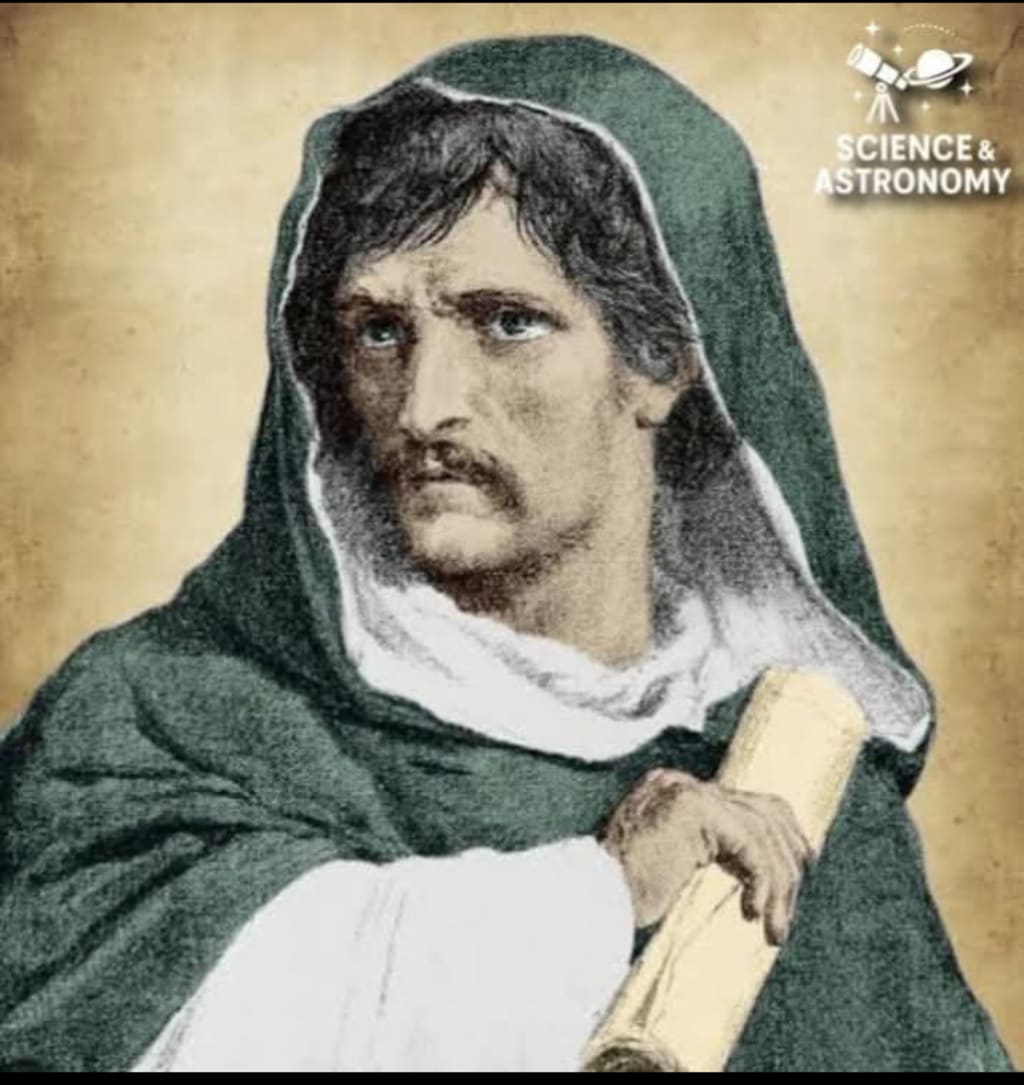
In the year 1548, in the small Italian town of Nola near Naples, a boy named Filippo Bruno was born. No one could have guessed that this child would grow into one of history’s most daring thinkers — a man who would challenge the most powerful institution of his age and pay the ultimate price.
From an early age, Filippo was restless, curious, and hungry for knowledge. He joined the Dominican Order at the age of 17, taking the name Giordano after his mentor. Life in the monastery gave him access to books, philosophy, theology, and the wisdom of ancient scholars. But while others studied to strengthen their faith, Giordano’s mind worked differently. He asked questions, dangerous questions — about God, the universe, and the place of humanity in it.
During the Renaissance, the Catholic Church held firm control over what was considered truth. The Earth was believed to be the unmoving center of the universe, with the heavens revolving around it. But whispers of a new idea were spreading — the Copernican theory, which claimed that the Earth revolved around the Sun. To most, this was shocking. To Giordano Bruno, it was just the beginning.
He dared to go further than Copernicus ever had. In Bruno’s mind, the Sun was not the center of all things — it was simply one star among countless others. And if there were countless stars, why couldn’t each have its own worlds, perhaps with life of their own?
It was a breathtaking vision: an infinite universe without boundaries, filled with endless possibilities. No single world was at the center. No human being was the special focus of creation. The cosmos, he believed, was far greater than anyone had imagined.
But Bruno’s bold ideas didn’t stop at astronomy. He questioned the very structure of religion. He rejected the Church’s teachings on the Trinity, dismissed the idea of eternal damnation, and believed that God was not a distant ruler sitting above the world, but was present in every corner of the infinite universe.
For such thoughts, he quickly became a target. The Church considered these ideas heresy — dangerous to faith and authority. Bruno left Italy, traveling through Europe, teaching, debating, and writing. He visited France, England, and Germany, gathering both admirers and enemies. His brilliant mind fascinated many, but his sharp tongue and refusal to compromise often made him unwelcome.
In 1591, Bruno made a fateful decision. He returned to Italy, accepting an invitation to teach in Venice. Perhaps he thought he could live quietly, or perhaps his confidence blinded him to the danger. Whatever the reason, his past caught up with him. The Inquisition — the powerful arm of the Church that rooted out heresy — arrested him.
For seven long years, Bruno was imprisoned. He was interrogated, pressured, and offered chances to recant his beliefs. But he refused. For him, truth was worth more than life. The trial records suggest he stood firm in his belief in an infinite universe, his rejection of key Church doctrines, and his claim that reason and free thought must be allowed to question even the holiest teachings.
On February 17, 1600, in Rome’s Campo de’ Fiori, Giordano Bruno was led to the stake. He was gagged so that his final words could not be heard, but history has imagined them in the fire’s roar: defiance, courage, and unbroken spirit. The flames consumed his body, but not his ideas.
Today, Bruno is remembered as more than just a philosopher. He is celebrated as a martyr for free thought, a man who refused to let fear chain his mind. His vision of an infinite universe has been confirmed by modern science — telescopes have revealed countless galaxies, worlds, and wonders far beyond the wildest dreams of his time.
The bronze statue that now stands in the Campo de’ Fiori marks the place where he died. His eyes are cast toward the Vatican, a silent reminder that truth cannot be burned away.
Giordano Bruno’s life is a story of courage, imagination, and the unshakable belief that knowledge is worth any price. In his own words:
> “Truth does not change because it is, or is not, believed by the majority of the people.”
And so, his story lives on — inspiring every dreamer, thinker, and seeker who dares to look up at the night sky and imagine the infinite.
About the Creator
Hasbanullah
I write to awaken hearts, honor untold stories, and give voice to silence. From truth to fiction, every word I share is a step toward deeper connection. Welcome to my world of meaningful storytelling.
Keep reading
More stories from Hasbanullah and writers in History and other communities.
The Legend of Najabia Bathe: The Guardian of the Flame
In the heart of old Africa, long before maps carved lines through the soil and strangers walked the lands with chains, there lived a man named Najabia Bathe. He was born beneath a blood moon in a humble village near the banks of the great River Kumba, where crocodiles whispered secrets and elders spoke only truths.
By Hasbanullah7 months ago in History
Year 1952 in Review: Fun Facts, Trivia, and Historic Highlights
This quick read is a collection of fun facts, trivia, and historical events from the year 1952. Discover the year’s top news stories, most influential people, sports facts, U.S. economic trends, historic firsts, entertainment news, and much more.
By Gregory DeVictor7 days ago in History
Why Didn't Anyone Tell Us
Men, move along. This is not for you. This is for the women. I was forty-five when I began menopause. It is pretty young for that to be going on in a woman’s life, but I had undiagnosed PCOS, my entire life. Thank you to all the gynecologists I had seen my entire life. That in itself should encourage women to keep seeking second opinions, especially when you are not getting correct answers or any at all.
By Alexandra Grant5 days ago in Humans


Comments
There are no comments for this story
Be the first to respond and start the conversation.