

Ghana, located along the Gulf of Guinea and bounded by Côte d'Ivoire to the west, Burkina Faso to the north, and Togo to the east, possesses a rich and diverse history that reflects the complex interplay of indigenous cultures, European colonization, and post-colonial developments. This essay seeks to unravel the significant epochs of Ghana's history, from its ancient civilizations to present-day challenges and successes.
Pre-Colonial Era
Long before the establishment of modern Ghana, the region was inhabited by various groups with distinct cultures and social systems. The earliest known inhabitants were the Akan people, who established themselves in present-day Ghana over a thousand years ago. By the 11th century, the Ghana Empire, which was actually located to the north of present-day Ghana, emerged. Not to be confused with modern Ghana, this empire was a prominent force in West Africa, thriving on trade, particularly in gold and salt.
The rise of the Akan kingdoms in the 15th century marked a significant phase in Ghana's pre-colonial history. Notably, the Ashanti Empire, founded in the late 17th century, emerged as a dominant political and military force. The Ashanti were known for their advanced political organization, rich cultural heritage, and formidable military prowess. The empire's capital, Kumasi, became a bustling center for trade and culture, and its influence extended across much of present-day Ghana and neighboring regions.
Another critical player in the region's history was the Fante Confederacy, formed in the 18th century along the coastal areas. The Fante were instrumental in participating in the transatlantic trade, particularly dealing with European traders. This era’s economic activities laid the groundwork for Ghana's future interactions with foreign powers.
European Colonization
The arrival of European powers in the 15th century marked a transformative period in Ghana's history. The Portuguese were the first to arrive, seeking gold, spices, and other resources. However, it was the Dutch and the British who would ultimately establish significant colonial footholds in the region.
The British, in particular, sought to dominate trade, leading to several conflicts with local kingdoms, including the Ashanti. The Ashanti-British Wars occurred in the late 19th century, culminating in the defeat of the Ashanti Empire in 1900 and eventually its annexation as a British colony in 1902 under the name of the Gold Coast.
Colonial rule introduced various changes, including infrastructure development such as railroads and telegraph lines. However, these advancements primarily served colonial interests. Moreover, the exploitative nature of colonial administration and resource extraction fostered socio-economic disparities and discontent among the local populace.
Path to Independence
The interwar period saw rising nationalist sentiments among the Ghanaian people. The formation of the United Gold Coast Convention (UGCC) in 1947 was a pivotal moment, advocating for self-governance. However, the movement gained substantial momentum under the leadership of Kwame Nkrumah, who initially worked with the UGCC before forming the Convention People's Party (CPP) in 1949. Nkrumah’s charisma and vision resonated with many Ghanaians, advocating for immediate independence.
The struggle culminated in a series of protests and mass mobilizations against colonial rule, leading to increased pressure on the British government. On March 6, 1957, Ghana made history by becoming the first sub-Saharan African country to achieve independence from colonial rule. Kwame Nkrumah became the country’s first Prime Minister and later President, ushering in an era marked by ambitious social and economic reform efforts aimed at eradicating colonial legacies.
Post-Independence Challenges
While independence was a significant achievement, Ghana faced numerous challenges in the following decades. Nkrumah's government initially experienced considerable support, but growing dissent due to economic mismanagement, political repression, and increasing authoritarianism led to widespread public discontent. The situation culminated in a military coup in 1966, which deposed Nkrumah during a trip to China.
Subsequent decades were marked by political instability, with successive military regimes and short-lived governments. The era was characterized by coups, economic decline, and efforts toward reinstating civilian rule. It was not until 1992 that Ghana transitioned to a stable multi-party democracy, and the Fourth Republic was established with John Rawlings, who had initially led the country post-coup, as the elected president.
Modern Ghana
Since the re-establishment of democracy, Ghana has made significant strides in various sectors. The country has experienced relative political stability, becoming a model for democratic governance in West Africa. Economic reforms have fostered growth, and Ghana has emerged as one of the leading economies in the region, particularly in agriculture, mining, and oil production.
Social progress has also been notable, with improvements in education, healthcare, and women's rights. The country has made progress in addressing poverty, though challenges such as corruption, unemployment, and youth disillusionment remain pressing issues.
Conclusion
Ghana’s history is a testament to the resilience and dynamism of its people. From ancient civilizations to colonial struggles and the establishment of democracy, each phase of Ghana’s history reflects the complexities of a nation navigating its identity and aspirations amidst external and internal challenges. As Ghana moves forward, it continues to draw on its rich heritage while striving for progress that honors the struggles of its past. The journey of Ghana represents not just the history of a country but the enduring spirit of a people committed to realizing their potential on the global stage. As the world watches, Ghana stands as a beacon of hope and progress in Africa.
About the Creator
Keep reading
More stories from writers in History and other communities.
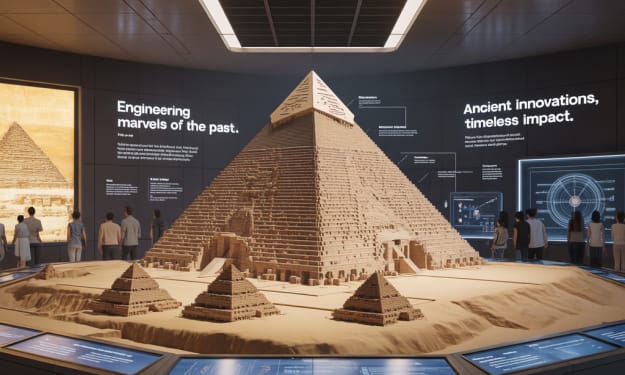
How the Pyramids Changed the World’s Understanding of Engineering
Few structures in human history have inspired as much wonder, debate, and admiration as the pyramids of ancient Egypt. Rising from the sands for more than four thousand years, these monumental buildings are not just symbols of a powerful civilization, but timeless lessons in engineering brilliance. Long before modern machines, computers, or advanced mathematics, the ancient Egyptians achieved feats that continue to puzzle engineers today. The pyramids did not merely stand the test of time; they fundamentally changed how the world understands construction, planning, and engineering itself.
By Binan Mooona day ago in History
Can World War III Be Prevented?
Can World War III Be Prevented? The idea of World War III is no longer limited to history books or fictional movies. Rising global tensions, regional wars, arms buildups, and political rivalries have made many people wonder whether another world war is possible—and more importantly, whether it can still be prevented. While the risks are real, global conflict is not inevitable. Prevention depends on choices made by leaders, institutions, and societies today.
By Wings of Time 6 days ago in History



Comments
There are no comments for this story
Be the first to respond and start the conversation.