

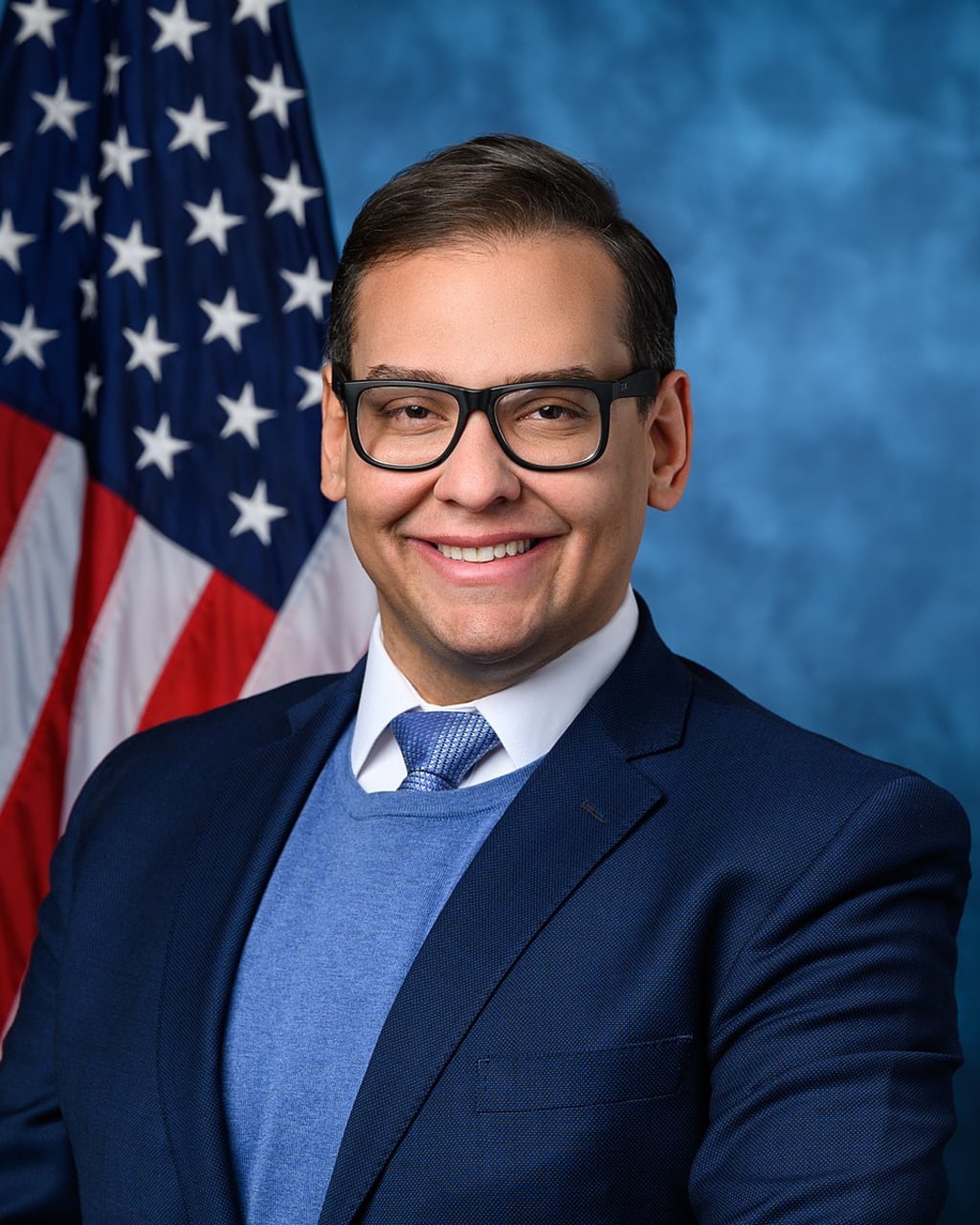
George Anthony Devolder Santos is an American former politician who became one of the most controversial figures in modern U.S. political history. Born in 1988, he gained national attention after being elected to the U.S. House of Representatives in 2022 to represent New York’s 3rd congressional district. His victory was seen as an important win for the Republican Party, but shortly after his election, his entire public image began to collapse under the weight of lies, scandals, and criminal accusations.
From the beginning, Santos presented himself as a self-made success story. He claimed to have graduated from Baruch College, worked at major financial institutions like Goldman Sachs and Citigroup, and built a strong career in business. He also described himself as a man of faith with Jewish ancestry, saying his grandparents fled Europe during the Holocaust. However, journalists and investigators later discovered that nearly all of these statements were false or exaggerated. Records showed no trace of his supposed education, no employment history with the companies he mentioned, and no evidence of his family’s claimed heritage.
As the inconsistencies grew, more of Santos’s personal stories were questioned. He claimed his mother died as a result of the September 11 attacks, that he had been a champion volleyball player, and that he had rescued dogs through a charity. Each of these stories was later shown to be fabricated or unsupported. The combination of deceit and arrogance made Santos a symbol of political dishonesty in the digital age, where misinformation spreads quickly and fact-checking often comes too late.
The U.S. House Ethics Committee launched an investigation into Santos in 2023 after suspicions emerged about his campaign finances. The investigation revealed that he had used campaign funds for personal expenses such as luxury shopping, Botox treatments, OnlyFans subscriptions, and private travel. It also found that he had falsified campaign reports, created fake loans to make his campaign seem more successful, and misled donors by using their money for personal gain. The report concluded that Santos had engaged in serious misconduct, violated federal laws, and acted in a way that disrespected the institution of Congress.
The revelations led to a historic vote in December 2023, when the House of Representatives expelled Santos from Congress. He became one of the very few members in American history to be expelled, and the first to be removed without a prior criminal conviction. His removal was a bipartisan decision, supported by members of both parties who agreed that his lies and financial crimes had disqualified him from public office.
Meanwhile, federal prosecutors in New York charged Santos with a long list of crimes, including wire fraud, identity theft, money laundering, and making false statements. They accused him of creating fake fundraising schemes, stealing donors’ credit card information, and lying to federal election authorities. In August 2024, Santos pleaded guilty to wire fraud and aggravated identity theft as part of a plea deal, admitting to much of the conduct that had been exposed by investigators.
In April 2025, he was sentenced to 87 months in federal prison, which is a little more than seven years. He was also ordered to repay more than three hundred thousand dollars in restitution and forfeit over two hundred thousand dollars of illegal gains. Santos surrendered to begin serving his sentence that summer. However, just a few months later, in October 2025, former President Donald Trump commuted his prison sentence, reducing it to time served. The commutation meant that Santos would be released immediately and face no additional probation or fines.
The commutation was highly controversial. Supporters of Trump and Santos argued that the original sentence was too harsh and that he had been treated unfairly in prison. Critics said the move showed political favoritism and undermined the justice system, since Santos’s crimes involved corruption, fraud, and deception of voters. Regardless of the political debate, the commutation did not erase his convictions; it only shortened his punishment. Santos remains a convicted felon under federal law.
Public reaction to Santos’s rise and fall has been strong and divided. Many Americans were shocked by how easily he had managed to deceive voters, donors, and party officials. His case raised serious questions about how candidates are vetted before elections and how campaign finances are monitored. Others saw him as a product of a political culture that rewards charisma and media manipulation over honesty and transparency.
The Santos scandal has broader implications for American politics. It highlights how misinformation, when left unchecked, can help dishonest figures gain power. It also demonstrates the limits of accountability in a polarized political system, where some leaders may protect or excuse wrongdoing if it serves their interests. His case underscores the need for stronger election oversight, clearer financial transparency laws, and better mechanisms to verify candidates’ claims before they assume public office.
Today, George Santos is a symbol of political deceit and a warning to voters about the dangers of ignoring truth in public life. His story serves as a reminder that democracy depends not only on elections but on trust, honesty, and accountability. Even though he no longer holds power, his scandal continues to influence discussions about ethics and integrity in government, leaving a lasting mark on American political history.
About the Creator
America today
Breaking news, political insights, real-time analysis, U.S. politics, global politics, elections, government policies, international relations, diplomacy, political debates, trending political stories, expert commentary, factual reporting,.
Keep reading
More stories from America today and writers in History and other communities.
Columbus Day
--- ## Columbus Day: An Overview and Key Questions Columbus Day is an American holiday observed on the second Monday in October to commemorate the arrival of Christopher Columbus in the Americas in 1492. It marks the moment when European exploration began an era of intense change, contact, colonization, and eventually global exchange. Over time, Columbus Day has evolved in meaning, significance, and controversy, becoming a flashpoint in debates over history, identity, and justice.
By America today 5 months ago in History
What Seven Soldier Skeletons Reveal About Their Lives.
History is often written by the victors, recorded in ink on parchment that celebrates grand strategies and royal decrees. However, the most honest account of war is frequently found beneath the earth, written in the very bones of those who fought it. When archaeologists uncover a mass grave—such as a recent discovery containing the remains of seven soldiers—they aren't just looking at the end of a life; they are opening a biological diary that spans decades.
By Irshad Abbasi 6 days ago in History




Comments
There are no comments for this story
Be the first to respond and start the conversation.