
Genghis Khan: The Life, Legacy, and Legend of the World's Greatest Conqueror
From a Humble Nomad to the Ruler of the Largest Empire in History

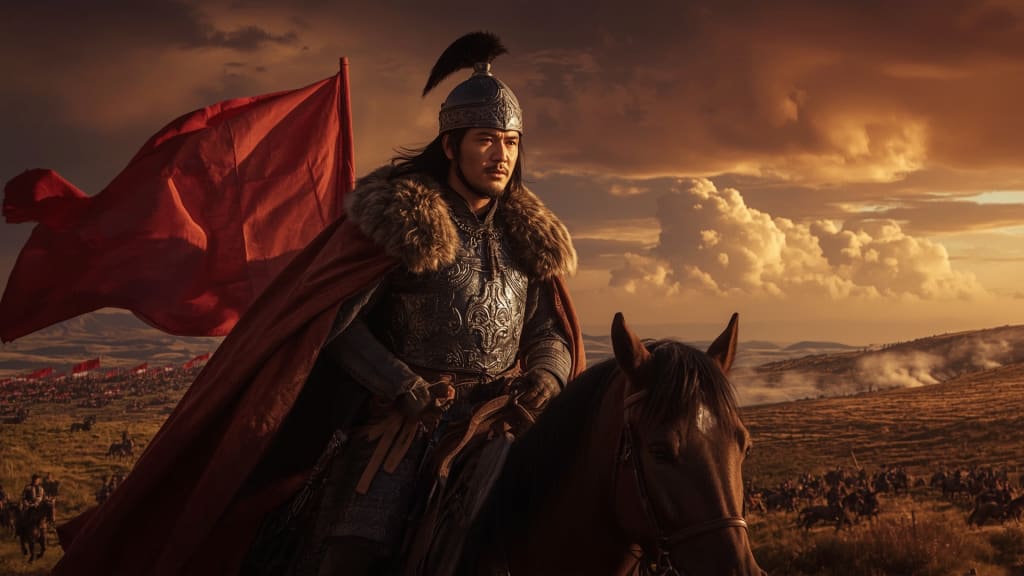
In the vast, unforgiving steppes of 12th-century Mongolia, a child was born who would change the world forever. His name was Temüjin—known to history as Genghis Khan. A brilliant strategist, a ruthless conqueror, and a visionary ruler, Genghis Khan rose from tribal obscurity to forge the largest contiguous empire the world has ever seen. But who was the man behind the legend? This article offers a complete, deeply researched journey through the life of Genghis Khan—from birth to death—examining the trials, triumphs, reforms, and conquests that shaped the destiny of millions across continents.
Birth and Early Hardships (c. 1162 – 1170s)
Temüjin was born around 1162 near the Onon River in the Khentii Mountains of present-day Mongolia. His birth was considered auspicious—he reportedly held a blood clot in his fist, symbolizing a future of battle and power. His father, Yesügei, was a tribal chief of the Borjigin clan, and his mother, Hö’elün, had been kidnapped by Yesügei and taken as a bride—a common Mongol practice at the time.
Tragedy struck early. Yesügei was poisoned by rivals when Temüjin was just a child. Their tribe abandoned his family, leaving them to survive alone on the harsh steppe. As a boy, Temüjin killed his half-brother Bekter during a dispute over food, asserting dominance at an early age. He was also once captured and enslaved by the Tayichi’ud tribe but managed a daring escape.
Rise to Power (1180s–1206)
Temüjin’s genius began to show as he built alliances with powerful tribes and influential leaders like Toghrul (Wang Khan) of the Kereit and his blood brother Jamukha. After marrying Börte, who was later kidnapped by the Merkit tribe, Temüjin successfully led a raid to rescue her—an act that boosted his reputation.
However, alliances turned to rivalries. In a critical battle against Jamukha in 1187, Temüjin suffered a devastating loss, but he learned valuable lessons about loyalty, structure, and trust. He began reorganizing his followers into a disciplined meritocratic system, eliminating aristocratic privilege.
By 1206, he had united the Mongol tribes and was proclaimed "Genghis Khan" (Universal Ruler) at a grand kurultai (tribal council). A new era had begun.
Military Campaigns and Conquests (1206–1227)
Genghis Khan’s military conquests were marked by brutal efficiency and strategic brilliance:
Western Xia (1209, 1226–1227): The Tangut kingdom was the first to fall. After an initial tributary arrangement, they were fully destroyed in 1227.
Jin Dynasty (1211–1215): Genghis launched devastating raids into northern China, capturing Zhongdu (modern-day Beijing).
Khwarazmian Empire (1219–1221): After the murder of a Mongol trade envoy, Genghis launched a full-scale invasion, decimating major cities like Samarkand, Bukhara, and Nishapur. Millions were killed.
Russian Steppe & Eastern Europe: Though Genghis didn’t personally lead these later campaigns, his generals ravaged territories as far as Kiev and Hungary.
His strategies included feigned retreats, encirclement, psychological warfare, and siege technologies learned from the Chinese.
Governance and Legal Reforms
Genghis Khan was not just a warlord—he was a reformer:
Yassa Code: A legal code that outlawed theft, adultery, and blood feuds. It encouraged religious tolerance and merit-based promotions.
Meritocracy: Positions of power were given based on ability, not lineage.
Yam System: A sophisticated communication network using mounted couriers, similar to a Pony Express.
Census and Taxation: A record-keeping system to streamline tax and military service.
Diplomatic Immunity: His diplomats had protections long before modern international law.
Cultural and Religious Tolerance
Despite the slaughter on battlefields, Genghis Khan promoted religious freedom throughout his empire. Buddhists, Muslims, Christians, and Taoists were all allowed to worship freely. He often invited scholars and religious leaders to debate in his court. This policy was one of the reasons behind the relative stability of the Mongol Empire.
Death and Secret Burial (1227)
Genghis Khan died during his campaign against Western Xia in 1227. The exact cause is debated: some say he fell off his horse; others claim he was injured in battle or died from illness.
His body was taken to the Khentii Mountains. Legend says his burial site was kept secret—soldiers killed anyone who saw the funeral procession, and a river was diverted over the grave to conceal it. To this day, the tomb remains undiscovered.
Succession and Legacy
Before his death, Genghis Khan chose his third son, Ögedei, as his successor. His empire was divided among his four sons:
Ögedei Khan: The second Great Khan, expanded westward.
Chagatai Khan: Controlled Central Asia.
Tolui Khan: Inherited the Mongol heartland.
Jochi Khan: His son Batu founded the Golden Horde.
His descendants included Kublai Khan, who later founded the Yuan Dynasty in China.
Lasting Impact
The Mongol Empire became the largest contiguous land empire in world history.
Silk Road Security: Trade flourished under Pax Mongolica.
Global Communication: Cultures and technologies spread between East and West.
Genetic Legacy: Modern studies show that about 16 million men in Central Asia may carry his Y-chromosome.
Military Doctrine: His strategies are still studied in military academies.
Conclusion: The Paradox of Genghis Khan
To many, Genghis Khan was a ruthless killer responsible for the deaths of millions. To others, he was a visionary leader who created a new world order. Perhaps he was both. What is undeniable is that Genghis Khan reshaped human history. From humble beginnings to global dominion, his life story is a testament to ambition, resilience, and the transformative power of leadership.
About the Creator
Keep reading
More stories from DRE Explains and writers in History and other communities.
The Vanishing Library of Baghdad—What Was Lost When the House of Wisdom Burned?
A Beacon Extinguished By the 9th century, the House of Wisdom—or Bayt al‑Hikma—had become Baghdad’s crowning jewel. Imagine a colossal domed edifice where Syriac, Persian, Sanskrit, and
By DRE Explains6 months ago in History
The Fall of Tibet to a Communist State: History, Causes, and Consequences
The incorporation of Tibet into the People’s Republic of China (PRC) after 1950 was not a single event but a complex process involving military force, political negotiation, ideological conflict, and long-lasting resistance. Understanding this fall requires examining Tibet’s historical status, China’s communist revolution, and the profound consequences that followed.
By Say the truth about 10 hours ago in History
Power's Sake
When it comes to gaining power, bad people use it to gain more They never gain power to do something with it, they gain power to have it, relish in it, double it down on itself so it grows exponentially and never goes anywhere. Even if you see the people in power commit an atrocity, that is never the true goal. It is a deplorable action for sure but the action itself usually doesn't matter it's the outcome.
By Donny Foley5 days ago in History



Comments
There are no comments for this story
Be the first to respond and start the conversation.