
Gamal Abdelnasser
A Legacy of Independence, Development, and National Pride

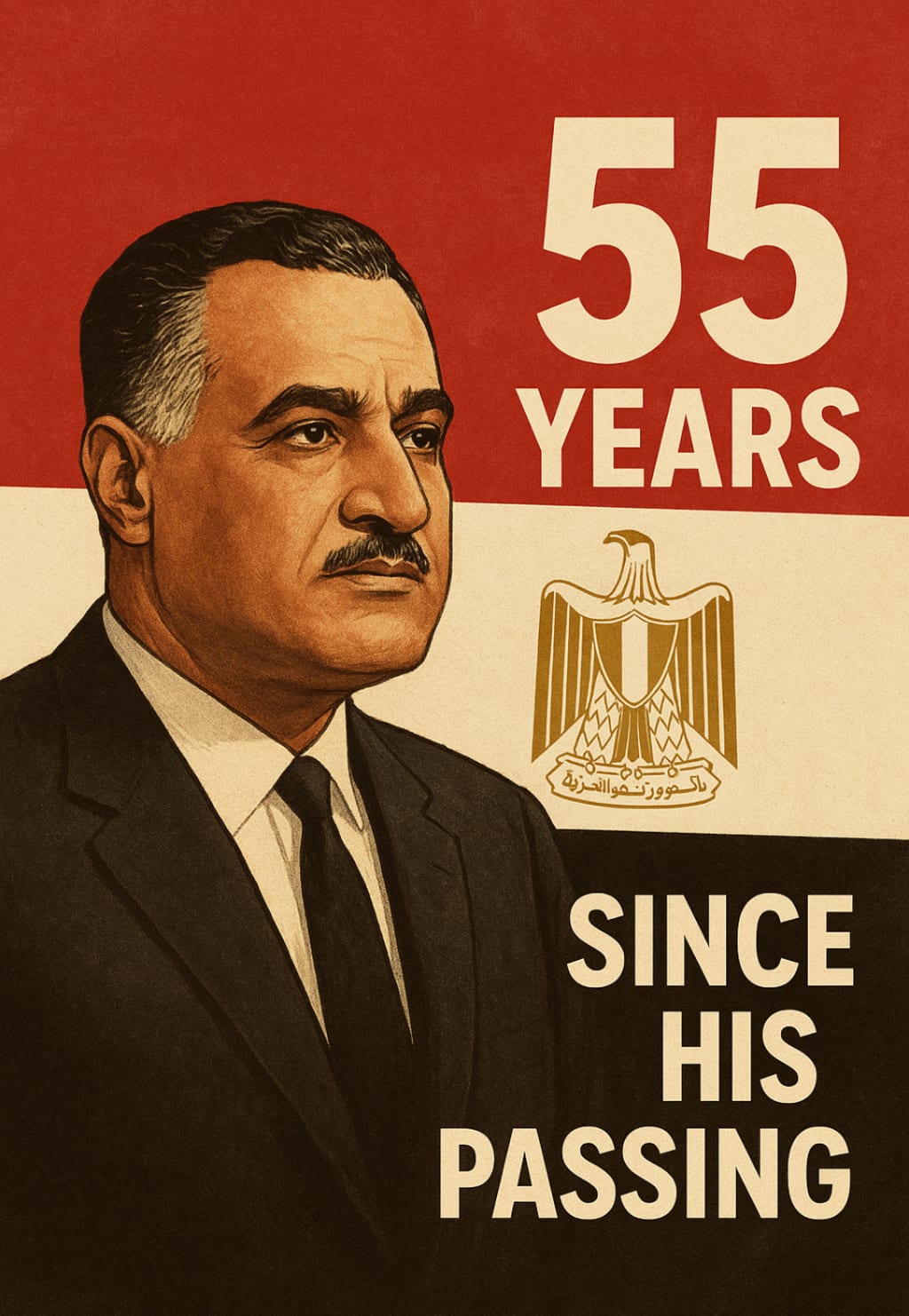
On September 28, 1970, Egypt lost one of its most influential leaders, President Gamal Abdel Nasser. His passing shocked the Arab world and left millions mourning in the streets of Cairo. Yet, more than five decades later, Nasser’s legacy continues to shape Egypt’s modern history and identity. His role in strengthening national independence, building vital institutions, and inspiring an entire generation of Egyptians and Arabs remains undeniable.
Champion of National Independence
Nasser rose to prominence in the aftermath of the 1952 Revolution, which ended the monarchy and set Egypt on the path toward republican governance. He believed strongly in the idea of complete sovereignty for Egypt, free from the control of colonial powers. One of his earliest and most defining acts was the nationalization of the Suez Canal in 1956. This bold decision challenged British, French, and Israeli interests and immediately placed Egypt at the center of global politics. The Suez Crisis that followed demonstrated both the risks of asserting independence and the resilience of a nation determined to control its own resources.
For Nasser, independence was not simply about borders; it was about making sovereign decisions free from external interference. This principle influenced Egypt’s foreign policy, as he sought alliances within the Non-Aligned Movement, promoting solidarity among nations that resisted being drawn into Cold War rivalries.
Building the Foundations of Modern Egypt
Nasser’s leadership was also defined by his ambitious domestic projects. Among them, the construction of the Aswan High Dam stands as a symbol of Egyptian determination to master its own future. Completed with the assistance of the Soviet Union, the dam transformed Egypt’s economy and agriculture. It allowed for year-round irrigation, helped control flooding, and generated massive amounts of hydroelectric power. Though the project was not without challenges, it represented the culmination of Nasser’s vision: harnessing Egypt’s natural resources for national development and independence.
Education was another cornerstone of Nasser’s project. During his presidency, the number of universities expanded significantly, giving opportunities for higher education to millions of Egyptians who would otherwise have been excluded. This expansion created a new generation of professionals, engineers, and scientists, all of whom contributed to Egypt’s modernization.
Industry also became a focus under Nasser. He pushed for rapid industrialization, building factories across the country in sectors ranging from textiles to steel production. The aim was clear: Egypt needed to reduce its reliance on imported goods and create jobs for its people. By establishing factories and promoting industrial growth, Nasser laid the groundwork for a more self-sufficient national economy.
The Intelligence Services and National Security
Nasser also recognized the strategic importance of building strong state institutions capable of defending Egypt’s sovereignty. Central to this was the development of the Egyptian intelligence services. Under his leadership, Egypt’s intelligence community became one of the most effective in the Middle East. It was tasked not only with protecting Egypt from external threats but also with supporting liberation movements across Africa and the Arab world.
The intelligence services became a tool of both defense and diplomacy. Through them, Egypt could monitor regional developments, counter espionage, and promote its own vision of Arab nationalism. This was particularly critical in the context of repeated confrontations with Israel, including the wars of 1956 and 1967. Despite the setbacks of the latter, Nasser’s emphasis on intelligence laid the groundwork for the eventual reorganization and strengthening of Egypt’s security apparatus in the years that followed.
A Symbol of Arab Nationalism
Beyond Egypt, Nasser became a symbol of Arab dignity and unity. His speeches resonated across the region, calling for solidarity among Arab nations against colonialism and foreign domination. While his pan-Arab vision faced challenges and contradictions, it nonetheless inspired millions who longed for independence and self-determination.
A Complex but Enduring Legacy
Gamal Abdel Nasser’s legacy is complex. His rule was marked by authoritarian measures, limitations on political freedoms, and controversial economic policies. Yet, it is equally true that his leadership gave Egyptians a renewed sense of pride and ownership over their national destiny. By building institutions such as the Aswan High Dam, expanding universities, and strengthening Egypt’s intelligence services, Nasser sought to create a country that could stand on its own feet.
Today, as Egypt reflects on the anniversary of his death, Nasser is remembered as a leader who placed independence at the heart of national policy. He believed that only by controlling its own resources, defending its sovereignty, and educating its people could Egypt truly rise. While his methods and policies remain debated, his vision of a strong, independent Egypt continues to inspire generations.
On this solemn anniversary, Gamal Abdel Nasser is remembered not just as a man, but as a symbol of resilience, ambition, and the enduring struggle for dignity and independence.
About the Creator
Mohamed Nabil Elmasry
Published author , political scientist, behavioral economist, plan based diet advocate , self help trainer , marketing consultant, nationalist , father and Egyptian entrepreneur.
Keep reading
More stories from Mohamed Nabil Elmasry and writers in History and other communities.
Seven Dials
Introduction Seven Dials is a famous and historic area located in London, England. It is found near Covent Garden, one of the busiest and most popular parts of the city. Seven Dials is known for its unique road design, rich history, old buildings, shops, cafés, and lively atmosphere. Today, it is a popular place for tourists and local people who enjoy culture, shopping, and history.
By Farhan Sayed2 days ago in History
Julius Caesar: The Rise and Fall of a Legend
The Rise and Fall of Julius Caesar In the first century BCE, the Roman Republic stood as one of the most powerful states in the ancient world. Its armies conquered vast territories, its laws shaped civilizations, and its Senate governed through a delicate balance of tradition and authority. Into this complex political world was born Gaius Julius Caesar in 100 BCE—a man whose ambition, brilliance, and fate would forever change Roman history.
By The best writer 7 days ago in History




Comments
There are no comments for this story
Be the first to respond and start the conversation.