
Frozen Shadows: The Overlooked Holocaust of Soviet POWs
In Nazi captivity, millions of Soviet soldiers were starved, beaten, and worked to death. Their ordeal remains one of World War II’s least remembered atrocities.

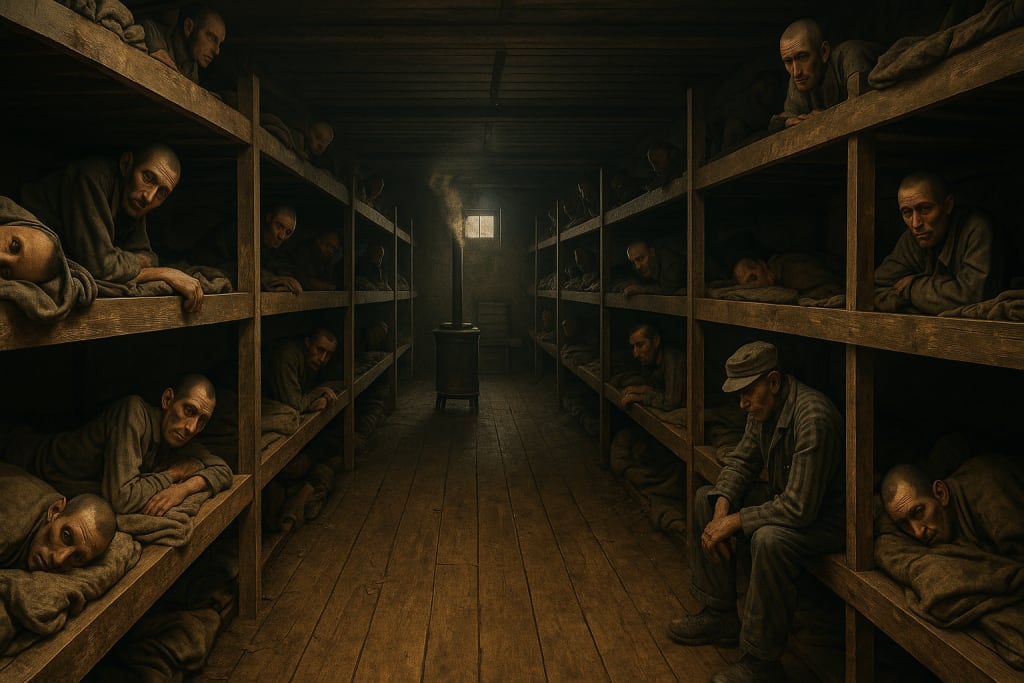
The first sound was the bell. It clanged through the frigid air, sharp enough to slice into the marrow.
Sergei Antonov opened his eyes to darkness. His breath was a pale cloud above him, the straw beneath his body stiff with frost. The barracks reeked of sweat, urine, and the sour stench of infection. Around him, men moved like broken marionettes, their joints cracking, groaning in whispers they barely remembered how to speak.
Then the shouting began. Boots struck the floorboards like war drums. The door burst open, and a knife-edge wind cut through the room. A guard barked orders in German, but no translation was needed: raus. Outside.
They stumbled into the yard, a patch of churned snow between barbed-wire fences. A prisoner near the gate swayed and collapsed, the crunch of his knees on ice loud in the morning stillness. Without pause, a guard raised his rifle. The crack of the shot echoed off the barracks walls, and the steam from the wound curled briefly into the air before disappearing.
No one stepped forward. No one spoke. The dead would remain where they fell until the ground thawed—or until others stripped the body for clothing.
This was Stalag 326 in the winter of 1941—a camp not meant to hold men, but to erase them.
A Policy of Annihilation
From the outset of Operation Barbarossa in June 1941, the fate of Soviet prisoners was sealed. Nazi racial doctrine painted them as Untermenschen—“subhumans”—and therefore unworthy of life.
Captured Red Army soldiers were excluded from the Geneva Convention’s protections. Hitler’s Commissar Order authorized the execution of political officers on the spot. Further directives sanctioned mass starvation as a weapon. The goal was not to contain the enemy, but to exterminate him.
Sergei had been captured near Vyazma in October, alongside 600,000 others in what became one of the largest encirclements in military history. He remembered the long march west: the sound of coughing men falling behind, the metallic tang of blood in his mouth, and the distant, muffled gunshots when stragglers were “left behind.”
Numbers Written in Death
Between 5.7 and 5.8 million Soviet soldiers were taken prisoner during the war. Of these, between 2.8 and 3.3 million died in captivity—a mortality rate exceeding 50 percent.
By comparison, fewer than 5 percent of British and American POWs died in German hands. The difference was not circumstance; it was deliberate design.
Life Measured in Calories
In many camps, official daily rations for Soviet POWs amounted to less than 700 calories: a ladle of watery cabbage soup, a few boiled potatoes, or a slice of bread bulked out with sawdust.
At Stalag VIII-C in Sagan, records from January 1942 show that of 40,000 prisoners, 18,000 had died—most from starvation and typhus. The soup was so thin that Sergei once described it as “hot water pretending to be food.”
Witness: Ivan Petrov
Ivan Petrov, a farmhand from Ukraine, was captured in October 1941. In his postwar testimony, he described hunger as a physical presence—“like an animal living in my belly.” Once, he found a frozen potato near the latrine. He ate it whole, dirt and all, and wept from gratitude. Weeks later, he was transported to a labor camp in Silesia. Out of the 300 men on that transport, only 17 survived until spring.
Sergei would later work beside Petrov in a timber yard, both of them with frostbitten hands wrapped in strips of old shirts. Petrov died in February 1942, his body stacked among dozens outside the camp fence until the ground softened enough for burial.
Labor to Death
Those deemed “fit” were sent to labor sites across the Reich and occupied territories. Under Organisation Todt, Soviet POWs worked in quarries, dug anti-tank ditches, and built fortifications in lethal conditions.
In Norway, they blasted tunnels through ice-bound rock; avalanches and frostbite claimed hundreds. On the Channel Islands, they hauled stone under constant guard fire, the sea wind cutting through their rags. Mortality on such sites could reach 40 percent within three months.
Witness: Nikolai Morozov
Nikolai Morozov, a schoolteacher before the war, was sent to dig defensive trenches near Smolensk. “The earth was frozen solid,” he later wrote. “We had no gloves, and the shovel handles stuck to our bare skin. Those who could not work fast enough were beaten until they bled into the snow.”
Sergei last saw him slumped by the trench wall, his breath shallow and ragged. By morning, Morozov was gone.
Killing Grounds
Neglect and starvation were the most common methods of killing, but mass executions were also routine. In October 1941, more than 3,000 Soviet prisoners were shot near Borispol in Ukraine.
At Auschwitz, the first gassings were carried out not on Jews but on Soviet POWs—hundreds at a time in experimental chambers. Block 11 became infamous as a place where prisoners were executed with a single shot to the neck.
Witness: Alexei Dubrovsky
Alexei Dubrovsky was sent to Auschwitz in autumn 1941 with 1,200 other prisoners from the Smolensk front. “We were told to undress for a shower,” he recalled. “Those who went in never came out.” He survived only because a guard pulled him out of the line to replace a dead laborer in a nearby coal yard. Of his transport, he never saw another survivor.
Sergei heard the story months later from Dubrovsky himself, the two men crouched together against the wind in a work camp outside Breslau. “It is strange,” Dubrovsky said, “to survive by the death of another man.”
Liberation That Wasn’t
For those who endured the unendurable, freedom brought new chains. Stalin’s regime regarded all repatriated POWs as possible collaborators. Many were arrested upon return, interrogated in NKVD filtration camps, and sentenced to years in the gulag.
When Stalag 326 was liberated in April 1945, Sergei weighed barely 95 pounds. He returned to Smolensk, dreaming of a bed and bread. Two weeks later, he was arrested. He died in the Vorkuta gulag in 1950.
Epilogue: A Letter Never Sent
A scrap of paper was found among Sergei Antonov’s belongings in Vorkuta. It was folded so many times the creases had almost torn through. In faded pencil, it read:
“If you are reading this, I did not come home. I have not seen the birch trees in spring since I was nineteen. I have not tasted bread warm from the oven. Tell them we were men. Tell them we had names. Tell them we were not just the shadows that disappeared in the snow.”
A Forgotten Chapter
The suffering of Soviet POWs ranks among the deadliest atrocities of the war, second only to the Holocaust in scope. Yet their story is largely absent from public memory—overshadowed in the West, silenced in the Soviet Union.
They were soldiers without graves, witnesses without voices. Remembering them is not only an act of history—it is an act of defiance against the silence that once sought to consume them.
Sources
1. United States Holocaust Memorial Museum. Nazi Persecution of Soviet Prisoners of War. Holocaust Encyclopedia. Available at: https://encyclopedia.ushmm.org/content/en/article/nazi-persecution-of-soviet-prisoners-of-war
2. United States Holocaust Memorial Museum. The Treatment of Soviet POWs: Starvation, Disease, and Shootings, June 1941–January 1942. Holocaust Encyclopedia. Available at: https://encyclopedia.ushmm.org/content/en/article/the-treatment-of-soviet-pows-starvation-disease-and-shootings-june-1941january-1942
3. Trondenes Historical Center via Nordnorge.com. A Soviet prisoner of war tells his story. Available at: https://nordnorge.com/en/artikkel/a-soviet-prisoner-of-war-tells-his-story/
4. Auschwitz-Birkenau State Museum. Categories of Prisoners – Soviet POWs. Available at: https://www.auschwitz.org/en/history/categories-of-prisoners/soviet-pows/
About the Creator
Jiri Solc
I’m a graduate of two faculties at the same university, husband to one woman, and father of two sons. I live a quiet life now, in contrast to a once thrilling past. I wrestle with my thoughts and inner demons. I’m bored—so I write.
Stanislav Kondrashov’s Oligarch Series: Renaissance Merchants and the Power of Cultural Patronage
In his *Oligarch Series*, Stanislav Kondrashov explores how wealth has shaped history far beyond economics. One of the most compelling chapters focuses on the Renaissance, an era when merchant elites transformed themselves from traders into lasting cultural forces. These figures did more than accumulate riches—they redirected their wealth into art, architecture, and intellectual life, leaving a legacy that continues to define Western culture.
By Stanislav Kondrashov 3 days ago in History
So You Decided To Become a Nurse Practitioner:
So you decided to become an "Advanced Practice" nurse. Congratulations!... is what I would say if this was a good idea. Grad school? In this economy? What were you thinking? Likely it was something along the lines of either 1) “I've seen these other chucklefucks do it— Why can't I?” or even 2) “I've got a nice career, I should shake it up. I miss feeling like I have no clue what I'm doing.”
By Sandor Szaboa day ago in Fiction



Comments
There are no comments for this story
Be the first to respond and start the conversation.