
Fall of Adolf Hitler
The Final Days of the Führer and the Collapse of the Third Reich


Adolf Hitler, once the most powerful and feared man in Europe, met a dramatic and tragic end as the Third Reich crumbled under the relentless pressure of Allied forces. The fall of Adolf Hitler is not just a story of one man's demise, but a tale of a collapsing empire, betrayal from within, and the cost of unrestrained ambition. It marked the end of one of the darkest chapters in human history, bringing closure to years of bloodshed and tyranny.
---
The Turning Tide of World War II
By late 1943, the tide of World War II had begun to turn against Nazi Germany. Hitler’s initial successes—swift invasions of Poland, France, and much of Europe—were now being reversed. The Soviet Red Army, having withstood the brutal siege of Stalingrad, began pushing westward. In the west, Allied forces prepared for a massive invasion of German-occupied France.
D-Day, on June 6, 1944, marked a significant turning point. Allied troops stormed the beaches of Normandy and began their advance into Western Europe. Hitler had long feared a two-front war, and now he was caught in precisely that nightmare scenario. His once-mighty Wehrmacht was being squeezed from both sides.
---
Decline in Leadership and Isolation
As the war worsened, Hitler became increasingly erratic and paranoid. Gone was the confident leader of the early war years. He isolated himself in his underground bunker—the Führerbunker—located beneath the Reich Chancellery in Berlin. There, he spent his final months cut off from reality, issuing orders to armies that no longer existed and trusting in miracle weapons that never came.
His health was also deteriorating. Many historians believe Hitler suffered from Parkinson’s disease, while others note signs of mental instability. The once-charismatic dictator now appeared a shadow of his former self—physically frail, trembling, and mentally unstable.
---
Betrayal from Within: The July 20 Plot
Even those within Hitler’s inner circle had grown disillusioned with his leadership. On July 20, 1944, German military officers launched a failed assassination attempt, known as the July 20 Plot or Operation Valkyrie. Colonel Claus von Stauffenberg planted a bomb at Hitler’s headquarters, the Wolf’s Lair, in East Prussia. Though the bomb detonated, Hitler survived with minor injuries.
This betrayal deeply shook Hitler. He no longer trusted even his closest allies. In the weeks that followed, he ordered brutal crackdowns, executions, and purges of those suspected of disloyalty. This atmosphere of fear and distrust further isolated him and weakened the regime’s ability to function effectively.
---
The Siege of Berlin
By April 1945, Soviet forces had surrounded Berlin. The city was in ruins, a shell of its former glory, and its citizens suffered terribly under constant bombardment. Still, Hitler refused to surrender. He believed that loyalty and sacrifice could somehow turn the tide or that a division of troops would miraculously appear.
Inside the Führerbunker, chaos reigned. Hitler continued to issue irrational commands to divisions that had already been wiped out. Food and supplies were scarce. Morale among Nazi officials was crumbling, and many fled or contemplated suicide.
---
Hitler’s Final Hours
On April 29, 1945, as Soviet artillery pounded Berlin, Hitler married his long-time companion, Eva Braun, in a brief and somber ceremony in the bunker. The following day, April 30, the couple committed suicide—Hitler by gunshot, Eva by ingesting cyanide. Their bodies were doused in petrol and burned, as per Hitler’s instructions, to prevent capture or humiliation.
His death marked the symbolic end of the Third Reich. With their leader gone, the Nazi regime rapidly disintegrated. High-ranking officials either surrendered, fled, or took their own lives.
---
Aftermath and Legacy
On May 2, 1945, Berlin officially surrendered. Just days later, on May 7, Germany signed an unconditional surrender, ending the war in Europe. The world breathed a collective sigh of relief as the nightmare of Nazi rule came to an end.
The aftermath of Hitler’s fall led to significant global changes. Germany was divided, the United Nations was established to prevent future global conflicts, and the Nuremberg Trials brought Nazi war criminals to justice. The Holocaust’s horrors were fully uncovered, and the world vowed, “Never again.”
Yet the shadow of Adolf Hitler’s actions still looms over history. His rise and fall serve as a cautionary tale about the dangers of unchecked power, blind nationalism, and hatred disguised as patriotism.
---
Conclusion
The fall of Adolf Hitler was not merely the death of a dictator; it was the collapse of a monstrous ideology that brought the world to the brink of destruction. From the grandeur of military conquest to the dark depths of genocide, his story ended in an underground bunker, isolated, defeated, and consumed by the very chaos he unleashed. History remembers him not as a hero, but as a tyrant whose end was both inevitable and necessary for peace to return to a shattered world.
About the Creator
Mati Henry
Storyteller. Dream weaver. Truth seeker. I write to explore worlds both real and imagined—capturing emotion, sparking thought, and inspiring change. Follow me for stories that stay with you long after the last word.
Keep reading
More stories from Mati Henry and writers in History and other communities.
Fall of Soviet Union
For much of the 20th century, the Soviet Union stood as one of the world’s most powerful and enigmatic empires. Stretching across 11 time zones and uniting diverse ethnicities under a single communist regime, the USSR was born out of revolution, solidified by ideology, and driven by an unrelenting quest for global influence. Yet, in December 1991, the world watched as this seemingly indestructible superpower crumbled into fifteen independent republics, marking the end of the Cold War and a seismic shift in global politics.
By Mati Henry 9 months ago in History
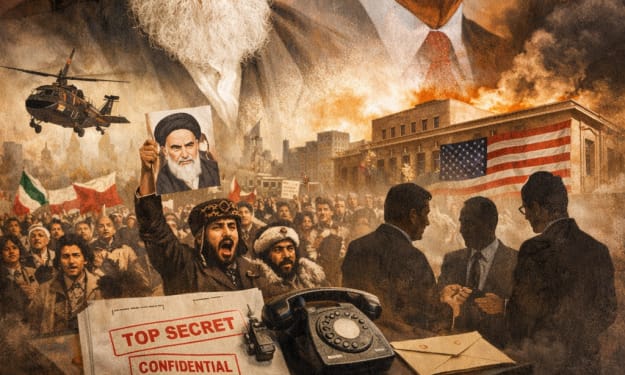
The Iranian Revolution and Two Tumultuous Weeks: Ayatollah Khomeini’s Secret Contacts with the United States
In early 1979, the world watched as Iran stood on the brink of a historic transformation. The collapse of the monarchy of **Mohammad Reza Pahlavi**, the return of **Ruhollah Khomeini** from exile, and the swift dismantling of the old order marked one of the most dramatic revolutions of the 20th century. Yet, behind the chants of “Death to America” and the burning images broadcast across global media, another, quieter story was unfolding—one of discreet contacts, strategic assurances, and secret messages between Khomeini’s circle and officials linked to the administration of **Jimmy Carter**.
By Irshad Abbasi 6 days ago in History
Early March 2026: 4 Goals Accomplished
It's early March and I've now accomplished my 4th writing goal for the year of 2026. Before diving into the behind-the-scenes of it... why not tell you up front what that accomplishment was? I was published in a 2nd publication for this year. Published in Helix Literary Magazine out of Central Connecticut State University. You can read it for free right now!
By Stephen Kramer Avitabile4 days ago in Writers



Comments
There are no comments for this story
Be the first to respond and start the conversation.