
FAKE AND REAL ABOUT DINOSAURS.
Misconceptions About Dinosaurs
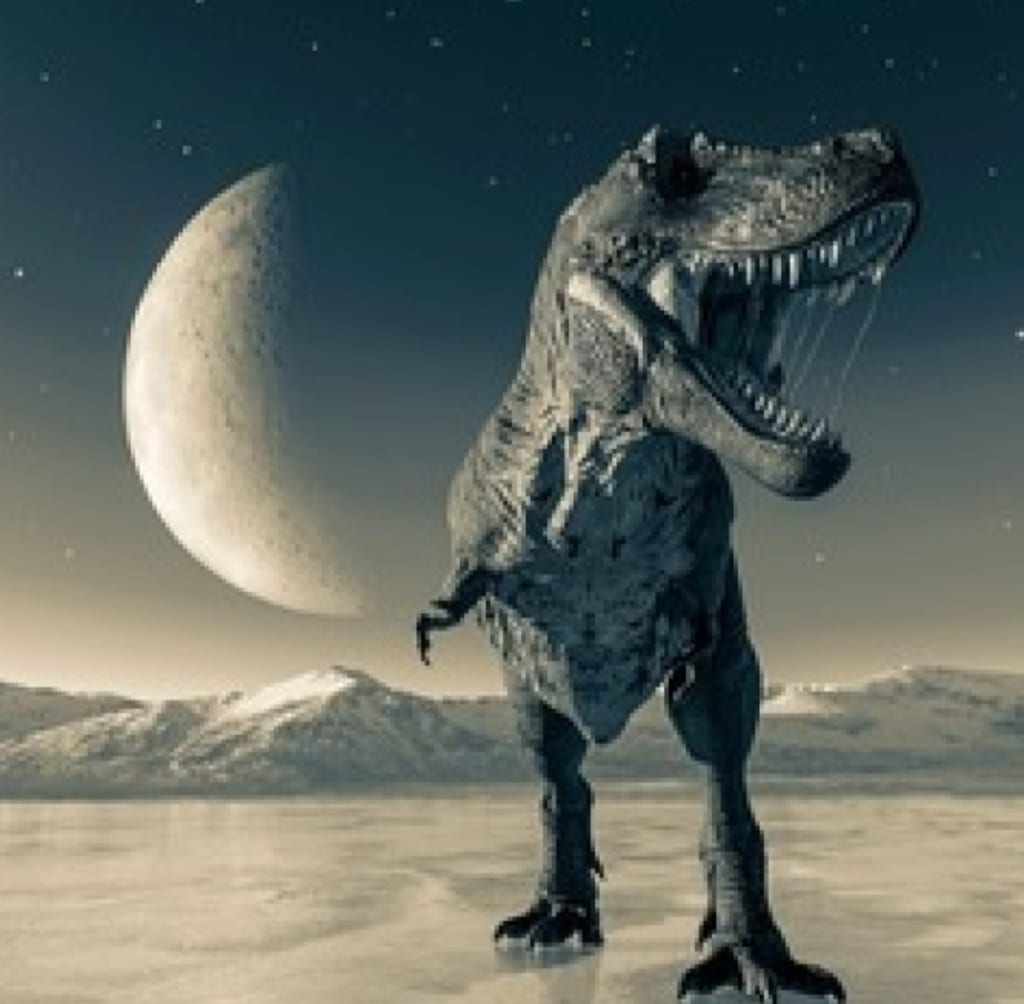
You might have heard that all dinosaurs disappeared 65 million years ago when a huge 15-kilometer-wide asteroid crashed into Earth and caused a mass extinction event. But that's not entirely true.
There was one group of dinosaurs called theropods that managed to survive. They were unique because they had feathers and hollow bones, and most of them could fly. This allowed them to rise above the blast and survive the aftermath. Now, many scientists believe that these theropod dinosaurs evolved into birds, so technically, dinosaurs are still alive and with us today.
But that's not the only thing you might have been misinformed about when it comes to dinosaurs. From non-existent species to the T-Rex's eyesight, there are many myths and misconceptions about the Mesozoic Era.
One of the craziest myths is that all dinosaurs were green and scaly monsters. In fact, many of them likely had feathers. Feathers served various purposes, from providing warmth to helping some flying dinosaurs stay airborne. Furthermore, dinosaurs came in a variety of colors, with some fossils preserving pigments that suggest they were not all brown, black, or green. They may have exhibited vibrant colors and even specific camouflage patterns depending on their environments.
Dinosaurs also had different textures to their skin; they weren't all scaly and slimy. Various dinosaur species would have had varying skin textures.
When you think of dinosaurs, you probably envision massive creatures like the T-Rex, which was about 12 meters long, or the tall, long-necked Brachiosaurus that stood up to 13 meters tall. However, not all dinosaurs were giants. Many of them were quite small, some even the size of modern-day birds.
For instance, the microraptor was a tiny dinosaur about the size of a crow, and it had wings and feathers, making it resemble a bird.
Dinosaurs are often portrayed as slow-moving, cold-blooded reptiles, but recent discoveries suggest this isn't entirely accurate. While some dinosaurs might have been cold-blooded, others were warm-blooded, and some had a metabolic system known as mesothermic, which falls in between cold and warm-blooded. This allows them to generate some internal heat, although not as much as warm-blooded animals.
The Brontosaurus, one of the most iconic dinosaurs, almost didn't exist in scientific classification. It was mistakenly identified as the Apatosaurus in the 19th century. It took until 2015, after extensive research, for the Brontosaurus to be recognized as its own distinct dinosaur.
Contrary to what movies like Jurassic Park depict, the T-Rex didn't have poor vision. In fact, it had binocular vision, allowing it to easily judge distances and see objects in three dimensions. Its eyesight might have been even better than that of modern-day birds due to its large optic nerves.
Dinosaurs didn't all live together simultaneously. The Mesozoic Era spanned over 180 million years and had three distinct periods: Triassic, Jurassic, and Cretaceous. Different dinosaur species were unique to these specific eras, evolving and going extinct over time. Some iconic dinosaurs like the stegosaurus and T-Rex never coexisted; they lived in entirely different time periods.
The posture of the T-Rex is often depicted as upright in movies, but recent research suggests it had a more horizontal posture, with its tail held up off the ground and its body balanced over its hips. The upright stance seen in movies would have been unstable and impractical for the dinosaur.
When fossils are unearthed, the "shrink wrap" method, which tightly draws skin and features against the skeleton, is often used to depict how dinosaurs looked. However, this method is considered outdated as it doesn't account for muscles, fat, or soft tissues. Paleontologists now consider muscle attachments and comparisons with modern animals to create more realistic depictions of dinosaurs.
While paleontologists have identified over 1,000 different dinosaur species, many more remain undiscovered. Fossilization is a rare process, and it depends on the environment whether a species gets preserved as a fossil. On average, about 50 new dinosaur species are discovered each year.
We don't know exactly what dinosaurs sounded like. Fossilization rarely preserves soft tissues like vocal cords, making it challenging to determine their sounds. However, scientists speculate that dinosaurs sounded more like birds and crocodiles since these are the closest living relatives of dinosaurs. Models based on fossilized skulls suggest that they might have produced low-frequency rumbles or bird-like calls.
As for cloning dinosaurs like in Jurassic Park, it's highly unlikely. DNA degrades over time, making it nearly impossible to find intact dinosaur DNA. Even if preserved in amber, DNA cannot survive for tens of millions of years. So, while it's a cool idea, creating our own Jurassic Park is just a fantasy.
The Mesozoic period was indeed an incredible time in Earth's history, spanning over 180 million years, and we continue to learn more about it every day. However, what happened immediately after the dinosaurs went extinct is a story for another time.
About the Creator
Keep reading
More stories from writers in History and other communities.
The Forgotten Flavors: How Ancient Recipes Could Change the Future of Food
Introduction: A Taste of What We’ve Lost Today, food is everywhere—globalized, homogenized, and, in the great majority of cases, severed from its place of origin. A hamburger consumed in New York has virtually the same taste as one consumed in Tokyo or Dubai. Pasta comes in a thousand variations, but the sauces follow the well-known: tomato, cream, or cheese. Supermarkets carry an incredible variety, but all are produced from the same limited list of international commodities: wheat, corn, soy, rice, sugar.
By The Chaos Cabinet2 days ago in History
Which Pastoral Dresses Are a Must-Have for Every Minister?
When it comes to leading a congregation, appearance matters as much as heart and spirit. Every minister needs clothing that reflects grace, professionalism, and faith. Pastoral dresses are a perfect choice for women ministers, offering elegance and comfort. In this guide, we’ll explore which styles are essential for any minister and why having the right women’s clerical wear can make a big difference.
By Sameera eclergys5 days ago in History




Comments
There are no comments for this story
Be the first to respond and start the conversation.