
Exploring Ancient Historical Landmarks
Unveiling the Timeless Stories of Human Civilization

INTRODUCTION
Since the dawn of human civilization, societies across the world have left behind incredible structures, monuments, and ruins that stand as witnesses to their existence. These ancient historical landmarks are not just physical remnants of the past; they are cultural testaments to human creativity, resilience, and ingenuity. From sacred temples and royal palaces to entire lost cities hidden beneath jungles, these landmarks allow us to journey into the lives, beliefs, and achievements of our ancestors. Exploring them is not merely about looking at old stones—it is about uncovering the timeless stories of humanity’s shared past.
The Role of Landmarks in Ancient Civilizations
Every ancient landmark had a purpose. Some were built for religious and spiritual practices, such as temples and shrines, where people sought blessings from their gods. Others served as political or administrative centers, reflecting the power of rulers and empires. Many also acted as defensive fortresses or trading hubs that connected different cultures.
The significance of these landmarks goes beyond architecture. They reveal the technological advancements of their times. For example, the precision of the Pyramids of Giza shows the Egyptians’ knowledge of mathematics and astronomy, while the aqueducts of Rome display their advanced engineering skills. Each structure embodies both cultural values and technological mastery.
Iconic Ancient Landmarks of the World
1. The Pyramids of Giza, Egypt
Perhaps the most recognized ancient landmark in the world, the Great Pyramid of Giza is the last surviving wonder of the original Seven Wonders of the World. Built around 4,500 years ago, these pyramids served as monumental tombs for pharaohs. The sheer scale and mathematical precision still puzzle scholars today. They stand as symbols of the Egyptians’ belief in the afterlife and their exceptional architectural genius.
2. Stonehenge, England
Located on Salisbury Plain, Stonehenge remains one of history’s greatest mysteries. This circle of massive standing stones, dating back over 4,000 years, has long been associated with astronomical observations, rituals, and burial practices. Its alignment with the summer solstice sunrise suggests that it may have functioned as an ancient calendar or spiritual site.
3. Machu Picchu, Peru
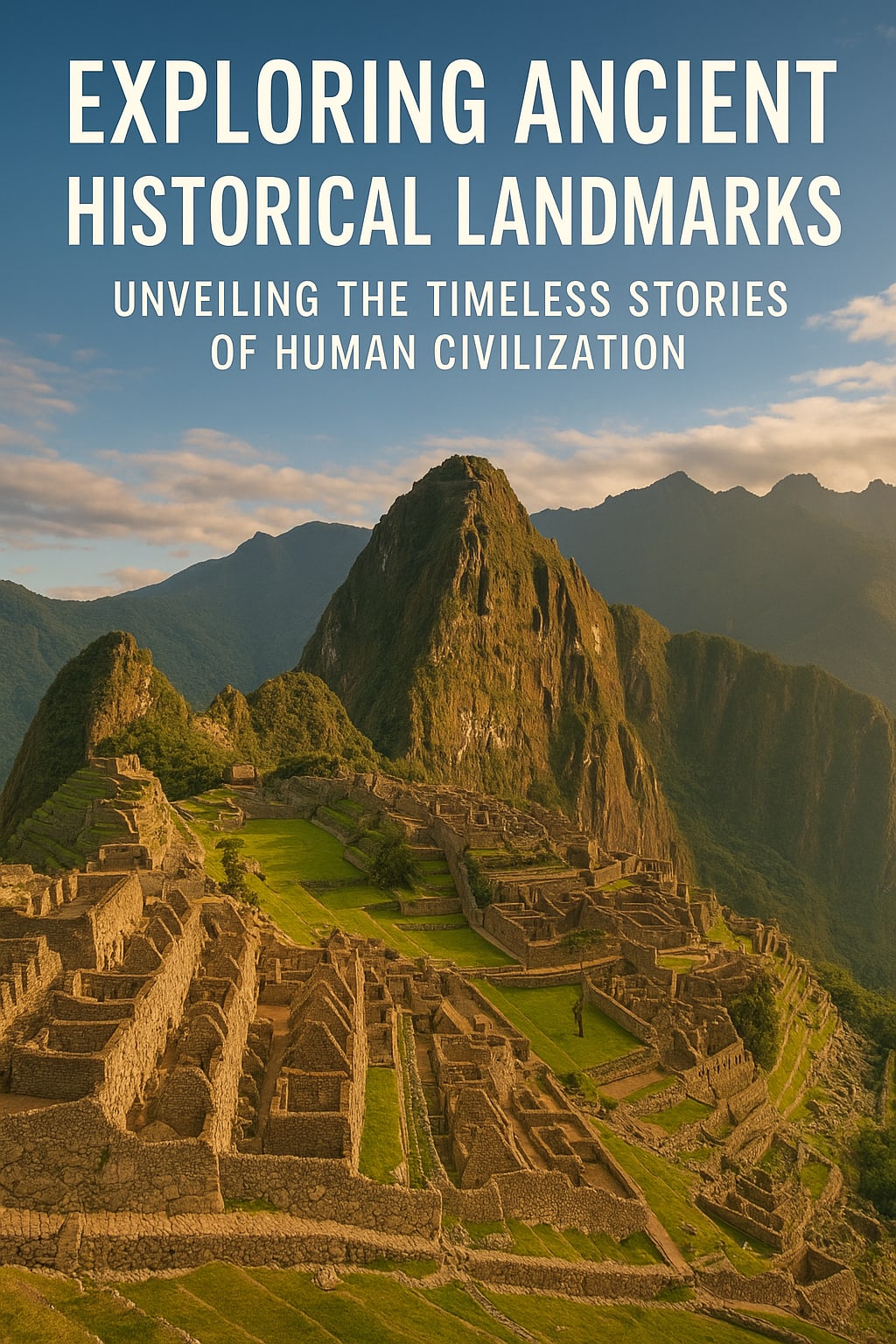
Hidden high in the Andes Mountains, Machu Picchu is the jewel of the Inca civilization. Built in the 15th century, it served as a royal estate or religious retreat for Incan rulers. The site is a masterpiece of stonework, with terraces and temples harmoniously blending into the surrounding landscape. Its mysterious abandonment continues to intrigue archaeologists.
4. The Great Wall of China
Stretching thousands of miles, the Great Wall was not a single continuous wall but a collection of fortifications built over centuries to protect China from invasions. Beyond its military role, the wall also controlled trade along the Silk Road, symbolizing China’s unity and resilience.
5. Petra, Jordan
Nicknamed the “Rose-Red City,” Petra was the capital of the Nabataean kingdom. Its rock-cut architecture and advanced water systems reflect both artistic creativity and survival skills in a desert environment. Petra’s famous Treasury and Monastery continue to inspire awe with their intricate carvings.
6. Angkor Wat, Cambodia
Built in the 12th century, Angkor Wat is the largest religious monument in the world. Originally dedicated to the Hindu god Vishnu, it later became a Buddhist temple. Its grand scale and detailed carvings tell stories of mythology, devotion, and cultural transformation in Southeast Asia.
The Cultural Significance of Ancient Landmarks
Ancient landmarks are not just silent ruins; they carry cultural identity and memory. They connect modern generations with their ancestors, reminding us of shared traditions, values, and achievements. For example, the Acropolis in Athens is more than a group of ancient temples—it is a symbol of democracy, philosophy, and artistic excellence that shaped Western civilization.
Furthermore, these sites often influence literature, art, and modern architecture. The Roman Colosseum inspired modern stadium designs, while Mayan pyramids influence contemporary art and tourism. Preserving these landmarks ensures that their cultural impact continues to guide and inspire future generations.
Challenges of Preservation
Sadly, many ancient landmarks face threats from natural disasters, climate change, and human activity. Earthquakes, floods, and erosion can destroy centuries of history in seconds. Human threats—such as looting, urban expansion, and conflict—are equally devastating. For instance, wars in the Middle East have endangered precious sites like Palmyra in Syria.
Tourism, though vital for awareness and economic growth, can also harm these fragile sites if not managed responsibly. Overcrowding, pollution, and vandalism pose serious risks. This is why organizations like UNESCO work tirelessly to designate World Heritage Sites and ensure their preservation.
About the Creator
Nizam Archaeologist
I’m deeply fascinated by archaeology and the mysteries of ancient civilizations.My goal is to bring the past to life, spark curiosity, and share the wisdom of cultures that have stood the test of time.
Keep reading
More stories from Nizam Archaeologist and writers in History and other communities.
The World of Ancient History
1. Foundations of Civilization Mesopotamia: The Cradle of Written History Mesopotamia, nestled between the Tigris and Euphrates rivers, stands as the birthplace of urban society. The Sumerians pioneered cuneiform writing around 3100 BC—revolutionizing record-keeping, communication, and cultural continuity. The Code of Hammurabi, one of humanity's earliest law codes, introduced foundational legal principles still recognizable in modern jurisprudenc. Additionally, the Mesopotamians’ developments in mathematics and astronomy—a base-60 system and early calendars—continue to underlie our timekeeping and geometry.
By Nizam Archaeologist5 months ago in History
3 Everyday Rules That Exist Because Someone Once Did Something Very Stupid
Everywhere you go, you are surrounded by rules that feel oddly specific. Do not touch. No running. Contents hot. Do not insert body parts. These warnings aren’t theoretical. They weren’t written by pessimists or lawyers with too much free time. They exist because at some point in history, a real human being looked at a situation and thought, “This will probably be fine.”
By Enoch Saginia day ago in History
Nanchang: A Modern Symbol of China’s Naval Power
In recent years, the world has closely watched the rapid modernization of the Chinese People’s Liberation Army Navy (PLA Navy). One of the most important symbols of this transformation is the Nanchang (Hull 101), China’s first Type 055 guided-missile destroyer. Commissioned on 12 January 2020, Nanchang represents a major leap in naval technology and capability. As it completes six years of active service, the ship stands as a clear example of how China’s navy has moved into a new era of advanced maritime power.
By sehzeen fatima3 days ago in History



Comments
There are no comments for this story
Be the first to respond and start the conversation.