
Enduring Legacy of the Great Wall
Ancient fortification symbolizing China’s strength, unity, and resilience forever.
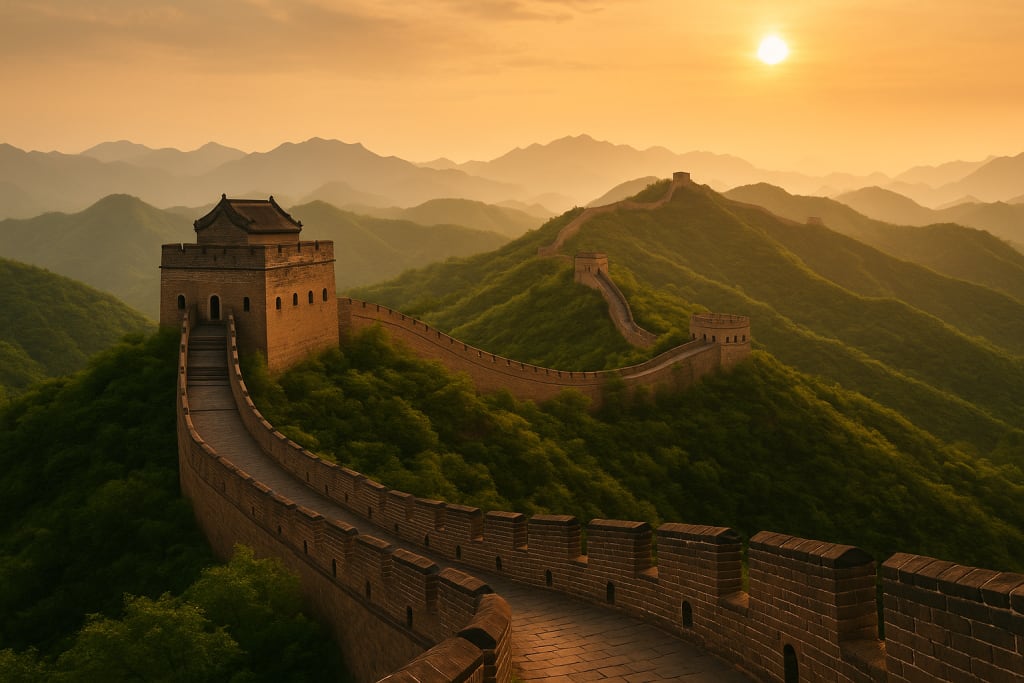
The Great Wall of China: A Monument of Endurance and Empire
The Great Wall of China, one of the most iconic landmarks in the world, winds across northern China like a stone dragon, stretching over 13,000 miles. The image you see—a majestic section of the Wall snaking over green hills beneath a golden sky—represents not just architectural achievement, but a profound testament to China's ancient civilizations, military strategy, cultural identity, and resilience.
Origins in Antiquity
The origins of the Great Wall date back over 2,000 years. Long before the construction of the wall as we know it today, various smaller walls were built by individual states during the Warring States period (475–221 BCE). These early fortifications were designed to defend against nomadic tribes and rival states. It wasn’t until the unification of China under the Qin Dynasty (221–206 BCE) that Emperor Qin Shi Huang ordered the consolidation and expansion of these fragmented walls into a unified defense system.
Constructed with tamped earth, wood, and local materials, this early wall spanned roughly 3,000 miles and aimed to protect the newly unified China from northern incursions—particularly from the Xiongnu, fierce nomadic warriors of the Mongolian steppes.
Han Dynasty and Further Expansion
The Han Dynasty (206 BCE – 220 CE) extended the Great Wall even further to protect the vital Silk Road trade routes. Under Emperor Wu, the wall was reinforced with watchtowers, garrisons, and beacons that enabled communication across vast distances using smoke signals by day and fire by night.
This era saw not just military expansion but the integration of frontier regions into the Han Empire, where soldiers stationed along the Wall often settled, intermarried, and contributed to the sinicization of the frontier zones.
The Ming Dynasty: The Wall We Know Today
The image most closely reflects the structure of the Wall during the Ming Dynasty (1368–1644), which rebuilt and fortified much of what remains visible today. After suffering devastating raids from Mongol horsemen, the Ming emperors undertook the most ambitious construction campaign in the Wall’s history.
Using bricks, quarried stone, and mortar, they transformed the wall into a more permanent and imposing fortification. The section in the image—characterized by robust stonework, crenellated battlements, and guard towers—is typical of this period. These walls stood on mountain ridges, maximizing natural defenses and offering sweeping views of the landscape.
The towers served as signal stations and lookouts, allowing troops to monitor for enemy movement. Barracks, armories, and stables were also built within the wall complex to support stationed soldiers. The result was not just a wall but a military ecosystem stretching across mountains, deserts, and grasslands.
Life on the Wall
Construction and defense of the Wall involved the labor of millions—soldiers, conscripts, prisoners, and peasants. The cost in human life was immense. Many laborers perished due to harsh working conditions, exposure to the elements, and inadequate supplies. Legends speak of bones buried beneath the Wall, giving rise to poetic descriptions like "the longest cemetery on Earth."
Despite the suffering, the Wall also became a symbol of cultural unity and national identity. It stood not only as a defense against foreign threats but as a psychological and political boundary between the civilized Han world and the nomadic “barbarians” beyond.
Decline and Legacy
By the time of the Qing Dynasty (1644–1912), the Wall’s military function had diminished. The Qing emperors, themselves of Manchu origin, incorporated northern territories through diplomacy and conquest rather than isolation. The Wall was gradually neglected, left to erosion and the elements.
In modern times, the Great Wall has become one of China’s most cherished cultural treasures and a global symbol of endurance. Recognized as a UNESCO World Heritage Site in 1987, it attracts millions of visitors annually. It has been restored in key areas, such as Badaling and Mutianyu near Beijing, though much of the Wall remains in ruins or reclaimed by nature.
Symbolism Today
The Great Wall of China endures as more than stone and mortar. It represents the ingenuity and determination of a civilization that has survived for millennia. It also serves as a powerful reminder of the cost of defense, the complexity of human ambition, and the intersection of culture, politics, and geography.
Seen in the image, stretching across the hills and glowing in the setting sun, the Wall evokes awe and contemplation. It invites viewers to reflect on history—not just of a nation, but of the timeless human quest for security, order, and legacy.
About the Creator
Keep reading
More stories from Mukhtiar Ahmad and writers in History and other communities.
Timeless Glory: Colosseum’s Enduring Legacy
Rising majestically in the heart of Rome, the Colosseum stands as one of the most iconic and enduring symbols of the Roman Empire. Known in ancient times as the Flavian Amphitheatre, this monumental structure was commissioned around 70–72 AD by Emperor Vespasian of the Flavian dynasty and completed by his son Titus in 80 AD. Built to demonstrate the might of the new regime, the Colosseum served not just as a center for entertainment but also as a powerful tool for political propaganda, showcasing the glory, wealth, and engineering genius of the empire.
By Mukhtiar Ahmad10 months ago in History
The Mughal Princess Who Changed the Image of the Imperial Harem
When people imagine royal harems in medieval empires, they often picture places of luxury, secrecy, and endless indulgence. The Mughal Empire is no exception. For centuries, the Mughal harem has been portrayed as a secluded world of wealth and pleasure where royal women lived hidden lives behind palace walls. However, one remarkable woman challenged this narrow view: Gulbadan Begum, a Mughal princess whose life and writings revealed a very different reality.
By Irshad Abbasi a day ago in History




Comments (1)
The Great Wall is truly amazing. It's incredible how it started as smaller walls and grew into this massive structure. I wonder how they managed to build it with the materials they had back then. And it's cool how different dynasties added to it for various reasons, like protecting trade routes. What do you think was the most challenging part of constructing the Great Wall?