
Elizabeth Barrett Browning
Women In History

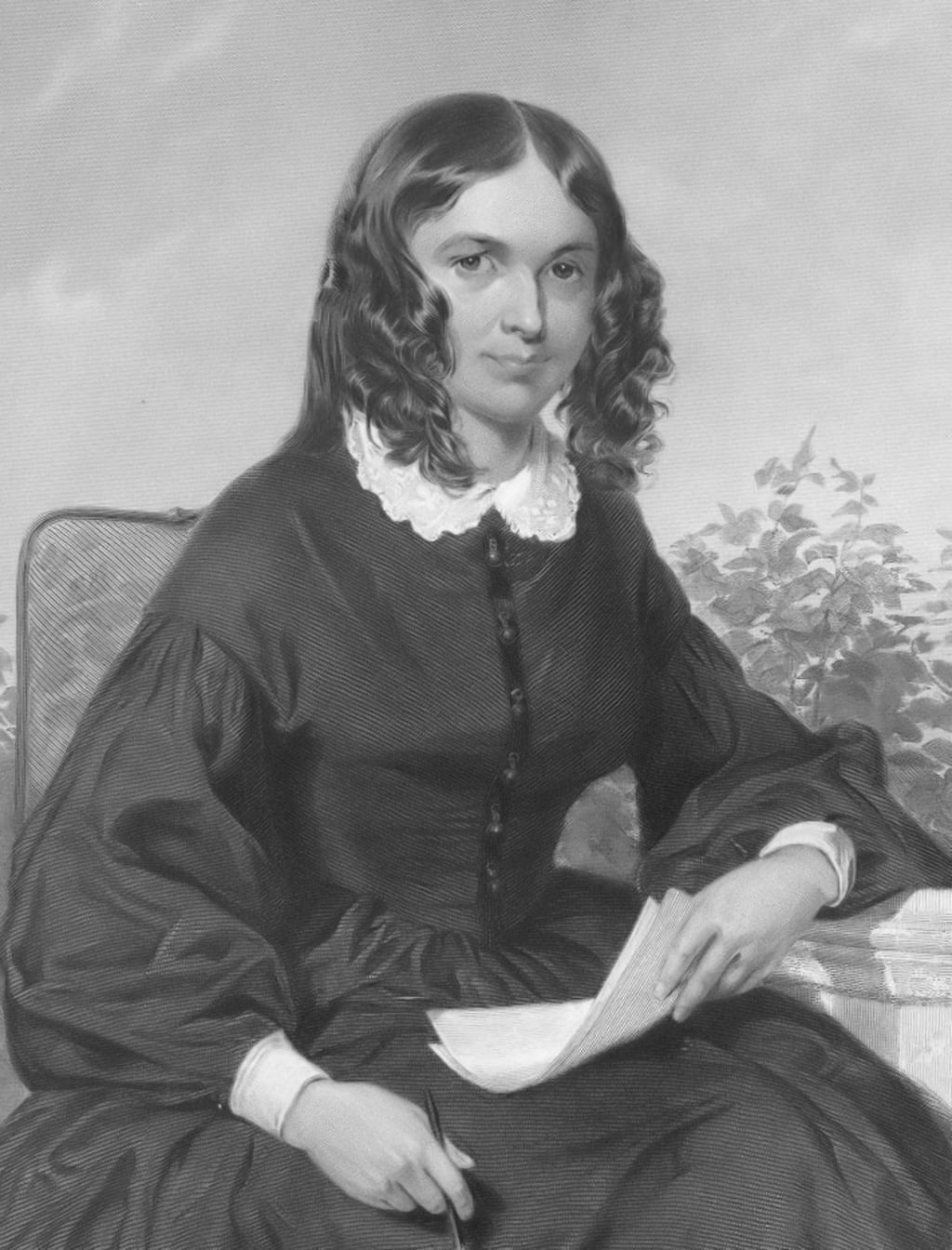
She was an English poet who lived during the Victorian Era. Her poems became popular in Britain and the United States whilst she was still alive. She wrote mainly love poems, “Sonnets from the Portuguese” becoming her most famous. Her poem “Aurora Leigh” is now considered an early feminist text.
She was Elizabeth Barrett Browning.
Elizabeth was born on 6th March, 1806, in Coxhoe Hall, County Durham, England. Her father was Edward Moulton-Barrett and her mother was Mary Graham Clarke. Both her paternal and maternal family profited from slavery, their wealth derived primarily from the ownership of slave plantations in the British West Indies. Growing up knowing this, Elizabeth became vocal against slavery and expressed this through her poetry.
Her two poems highlighting this were “The Runaway Slave”, (1849), and “A Curse for a Nation”, (1856).
She was the eldest of 12 children, having 8 brothers and 3 sisters, all of which had nicknames. Elizabeth’s was “Ba”. She had a happy childhood, riding her pony, going for family picnics and walks, socialising with the neighbours, and even enjoyed being in the family theatrical home ‘productions’. Mostly though, Elizabeth loved to immerse herself in books.
Being born into a wealthy family, Elizabeth was educated at home and was tutored, alongside one of her brothers, by Daniel McSwiney. She could write poetry by the age of 4, and as a child, Elizabeth was intensely studious and precocious, reading novels by the age of 6. She studied Greek when she was 10 years old.
At the age of 11, Elizabeth wrote “The Battle of Marathon: A Poem” which her father had published in 1820, but he made sure that all of the copies stayed within the family. Her mother compiled all of her daughter’s poems into collections of “Poems" by Elizabeth B.Barrett. Both parents encouraged their daughter’s love for poetry and the result is one of the largest collections of juvenilia, (this is a collection of ‘works’ by a young author), of any English writer.
The novelist Mary Russell Mitford described Elizabeth as having “a slight, delicate figure, with a shower of dark curls falling on each side of a most expressive face; large, tender eyes, richly fringed by dark eyelashes, and a smile like a sunbeam”.
At 15 years of age, our young poetress became ill with something that the doctors could not diagnose. She had intense pain in her spine and head, which made her lose mobility. All 3 sisters had the same ‘syndrome’ but it lasted all of Elizabeth’s life.
The normal ‘medication’ prescribed at the time was laudanum, which was an opium concoction, and morphine, and, unfortunately, Elizabeth became dependent on this ‘medication’ for most of her life. Having started on this at such a young age possibly contributed to her already frail health.
Elizabeth was a ‘passionate’ Christian and she was active in the Bible and Missionary Societies of her congregational church.
In 1826, Elizabeth’s collection called “An Essay on Mind and Other Poems” was published anonymously.
Over the following years, many changes occurred in Elizabeth's life. Her mother died in 1828 and her grandmother died in 1831. With lawsuits and the abolition of slavery, her father suffered financial losses. The family moved about, renting several different homes, until Elizabeth’s father decided on 50, Wimpole Street, Marylebone, London, to settle his family.
At her new home in London, Elizabeth spent most of her time in her room upstairs, and although her health seemed to improve, Elizabeth would see very few people other than her family.
From the years 1841 to 1844, Elizabeth wrote poetry day and night, as well as translation and ‘prose’, (a writing that doesn’t follow a rhyme scheme). This ‘prolific’ writing made her a rival to Tennyson as a candidate for poet laureate in 1850 on the death of Wordsworth.
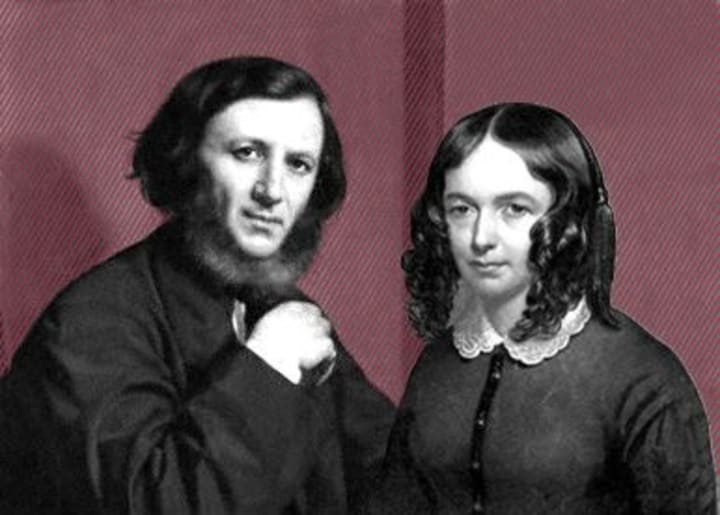
Elizabeth’s 1844 volume “Poems” caught the attention of her future husband. Robert Browning wrote: “I love your verses with all my heart, dear Miss Barrett”, and he praised their “fresh strange music, the affluent language, the exquisite pathos and true new brave thought”. He added: “I love you too”.
The couple met through a mutual friend and carried on a secret courtship. Her father was somewhat tyrannical and she was still living in his house which made Elizabeth ‘afraid’ of her father.
Elizabeth and Robert exchanged 574 letters over 20 months. They eloped in 1846. She was 40 years old and he was 34 years old. Her father never spoke to his daughter again because he was bitterly opposed to any of his children marrying, wanting to keep the surname Barrett and the inheritance within the family.
The young couple moved to Florence, Italy, where Elizabeth’s health began to improve. It was here that they had their only child, Robert Wideman Browning.
“Sonnets from the Portuguese", which Elizabeth wrote during her courtship to Robert, were published in 1850 and dedicated to her husband. Robert later explained: “I dared not keep to myself the finest sonnets within any language since Shakespeare’s”.
During her later life, Elizabeth’s work embodied political and social themes and she became recognized around Europe. She also ‘developed’ an interest in spiritualism and the occult, both of which became popular during the 1800’s.
On 29th June, 1861, Elizabeth died in the arms of her husband after her health had deteriorated. Robert said that she died: “smilingly, happily, and with a face like a girl’s — Her last word was — ‘Beautiful’”.
Elizabeth Barrett Browning was 55 years old when she died.
Although her life comes across as physically weak, with Elizabeth ‘being ill’ for most of her life, her strength comes out in her beautiful poetry, and it is here that we see an incredibly strong woman.
Her famous poem “Aurora Leigh" is an exploration of self-love and self-acceptance. Elizabeth writes: “Be patient. In this life we cannot do great things. We can only do small things with great love”.
About the Creator
Ruth Elizabeth Stiff
I love all things Earthy and Self-Help
History is one of my favourite subjects and I love to write short fiction
Research is so interesting for me too
Keep reading
More stories from Ruth Elizabeth Stiff and writers in History and other communities.
Nellie Bly
She was one of the original women journalists who used her love for writing to help improve other people's lives. She went around the world in 72 days and spent 10 days in a mental asylum as a (pretend) patient. She was the first woman to report from the Eastern Front during World War One. In 1986, she was inducted into the National Women’s Hall of Fame.
By Ruth Elizabeth Stiff7 months ago in History
Chinese Water Torture
Since the dawn of history, human beings have inflicted unimaginable suffering upon one another. Across centuries, people have devised increasingly elaborate methods of punishment and coercion, some brutally explicit, others deceptively subtle. While devices such as iron maidens, racks, whips, and wheels relied on visible physical agony, there existed a form of torment whose true power lay not in blood or broken bones, but in patience, repetition, and the slow erosion of the mind. This method came to be known as Chinese water torture.
By Pure childabout 10 hours ago in History
Saddam Hussein: Rise, Rule, and Fall
Saddam Hussein was born on April 28, 1937, in a small village near Tikrit, Iraq. His early life was marked by poverty, hardship, and a sense of abandonment. His father died before he was born, and his mother remarried soon after. Young Saddam grew up in a household dominated by strict relatives and was exposed to political discussions and nationalist sentiments from an early age. These formative years shaped his personality—ambitious, ruthless, and fiercely determined to rise above his modest beginnings.
By The best writer about 12 hours ago in History



Comments
There are no comments for this story
Be the first to respond and start the conversation.