
Echoes of Time: The Untold Story of Human Civilization
From Stone Tools to Space Exploration — How Humanity Shaped Its Destiny

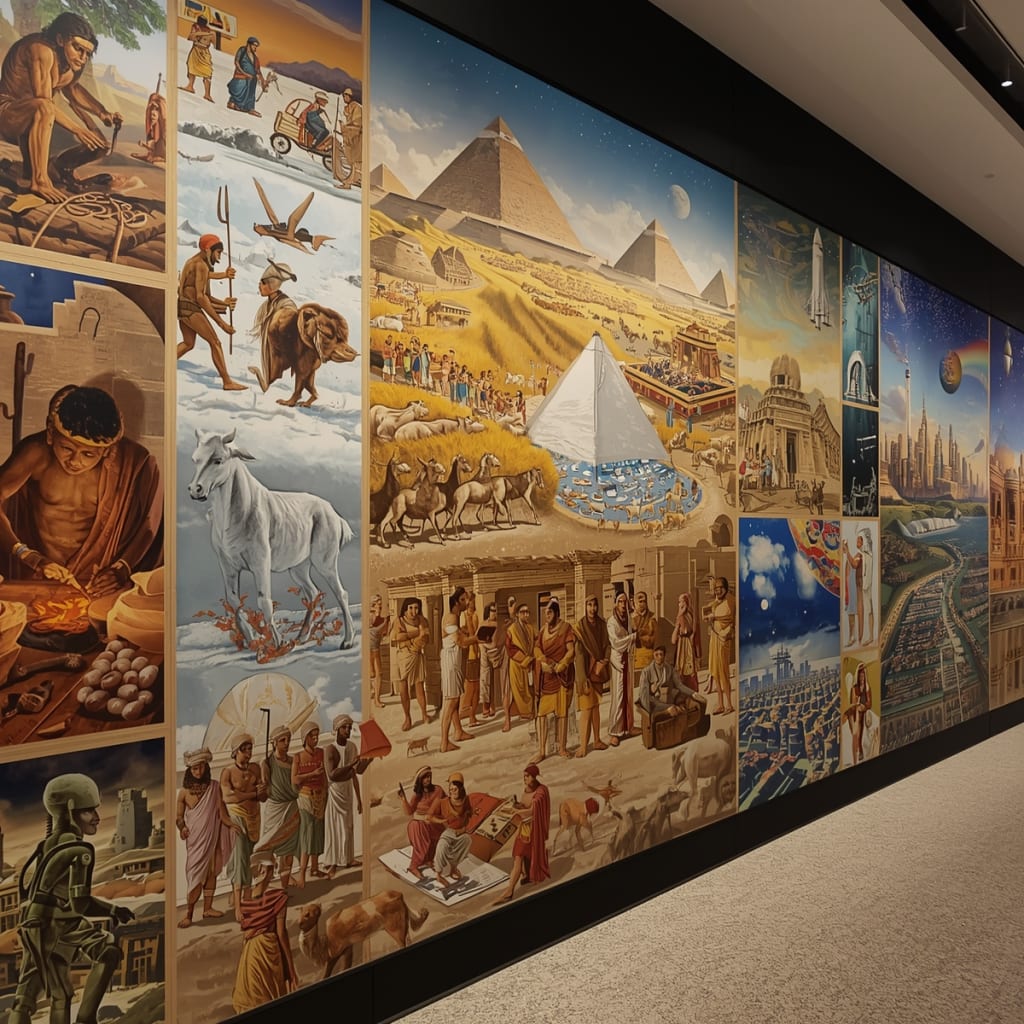
Human history is a saga of endless curiosity, daring exploration, and unyielding ambition. It chronicles the remarkable journey of a species that began as simple hunter-gatherers and evolved into architects of towering cities, creators of complex societies, and explorers of the cosmos. This story unfolds the layers of time, revealing how human civilization grew through innovation, conflict, and cooperation.
The First Steps: Life on the Savannah
Our story begins millions of years ago, in the vast landscapes of prehistoric Africa. Early ancestors, part of the hominin lineage, gradually adapted to changing environments. The defining moment was the development of bipedalism — walking upright on two legs — which freed hands for making and using tools.
The oldest known tools date back roughly 2.6 million years. These simple stone implements allowed early humans to hunt, gather, and protect themselves more effectively. The species known as Homo erectus is credited with mastering fire and spreading from Africa to Asia and Europe, setting the stage for a global human presence.
Mastering the Environment: Ice Ages and Migration
Throughout multiple Ice Ages, humans showed incredible resilience. They survived frigid climates by innovating clothing, shelters, and hunting techniques. Around 70,000 years ago, modern Homo sapiens began migrating out of Africa in waves, eventually populating every continent except Antarctica.
This migration brought humans into contact with different environments and challenges. From the tundras of Siberia to the jungles of Southeast Asia, humans adapted culturally and physically, inventing diverse languages, customs, and technologies. The spread also led to interactions—and sometimes conflicts—with other hominin species, such as the Neanderthals, who eventually disappeared.
The Agricultural Revolution: Foundations of Society
Around 10,000 years ago, a pivotal transformation began: the Agricultural Revolution. Humans transitioned from nomadic hunting and gathering to settled farming communities. The domestication of plants like wheat, maize, and rice, and animals such as cattle and pigs, ensured a more reliable food supply.
This change led to population growth and the formation of villages and towns. People developed pottery, weaving, and metalworking. Social roles diversified — some became artisans, priests, or rulers. This period saw the birth of religion, trade networks, and early governance systems.
The Birth of Cities and Writing
With surpluses of food, some communities grew into cities, the first true centers of civilization. The Mesopotamians, in the fertile land between the Tigris and Euphrates rivers, created the first cities around 3500 BCE. They developed cuneiform, one of the earliest writing systems, enabling record-keeping, law codes, and literature.
Simultaneously, ancient Egypt flourished along the Nile, building massive pyramids and developing hieroglyphic writing. In the Indus Valley, cities like Harappa and Mohenjo-Daro showed advanced urban planning and sanitation. Meanwhile, China saw the rise of dynasties that established philosophies, inventions like silk, and centralized rule.
Empires, Trade, and Cultural Exchange
Civilizations grew into vast empires, expanding their influence and connecting distant peoples. The Persian Empire established an efficient administrative system and a network of roads facilitating trade. The Greek city-states pioneered democracy, philosophy, and the arts, while the Roman Empire unified much of Europe, North Africa, and the Middle East with roads, law, and engineering marvels like aqueducts.
Trade routes such as the Silk Road and the Trans-Saharan routes linked continents, enabling the exchange of goods, ideas, religion, and technologies. Buddhism, Christianity, and Islam spread widely, influencing cultures and societies across the globe.
Intellectual Flourishing: Science and Philosophy
Across the ages, human curiosity fueled remarkable intellectual achievements. The Classical Age saw thinkers like Plato, Aristotle, Confucius, and Avicenna shaping ethics, science, and governance. In the Islamic Golden Age, scholars preserved ancient Greek texts and made breakthroughs in mathematics, astronomy, and medicine.
The Renaissance reignited Europe’s passion for learning and art, reviving classical knowledge and exploring new scientific methods. This era paved the way for figures like Copernicus, Galileo, and Newton, who transformed our understanding of the cosmos and natural laws.
Revolutions and the Modern World
The Industrial Revolution of the 18th and 19th centuries revolutionized production, transportation, and communication. Machines replaced manual labor, cities grew rapidly, and new social classes emerged. These changes sparked political revolutions advocating liberty and rights, reshaping governments and societies.
The 20th century brought unparalleled technological advances: electricity, automobiles, airplanes, computers, and space exploration. Yet, it also witnessed devastating wars and social upheavals. The struggle for civil rights, decolonization, and global cooperation reflected humanity’s ongoing quest for justice and peace.
Into the Future: Challenges and Opportunities
Today, humanity faces critical challenges like climate change, resource depletion, and ethical questions posed by artificial intelligence and biotechnology. However, our history suggests a capacity to adapt and innovate.
As we explore space, decode the human genome, and build interconnected digital societies, the echoes of our past remind us that the human story is far from over. It is a tale of endless possibilities shaped by our choices and dreams.
About the Creator
Alexander Mind
Latest Stories
Keep reading
More stories from Alexander Mind and writers in History and other communities.
The Journey of Humanity: From Dawn to Civilization
Human history is a grand tapestry woven from countless stories of survival, innovation, conflict, and cooperation. From the earliest ancestors who took their first steps in the African savannas to the sprawling civilizations that shaped the world, the history of humanity is an epic journey of growth and transformation. This story traces the pivotal moments that defined our species and highlights the remarkable resilience and creativity that propelled us forward.
By Alexander Mind4 months ago in History
Power's Sake
When it comes to gaining power, bad people use it to gain more They never gain power to do something with it, they gain power to have it, relish in it, double it down on itself so it grows exponentially and never goes anywhere. Even if you see the people in power commit an atrocity, that is never the true goal. It is a deplorable action for sure but the action itself usually doesn't matter it's the outcome.
By Donny Foley5 days ago in History
How Case Documents Are Maintained in Philadelphia County
Case documentation forms the backbone of judicial accountability in Philadelphia County. Every filing, order, transcript, and judgment plays a defined role in preserving procedural accuracy and historical reference. The methods used to preserve these materials reflect long-standing legal standards combined with structured administrative practice. This article explains how case documents are created, organized, stored, reviewed, and preserved within Philadelphia County, with a clear focus on factual processes rather than commentary or promotion.
By Owen Perryabout 16 hours ago in History


Comments
There are no comments for this story
Be the first to respond and start the conversation.