
The Journey of Humanity: From Dawn to Civilization
How Humans Evolved, Adapted, and Built the Foundations of Modern Society

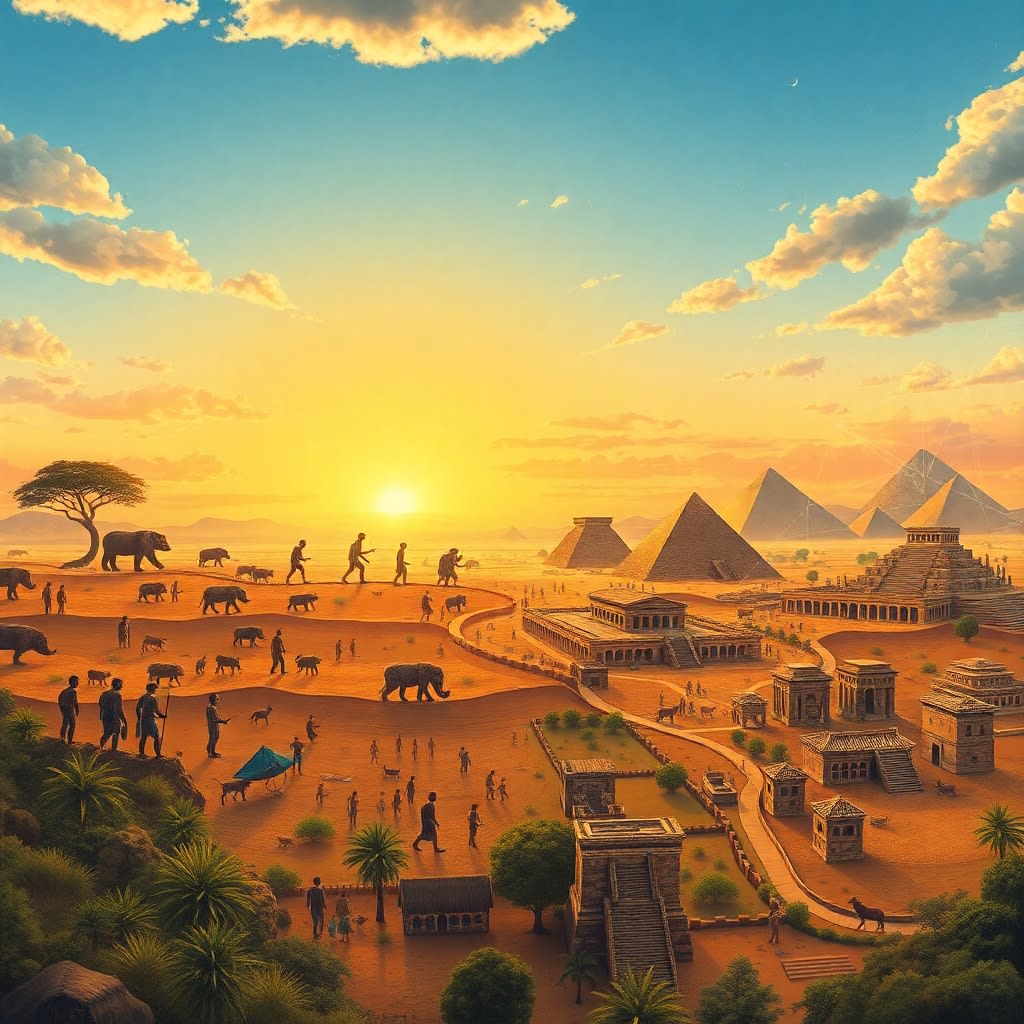
Human history is a grand tapestry woven from countless stories of survival, innovation, conflict, and cooperation. From the earliest ancestors who took their first steps in the African savannas to the sprawling civilizations that shaped the world, the history of humanity is an epic journey of growth and transformation. This story traces the pivotal moments that defined our species and highlights the remarkable resilience and creativity that propelled us forward.
Origins in the African Savannah
The story of humanity begins around 7 million years ago in the heart of Africa. Early hominins—our distant ancestors—began to diverge from the great apes. One of the most significant milestones in this journey was the emergence of Homo habilis, often called the “handy man,” approximately 2.4 million years ago. This species demonstrated the first known use of stone tools, marking the beginning of human technology.
Over hundreds of thousands of years, our ancestors evolved physically and mentally, developing larger brains and more complex social behaviors. Around 300,000 years ago, Homo sapiens, anatomically modern humans, appeared. These early humans were more than just survivors; they were innovators. They developed language, created art, and began to form intricate social networks.
The Great Migration and Adaptation
One of the most extraordinary chapters in human history is the Great Migration, when Homo sapiens began leaving Africa approximately 70,000 years ago. This migration spread humans across the continents, from the icy tundras of Europe to the dense jungles of Southeast Asia, and finally to the isolated lands of Australia and the Americas.
As they moved, humans adapted to diverse climates and environments. They learned to make clothing, build shelters, and hunt a variety of animals. In colder regions, they invented tools like spears and developed fire management techniques to survive harsh winters. These adaptations show not only physical survival but cultural evolution as well.
The Dawn of Agriculture and Settled Life
For tens of thousands of years, humans lived as hunter-gatherers, moving with the seasons and available food. However, about 12,000 years ago, during the period known as the Neolithic Revolution, humans discovered agriculture. This monumental shift from hunting and gathering to farming fundamentally changed human society.
People began domesticating plants like wheat, barley, and rice, as well as animals such as sheep, goats, and cattle. Agriculture allowed for food surpluses, which in turn enabled population growth and the establishment of permanent settlements. The first villages appeared, gradually evolving into towns and cities.
One of the earliest known settlements was Çatalhöyük in modern-day Turkey, dating back to around 7500 BCE. Here, people lived in densely packed homes and developed early forms of social organization. This transition laid the groundwork for more complex civilizations.
The Rise of Civilizations and Empires
With stable food supplies and growing populations, human societies became more complex. Around 3000 BCE, the first great civilizations emerged in regions known as the Cradles of Civilization: Mesopotamia (modern Iraq), Ancient Egypt, the Indus Valley (modern Pakistan and India), and Ancient China.
These civilizations developed writing systems, such as cuneiform in Mesopotamia and hieroglyphics in Egypt, which allowed for the recording of history, laws, and trade. The invention of writing marked the beginning of recorded history, allowing knowledge to be preserved and passed down.
Cities became centers of power, culture, and trade. Monumental architecture like the pyramids of Egypt and the ziggurats of Mesopotamia showcased human ingenuity. Governments and religions became more organized, often intertwined, with rulers claiming divine authority.
Empires soon followed, expanding these civilizations’ reach. The Babylonian Empire, Persian Empire, and later the Roman Empire built vast networks of roads, trade routes, and governance that connected diverse peoples. These empires were responsible for significant advances in law, engineering, and philosophy.
Philosophy, Science, and the Quest for Knowledge
As civilizations matured, the quest for understanding the world intensified. Ancient Greece, often called the birthplace of Western philosophy, produced thinkers like Socrates, Plato, and Aristotle. Their inquiries into ethics, politics, and metaphysics laid the foundation for Western intellectual tradition.
Meanwhile, in the East, Chinese scholars developed Confucianism and Daoism, philosophies that emphasized harmony, order, and balance. Indian sages contributed profound insights through the Vedas and Upanishads, exploring spirituality and the nature of existence.
Science and mathematics flourished in civilizations across the globe. The Babylonians devised early forms of algebra and astronomy, while Egyptian physicians practiced rudimentary medicine. The Islamic Golden Age (8th to 14th century CE) saw remarkable advancements in mathematics, medicine, astronomy, and chemistry, preserving and expanding upon ancient knowledge.
The Middle Ages and Renaissance
After the fall of the Western Roman Empire in the 5th century CE, Europe entered a period known as the Middle Ages. While often portrayed as a time of stagnation, this era also saw the rise of powerful kingdoms, the spread of Christianity, and the establishment of universities.
The Islamic world preserved and enhanced classical knowledge during this period, with cities like Baghdad becoming vibrant centers of learning.
The Renaissance, beginning in the 14th century in Europe, marked a rebirth of art, science, and culture. Inspired by classical antiquity, figures like Leonardo da Vinci and Galileo Galilei pushed the boundaries of human knowledge. This era set the stage for the Scientific Revolution and Enlightenment, which profoundly influenced modern thought and governance.
Modern Era: Revolution and Globalization
The past few centuries have witnessed unprecedented changes. The Industrial Revolution transformed economies, societies, and environments, shifting the world from agrarian to industrial production. Steam engines, factories, and mechanized transport reshaped daily life.
Political revolutions—the American Revolution, the French Revolution, and others—challenged monarchies and promoted ideals of liberty, equality, and democracy.
The 20th century was marked by both the horrors of two World Wars and remarkable progress in technology, medicine, and human rights. The digital revolution has connected the globe in ways once unimaginable, accelerating the pace of innovation.
The Ongoing Human Story
Today, humanity stands at a crossroads, facing challenges like climate change, inequality, and technological ethics. Yet, our history shows an extraordinary ability to adapt and collaborate.
From the humble beginnings of early hominins to the complex societies of the present, the story of humanity is one of perseverance and creativity. It is a story still unfolding—one that we all are part of, writing every day.
About the Creator
Alexander Mind
Latest Stories
Keep reading
More stories from Alexander Mind and writers in History and other communities.
The Algorithmic Oracle: How Google Reshaped Humanity's Relationship with Knowledge
In the autumn of 1998, two Stanford University graduate students, Larry Page and Sergey Brin, unleashed upon the world a deceptively simple tool that would fundamentally reshape human civilization. Their creation—initially named "Backrub" before settling on "Google"—represented more than just another search engine in an already crowded field. It embodied a radical new approach to organizing human knowledge, one that would eventually become so woven into the fabric of daily life that its name transformed from proper noun to verb in dictionaries worldwide.
By Alexander Mind4 months ago in History
Rajendra Chola I and the Conquest of the Ganga: A Monumental Feat in Indian History
Known as the “Gangaikonda Chola” (the Chola who conquered the Ganga), Rajendra transformed a South Indian maritime empire into a pan-Indian power whose influence stretched from the Indian Ocean to the heart of the subcontinent. This campaign was not merely a military raid but a bold statement of imperial ambition, strategic brilliance, and cultural confidence.
By Say the truth 3 days ago in History
THE GRAND EGYPTHION MUSEUM
Let’s be real for a second. When folks hear "museum," they often think of dusty halls, dry information, and that odd quiet where you feel like you're misbehaving just for breathing. But the Grand Egyptian Museum isn't like that. I really don't think that's it. It's not accurate at all. This just seems wrong. This place is really nice. Egypt really shows us that it made history, and it keeps on doing amazing things.
By Beshoy Zayerabout 23 hours ago in History



Comments
There are no comments for this story
Be the first to respond and start the conversation.