
Echoes of the Wild: The Ancient Lifestyle of People in Forests and Tropical Lands
Read about ancient lifestyle that once thrived
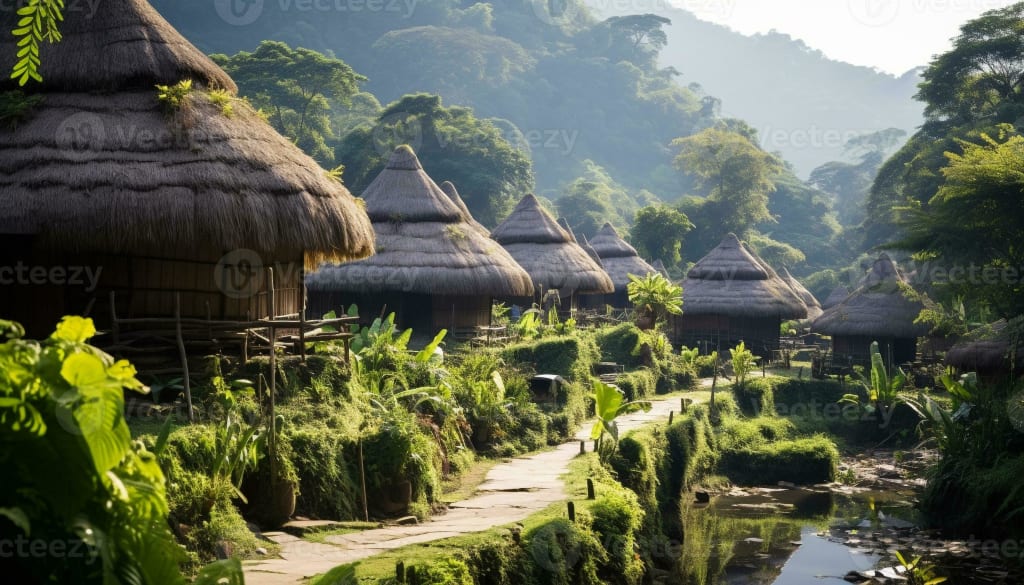
Long before wires tainted the skies and cities littered the landscape, life grew in quiet abundance under green cover. In the far reaches of the jungles on a planet called Earth — wet, twisted, and teeming with unseen things — humans lived in concert with the world. They did not rule their world. They belonged to it.
It is a tale of how the early forest dwellers lived, not as victims but as masters of simplicity.
Refuge from Nature, by Nature
Shelter was never intended to be exclusive of nature — it was designed to exist alongside it.
Bamboo, palm frond, banana frond, and tree bark yielded material for dwellings. They had varying styles by region, but they typically had a few things in common: they had waterproof roofing, elevated floors, and ventilated walls. Air entered openings to cool them. Shade and exposure were carefully selected in accordance with wind, sunlight, and rain patterns.
There wasn’t a single machine or modern equipment; they built with pointed stones, bones, and vines as a makeshift rope. Every building was practical and pretty — and could be built, dismantled, and rebuilt with materials from the forest.
Living Pharmacies and Markets in the Canopy
For dwellers in the forest, the environment wasn’t so much background as a living, nourishing presence.
They had knowledge of what to consume, what not to consume, and how to cure. They applied paste from crushed leaves with antibacterial compounds to cure cuts. They applied tree bark decoctions to reduce fevers. They applied twigs of neem to cure toothaches, long before modern dentistry realized their power.
Cassava, wild yam, jackfruit, guava, banana, and coconuts — each had a different method of harvest and tradition for preparation. The tubers themselves could be boiled, roasted, or processed into a paste. Termites and grubs were also a source of fat and protein.
The forest was a kitchen and a pharmacy. Each plant contained a tale. Each root had a lesson.
Hunting and the Ritual Taking of Life
Dominance wasn’t what hunting was about — it was a balancing act.
Equipment provided:
• Poison darts, typically from curare plants, discharged by blowpipes
• Flexible wooden bows created from hardwood
Stone or bone-tipped spears for close-range combat
Tracking was a science. They could identify disturbed leaves, snapped twigs, noises from animals, and odor trails. They coated themselves with mud for camouflage and depended upon wind currents to cover their scent.
And to begin with, they observed ritual respect. They thanked animals, they didn’t consume them. They performed ceremony prior to or subsequent to a kill, in appreciation for the life they had ended — spiritual exchange, not consumption.
Fire and Food: The Heart of Forest Home
Fire provided warmth, light, protection, and food.
Cooking was over open fires in hollowed bamboo or clay pots. Food was simple but nutritious — smoked fish, boiled greens, roasted roots, sometimes wrapped and steamed in leaves. Meals were eaten by the elder members of the group first. Children learned by watching.
Fermenting processes saved food and also made ritual beverages. Certain tribes buried vessels containing fruit in the earth to make lighter alcohols for ceremonies or feasting.
Whenever they sat to eat, it was a time for sharing — food, as well as memory, and culture.
Earthly Spirituality Rooted in Heaven
The world, to the people who lived in the forest, was alive. Each river had a spirit. Each tree could hear. Each storm had a message.
The shamans, the spiritual practitioners, used chanting, healing smoke, and, in some instances, hallucinogenic substances in order to translate dreams, illness, or natural portents. These were not “superstitions” — they constituted rudimentary systems for understanding energy, emotion, and ecology.
The stars served as calendars. Moon stages determined harvests. Frogs’ croaks even foretold the coming rains. The world wasn’t haphazard — it was readable.
Clothing, Tools, and Tribal Identity
Traditional clothing of ancient Egypt — a reflection of status, culture, and artistry.
The clothing was for functional purposes: protection from insects, thorns, and the sun. Grass skirts, bark cloth, and hides were some common materials. Seed, tooth, shell, and feather jewelry had a spiritual or tribal meaning.
Tools had been handmade: bone needles, wooden digging sticks, stones with blades, and fiber-woven baskets. Drums or flutes, being musical instruments, had been created using bamboo and gourds. Music and art also served a purpose — they preserved knowledge, they honored ancestors, and they taught children.
Community, Roles, and Oral Tradition
The focus was on the group, not the individual.
They shared knowledge by telling stories, by song, and by direct example. Elders were the memory of the community, respected for what they had learned, not for what they could continue to perform.
Women and men typically had complementary tasks — hunting, gathering, making tools, healing, child-rearing — but with the method determined by skill, not by sex. The children were communally reared. Problems were solved by negotiation or symbolic ritual.
There were no written laws — just common values, and an agreement to be bound within the confines of the forest.
What exists today
In remote reaches of the world — the Amazon, Papua New Guinea, the Congo Basin — remain cultures with fragments of this pre-industrial lifestyle. They possess endangered languages. They possess shrinking homelands. But they possess powerful knowledge.
These remind us of a truth that we’ve nearly forgotten: that not all change is progress, and that wealth once meant knowing the forest, not owning it.
Closing Words:
The native inhabitants of the forest were not savages. They were right, clever, and religiouly serious. They did not live a life that was luxurious — but open, meaningful, and relational.
They know the name of birds by their songs, the time of year by the taste in fruits, and that rain has come by the stillness in frogs. They can get lost in the leaves with each step, but they leave behind that wisdom — in whispers in the trees, in songs in rivers, and in the silence that we overlook. Flok If this glimpse into the wild inspired you, share and/or follow for additional posts on lost knowledge, living sustainably, and ancient civilizations
About the Creator
Keep reading
More stories from writers in History and other communities.
Alexander the Great: The Life, Conquests, Vision, and Legacy of History’s Greatest Warrior King
Part 1: Birth and Early Life Alexander was born in 356 BCE in Pella, the capital of Macedonia. He was the son of King Philip II of Macedon and Queen Olympias. From an early age, Alexander was surrounded by power, politics, and warfare. Olympias deeply influenced him, often telling him that he was descended from Achilles and even the god Zeus. These stories shaped Alexander’s belief that he was destined for greatness.
By Say the truth 4 days ago in History
The Ecology of Self-Destruction
Human civilizations often imagine their downfall as something imposed from the outside—by enemies, invasions, or natural disasters. Yet, as Jared Diamond argues in Collapse: How Societies Choose to Fail or Succeed, many societies have played the central role in their own destruction. Through the reckless over-exploitation of natural resources, short-term thinking, and failure to adapt to environmental limits, nations repeatedly undermine the very ecological systems that sustain them. Diamond’s comparative study of past and present societies reveals a sobering pattern: environmental self-destruction is rarely accidental, and collapse is often the predictable outcome of collective choices.
By Rachid Zidinea day ago in History
Our Song
Evening has given way to night. Gently, I settle next to you on the comfortable, old love seat and reach for your hand. You snatch it away, again. It cuts me to the quick, but I hide the pain, understanding that the reaction is but part of your demented state. Since the accident, your presence here in our cozy home has been clouded by a haze I can't see. Nevertheless, I feel the frigidity of your expressions and it serves as an excruciating reminder of the immeasurable distance between us.
By Dana Crandell4 days ago in Fiction



Comments
There are no comments for this story
Be the first to respond and start the conversation.