
Echoes of the Mind: Unveiling Ancient Human Psychology
How Early Communities Shaped—and Were Shaped By—the Inner Workings of the Human Psyche
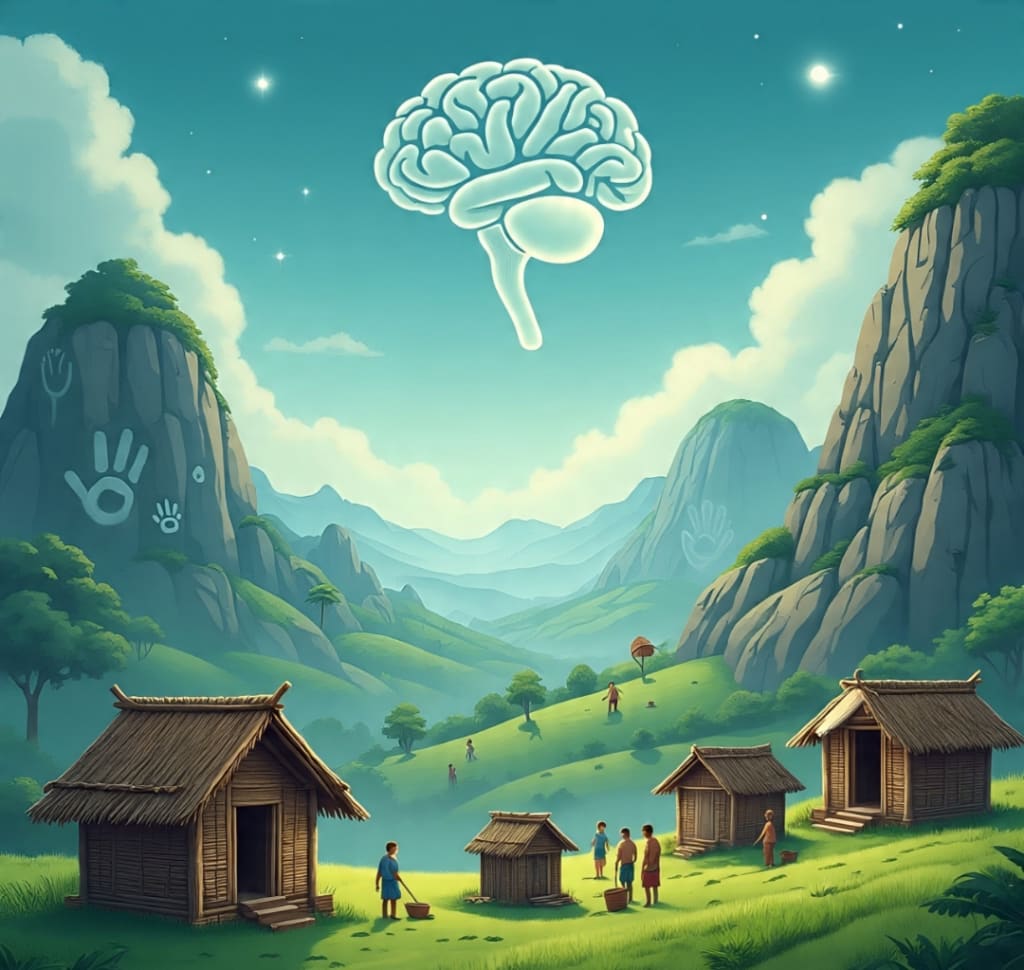
Long before cities rose from the earth and language danced on parchment, early humans gathered under starlit skies, huddled around fires that did more than warm their bodies—they illuminated their minds. In these fireside circles, the seeds of psychology were quietly sown, not in books or laboratories, but in laughter, shared food, grief, and the primal need to belong.
Aran was a young hunter in a tribe nestled along the edge of a vast river. His people, the early ancestors of modern humans, had no written language. Their stories were carried in memory, passed down through drumbeats, carvings on stone, and the hush of whispered wisdom. Each member of the tribe had a role, and with each role came a subtle shaping of the mind. This shaping—this hidden psychology—bound the group together.
Though Aran was known for his speed and accuracy with a spear, what truly set him apart was something far less visible: empathy. He noticed when a tribe elder sat silently by the fire, eyes dimmed with grief. He sensed when a child wandered too far from safety, drawn by the pull of curiosity. And he understood the unspoken emotions of his fellow hunters when a hunt failed. These instincts weren’t unique to Aran. They were ancient and deeply rooted—evolution’s quiet adaptation to help early humans survive together.
Community, after all, was survival.
Anthropologists today understand that early human psychology was not shaped in isolation. It was built in groups—tribes, families, clans—where emotions were contagious and cooperation was critical. The human brain evolved not just to hunt or build tools, but to read expressions, to form alliances, to feel guilt, pride, and love. Even before language, emotional signals were shared through posture, eye contact, touch, and voice tone. These early psychological skills gave tribes like Aran’s an incredible advantage.
Back in Aran’s world, every member of the tribe contributed to a shared mental world. The shaman, a woman named Elo, used rhythm, ritual, and plant medicine not just to heal bodies, but to guide the mind. She understood, intuitively, what modern psychologists would later prove: that belief and emotion could change how people experienced pain, fear, and even memory. Her chants soothed warriors before battle. Her symbols brought peace to grieving parents. She taught the tribe not just to survive, but to find meaning in their lives.
This communal way of thinking created more than physical safety. It created psychological resilience. When the river flooded one spring and food became scarce, it wasn’t just Aran’s strength that carried him through. It was the comfort of shared songs, the hope in elders’ stories, and the knowledge that he was not alone. The tribe had him, and he had the tribe.
Over thousands of years, these patterns became embedded in the human psyche. We carry them still. The way we form friendships, the reason we crave connection, the way we suffer in isolation and thrive in belonging—all of it echoes back to communities like Aran’s. What we now call “social bonding” or “emotional intelligence” was once a matter of life and death.
In the ancient cave art of regions like Lascaux or Chauvet, we see more than drawings—we see psychology in action. We see hands pressed onto stone, symbols repeated, animals painted with reverence. These were not merely decorations. They were acts of memory, identity, and shared belief. They told stories, kept histories, and offered hope. They connected the living to the dead, the present to the past. This was the mind of the ancient world: deeply communal, spiritually curious, and emotionally alive.
Today, as we navigate cities filled with strangers and digital lives that stretch beyond physical contact, we are still wired for the small circle around the fire. We still long for shared meaning, for understanding eyes, for rituals and stories. Ancient human psychology lives on in our need for belonging, in the warmth of a hug, and in the quiet peace we feel when we are truly seen.
So when we study early humans, we are not just studying bones or tools. We are looking into a mirror, finding reflections of ourselves in their fears, dreams, and the quiet strength of their togetherness.
Because even now, thousands of years later, the fire still burns.
About the Creator
Keep reading
More stories from Muhammad Saad and writers in History and other communities.
Wheels of Time: The Legacy of Old Transport Systems
Before sleek cars zipped across highways and airplanes soared above the clouds, the world moved at a different pace. People relied on the ingenuity of their time, crafting unique methods of transportation that not only served practical purposes but also shaped culture, trade, and human connection. The story of old transport systems is a journey into the past—a testament to human creativity and resilience. Long before engines roared to life, nature offered the first means of mobility: walking. For thousands of years, humans migrated on foot, forming trails that would later become trade routes and highways. Eventually, necessity gave birth to invention. In Mesopotamia, around 3500 BCE, the wheel was born—arguably the most important innovation in transport history. Initially used for pottery, it soon revolutionized movement when adapted to carts and wagons pulled by oxen or horses. The ancient Egyptians used wooden sleds to transport massive stones to construct the pyramids. In regions like South America, where wheeled vehicles weren't widely adopted, humans built intricate road systems like the Incan trails, stretching thousands of miles through mountains and valleys, used by runners and llamas to carry goods and messages. Meanwhile, in India and China, animal-drawn carts became vital for moving people and goods through growing civilizations. By the time of ancient Rome, roads had become engineering marvels. Roman roads stretched over 250,000 miles at their peak, carefully layered with stone, gravel, and sand. Chariots and carriages sped along these roads, allowing for military dominance, trade, and cultural exchange across Europe, Africa, and Asia. Maritime transport also saw huge developments. Ancient seafarers from the Polynesian islands navigated vast oceans in double-hulled canoes using the stars. Viking longships explored and raided distant lands, and Mediterranean civilizations like the Greeks and Phoenicians used sailboats for commerce and conquest. These vessels laid the foundation for global navigation centuries before steam or diesel. The Middle Ages saw the slow rise of more localized transport. In Europe, horse-drawn carts, canal boats, and early sleds helped support growing towns and feudal economies. Roads were often muddy and impassable in bad weather, so rivers and canals became vital. In China, the Grand Canal—stretching over 1,100 miles—connected cities and helped unify the country economically. Then came the Industrial Revolution, which changed everything. Steam engines redefined transportation. In the early 1800s, steamships and locomotives began to dominate. George Stephenson's "Rocket," built in 1829, could travel at 30 miles per hour—faster than anyone had moved before on land. Railways exploded across Britain, then Europe, Asia, and North America, shrinking distances and fueling industrial economies. They turned weeks of travel into days and sparked the growth of towns and cities along the tracks. Even personal transport evolved. The invention of the bicycle in the early 19th century offered an affordable and accessible way for individuals to travel. The early "penny-farthing" bicycle, with its oversized front wheel, gave way to the safer and more balanced "safety bicycle" that still resembles modern bikes. For many, especially women and working-class people, bicycles represented newfound freedom and independence. At the turn of the 20th century, the first automobiles began to appear, clunky and slow but full of promise. Henry Ford’s assembly line method revolutionized car production, making the Model T affordable to ordinary families. Meanwhile, the last great era of horse-drawn transport faded into memory. Each mode of old transport—whether a humble ox-cart or a grand steam locomotive—tells a story. They reveal how humans adapted to geography, climate, and necessity. In deserts, people rode camels; in snowy lands, they used dog sleds; in Venice, they built canals and used gondolas. Everywhere, people found ways to connect. Today, as we whiz by in electric vehicles or fly across continents in hours, it’s easy to forget the long journey that brought us here. But the legacy of old transport systems lives on—not just in museums or nostalgic photographs, but in the very roads, bridges, and habits that shape our modern world. These systems weren’t just about getting from one place to another. They were lifelines of communication, trade, exploration, and culture. They were how ideas traveled, how families reunited, how empires rose and fell. In every clatter of a horse hoof or whistle of a steam train, there is a story of progress—of how humanity learned to move, together.
By Muhammad Saad 8 months ago in History
The ‘Lone Warrior’ of Freedom Who Declared an Independent Pashtun State
The history of the subcontinent’s struggle against colonial rule is filled with famous leaders, mass movements, and political negotiations. Yet hidden within these narratives are figures whose stories remain lesser known but deeply fascinating. One such personality was Fakir of Ipi, a tribal leader from the rugged mountains of Waziristan who spent decades resisting British authority and later opposed the creation of Pakistan. Known to many as the “lone warrior of freedom,” Fakir of Ipi became a symbol of tribal resistance and a controversial advocate for an independent Pashtun homeland.
By Irshad Abbasi 2 days ago in History


Comments
There are no comments for this story
Be the first to respond and start the conversation.