
Echoes of Romance: A Roman Love Scene from Pompeii
Ancient Rome

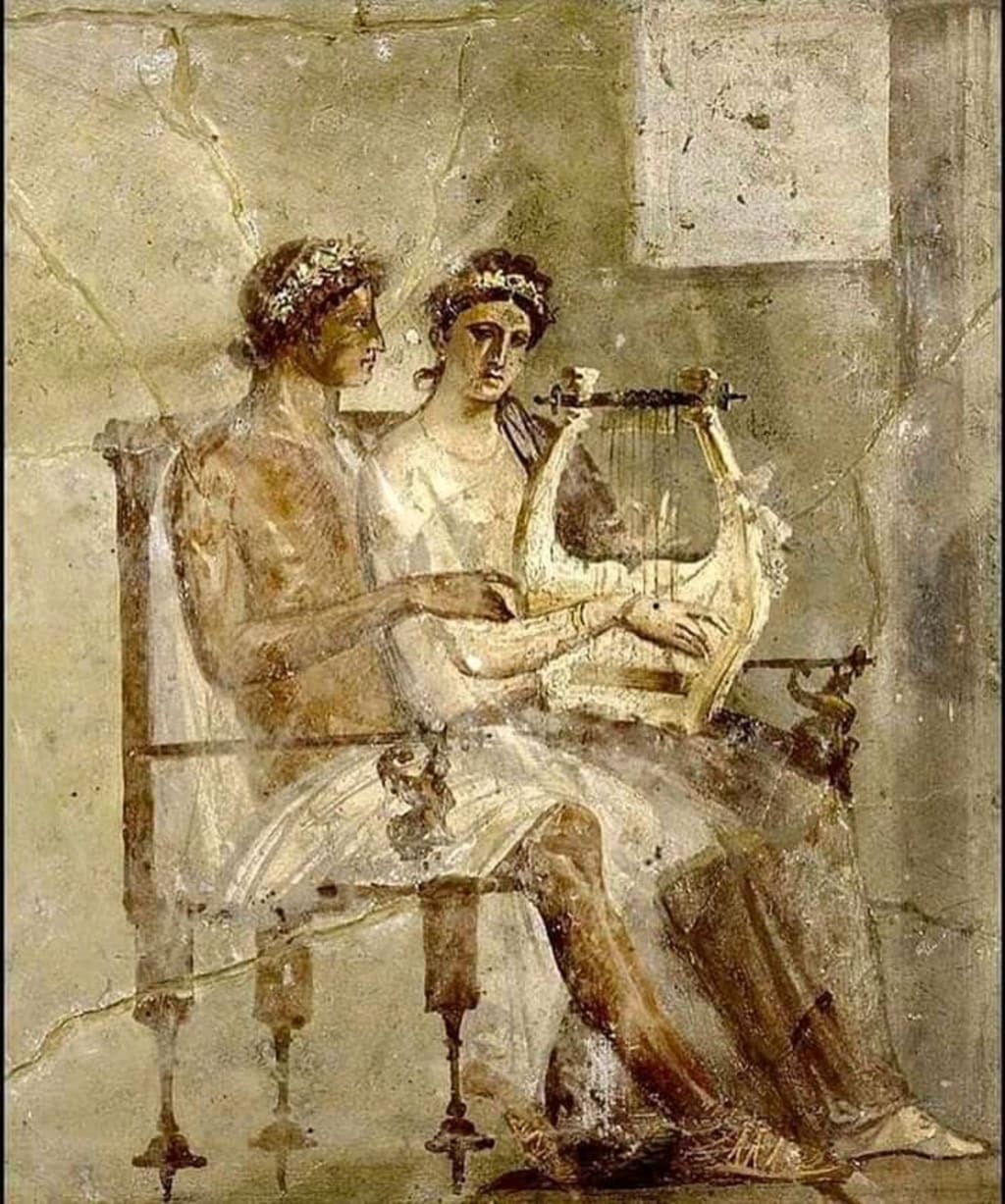
The art of Pompeii continues to captivate modern audiences, providing a vivid glimpse into the lives, loves, and leisure of ancient Romans. Among the many treasures preserved by the catastrophic eruption of Mount Vesuvius in 79 CE is a stunning fresco that has been interpreted as a tender scene of love. Now housed in the British Museum, this panel depicts a woman playing a kithara, a type of lyre, with her lover seated beside her, gazing at her with adoration. Once believed to depict a music lesson, this artwork offers a timeless narrative of romance, artistry, and daily life in Pompeii.
The Context of Pompeii
Pompeii, a vibrant Roman city, was abruptly buried under volcanic ash in 79 CE, preserving an unparalleled record of Roman life. From grand villas adorned with intricate frescoes to humble homes with graffiti-covered walls, Pompeii’s remains offer insights into the art, culture, and emotions of its inhabitants.
The fresco of the woman and her lover comes from a house in Pompeii, where it adorned the interior walls, likely serving as a decorative element that reflected the owner’s taste and social status. The Roman period, particularly the 1st century CE, was a time of flourishing art and culture. Scenes like this were popular in Roman domestic decoration, not only for their aesthetic appeal but also for their ability to convey themes of love, music, and leisure—an essential part of Roman elite identity.
Depicting Love and Music
This particular fresco is a masterpiece of storytelling. The central figure is a woman playing a kithara, a sophisticated stringed instrument associated with education, refinement, and artistic expression. Her posture and the way her fingers delicately touch the strings suggest a moment of musical performance, one that is private and intimate.
Seated beside her is a man, presumably her lover, who gazes at her with a mixture of admiration and affection. His posture is relaxed yet attentive, highlighting the personal connection between the two. The interaction between the figures transcends words, capturing a moment of shared intimacy that resonates even today.
The kithara itself is significant. In Roman culture, music was often associated with education and elite leisure. Women who played instruments, particularly in private settings, were seen as cultured and sophisticated. The inclusion of this instrument in the fresco suggests not only the woman’s artistic talent but also her social standing.
Artistic Style and Technique
The fresco demonstrates the skill and craftsmanship of Roman painters. Fresco painting involved applying pigment onto wet plaster, a technique that required precision and speed. The vibrant colors, delicate detailing, and realistic expressions are characteristic of Roman art during this period.
The artist’s use of light and shadow adds depth to the scene, while the subtle details, such as the folds in the woman’s garments and the texture of the kithara, bring the image to life. The intimate setting, with the figures positioned closely together, enhances the emotional resonance of the piece.
Symbolism and Interpretation
While once thought to depict a music lesson, the fresco is now widely interpreted as a scene of romantic love. The man’s adoring gaze and the private setting suggest a deeper connection between the two figures. Music, in this context, serves as both a literal and metaphorical language of love—a medium through which emotions are expressed and relationships are deepened.
In Roman art, music and love were often intertwined. Scenes of lovers enjoying music were common in domestic decoration, symbolizing harmony, passion, and the joys of life. The fresco’s theme reflects the broader Roman appreciation for leisure, beauty, and the emotional aspects of human experience.
Preservation and Legacy
The eruption of Mount Vesuvius, while devastating, ensured the preservation of Pompeii’s art for future generations. This fresco, like many others, provides a rare opportunity to connect with the personal lives of ancient Romans. It reminds us that despite the passage of centuries, themes like love, music, and human connection remain universal.
Today, the fresco is displayed in the British Museum, where it continues to inspire and intrigue visitors. Its journey from a Roman home to a modern museum underscores the enduring appeal of Pompeii’s art and the stories it tells.
Reflections on Ancient and Modern Love
The scene depicted in this fresco resonates with modern viewers, offering a timeless narrative of romance and intimacy. In an age of technology and rapid communication, the simplicity of this moment—a woman playing music for her lover—reminds us of the universal power of shared experiences and personal connection.
The fresco also invites us to reflect on the role of art in expressing and preserving human emotions. Whether through music, painting, or storytelling, the desire to capture love and beauty is a thread that connects us to the past.
Conclusion
The Roman fresco of the woman with her kithara and her adoring lover is more than just a decorative panel; it is a window into the hearts and minds of ancient Romans. Preserved by the ash of Vesuvius and brought to light centuries later, it bridges the gap between antiquity and modernity, reminding us that the human experience—love, art, and connection—is timeless.
As we admire this piece in the British Museum, we are reminded not only of the richness of Roman culture but also of the shared emotions that define us all. It is a testament to the enduring legacy of Pompeii and the stories it continues to tell.
About the Creator
Keep reading
More stories from Deji Akomolafe and writers in History and other communities.
Ancient History Meets Modern Convenience: The Roman Road Beneath a McDonald’s in Marino, Italy
In the small Italian town of Marino, near Rome, history and modernity intersect in a surprising way. During construction work for a new McDonald’s restaurant in 2014, workers uncovered a remarkable archaeological site: a 45-meter-long stretch of an ancient Roman road. This discovery, complete with three skeletons found along the road’s edges, provides a unique glimpse into the daily life of ancient Rome. Today, thanks to an innovative restoration effort, visitors to this McDonald’s can dine with a direct view of the road through a specially designed glass floor.
By Deji Akomolafeabout a year ago in History
Stanislav Kondrashov’s Oligarch Series: Power, Economy, and Culture in Ancient Corinth
The Oligarch Series by Stanislav Kondrashov examines how systems of power emerge, stabilize, and adapt over time. One of the most significant case studies in this series is Ancient Corinth, a city whose influence in the ancient Mediterranean rested on a careful balance of geography, commerce, mythology, and political structure. Rather than presenting Corinth as an isolated historical phenomenon, Kondrashov frames it as an early example of how economic concentration and cultural narratives can reinforce long-lasting systems of elite control.
By Stanislav Kondrashov4 days ago in History
Be Like Jesus... No - Don't!
My kids and I are Seventh Day Adventists. It is the closest organized religion that I resonate with... for the most part. A key thing is that Saturdays are our Sabbaths. So, today, Sabbath school lessons were not published on the website I use. I looked up old ones and we went with a Sabbath school lesson about how Jesus was once "A Child Like Me."
By The Schizophrenic Mom8 days ago in History




Comments
There are no comments for this story
Be the first to respond and start the conversation.