
Dolly: The Life of a Miracle Sheep
The Lamb That Wasn't Born, But Made

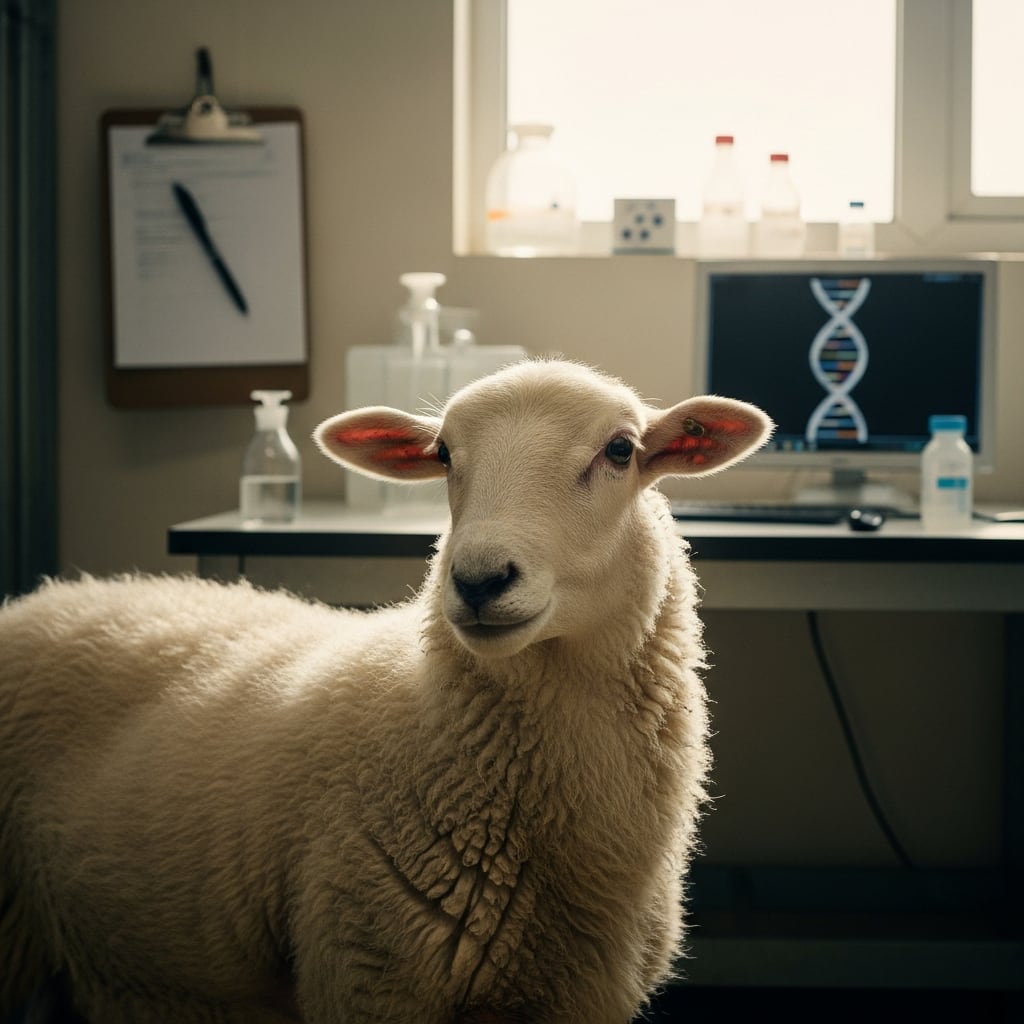
For most of history, life had one simple, unbreakable rule: you are born from a mother and a father. Every animal, from a blue whale to a tiny ant, started from a single cell created when its parents' cells joined. That's just how it worked. Until a quiet sheep in Scotland changed everything.
In 1996, inside a research lab at the Roslin Institute, a miracle was hiding in plain wool. Her name was Dolly. She looked like any other Finn Dorset sheep—white face, fluffy coat. But Dolly was different. She did not have a father. And, in a way that boggled the mind, she did not have a mother either. Not in the normal sense.
Dolly was a clone. The scientists, led by Ian Wilmut and Keith Campbell, did something that sounded like science fiction. They took a single, ordinary cell from the udder of a six-year-old adult sheep. This cell wasn't special; it was just a regular body cell, containing the complete genetic blueprint of that adult sheep. They had also taken an unfertilized egg cell from a different sheep and carefully removed its nucleus, which held its own genetic instructions. Think of it as taking the "brain" out of the egg.
Then came the revolutionary part. They took the adult udder cell and fused it with the empty egg cell using a tiny electric spark. It was like giving the egg a whole new instruction manual—the one from the adult sheep. This fused cell began to divide and grow, just like a normal fertilized egg. It was placed into the womb of a third sheep, a surrogate mother.
On July 5th, 1996, a lamb was born. They named her Dolly, after the singer Dolly Parton, a playful nod to the fact she was made from a mammary (udder) cell. When they tested her DNA, it was a perfect match to the six-year-old adult ewe who donated the udder cell. Dolly was not that ewe's daughter. She was that ewe's genetic twin, born years later.
The world went crazy. Headlines screamed about cloning. People immediately thought of dinosaurs and human copies. But for scientists, Dolly's real message was different and even more powerful: a specialized adult cell could be reprogrammed to create a whole new life. This proved that every cell in your body, be it a skin cell or a liver cell, still holds the full map to make you. It just needs the right instructions to turn back on.
Dolly lived a normal, healthy sheep life at the Roslin Institute. She had six lambs of her own, the old-fashioned way, proving clones could be fertile. But she also aged in a way that raised big questions. She developed arthritis and a lung disease common in older sheep. In 2003, at just six years old—about middle-aged for a sheep—she was put down. This led scientists to wonder: because she came from a six-year-old's cell, was she born with an "old" clock? Did her life start at age zero, or at age six? These were profound puzzles about aging and biology that Dolly left behind.
Dolly's life was short, but her impact is forever. She wasn't a monster or a threat. She was living, breathing proof of a stunning scientific principle. She opened the door to incredible possibilities: saving endangered species from a single skin cell, creating animals that produce medicines in their milk, and understanding how to regenerate damaged human tissues. She also sparked urgent, worldwide debates about ethics that we are still having today.
Dolly wasn't just a transgenic animal—an animal with genes from another species. She was something entirely new: a landmark. A gentle, bleating creature who showed us that the recipe book of life could be read backward, and that the rules of biology, once written in stone, could sometimes be gently rewritten.
"The core theme of Dolly the transgenic animal is the astonishing, world-changing idea that science had discovered a way to 'rewrite the rules of life,' proving a complete, living creature could be created from a single adult body cell, making her not an offspring but a delayed genetic twin, which sparked global wonder about the possibilities of cloning for medicine and conservation, while also raising deep, urgent ethical questions about playing with the fundamental blueprint of life, reminding us that with every great leap in knowledge comes profound responsibility."
About the Creator
LegacyWords
"Words have a Legancy all their own—I'm here to capture that flow. As a writer, I explore the melody of language, weaving stories, poetry, and insights that resonate. Join me as we discover the beats of life, one word at a time.
Keep reading
More stories from LegacyWords and writers in History and other communities.
The History of Sheikh’s Spear
It wasn't always called Sheikh’s Spear. In the beginning, it was just a length of strong, straight wood, chosen from an acacia tree that grew alone in a dry valley. The man who found it was a young herder named Khalil. He needed something to guide his goats and lean on during long walks. He smoothed the wood with sand and stone until it felt like a part of his own arm.
By LegacyWords3 months ago in History
The Search for the Distant World
Long before powerful telescopes and modern space missions, astronomers spent countless nights studying the sky. They watched the stars carefully and recorded the movements of the planets. Each discovery helped scientists understand the vast universe a little better. Among the most fascinating discoveries in astronomy was the discovery of Pluto, a tiny and distant world at the edge of our Solar System. The story of Pluto’s discovery is not just about a planet. It is a story of curiosity, patience, and the determination of scientists who spent years searching for something that no one had ever seen before. The Mystery of Planet X In the early 1900s, astronomers believed there might be another planet beyond Neptune. They noticed that the orbits of Uranus and Neptune did not behave exactly as expected. Some scientists thought that the gravity of an unknown planet might be affecting their motion. One astronomer who became very interested in this mystery was Percival Lowell. Lowell believed strongly that a hidden planet existed far beyond Neptune. He called this mysterious world “Planet X.” To find it, Lowell built an observatory in Arizona known as the Lowell Observatory. From there, he and his team carefully studied photographs of the night sky. They searched for a small object that slowly moved among the stars. Unfortunately, Lowell died in 1916 before he could find the planet he was looking for. But the search did not end. A Young Man with a Dream Years later, a young farm boy named Clyde Tombaugh became interested in astronomy. Tombaugh lived in Kansas and did not have expensive scientific equipment. However, he loved building telescopes and observing the planets from his backyard. Tombaugh carefully drew detailed pictures of Mars and Jupiter using a homemade telescope. He sent these drawings to Lowell Observatory, hoping that professional astronomers might notice his work. The scientists at Lowell Observatory were impressed by his careful observations. In 1929, they invited Tombaugh to work at the observatory and continue the search for the mysterious Planet X. For Tombaugh, it was the opportunity of a lifetime. The Difficult Search The search for Planet X was extremely challenging. The distant planet would appear very small and faint in photographs of the sky. It would look almost exactly like a star. To find it, Tombaugh used a special machine called a blink comparator. This device allowed him to compare two photographs of the same part of the sky taken several days apart. When he looked through the machine, the images switched back and forth quickly. Most stars stayed in the same place. But if an object moved slightly between the two photographs, it would appear to jump back and forth. That movement could reveal a planet. Night after night, Tombaugh studied thousands of star images. The work required incredible patience and concentration. Sometimes he spent hours searching through photographs without finding anything unusual. But he never gave up. The Moment of Discovery On February 18, 1930, Tombaugh was examining photographs taken in January of that year. While comparing two images, he noticed a tiny dot that moved slightly from one position to another. At first, he looked again carefully to make sure it was not a mistake or a flaw in the photograph. But the tiny object had definitely moved. This meant it was not a star—it was something within our Solar System. After additional observations confirmed the movement, the scientists at Lowell Observatory realized that Tombaugh had discovered the long-sought Planet X. The discovery was officially announced on March 13, 1930. Astronomers around the world celebrated the discovery of a new planet beyond Neptune. It was one of the most exciting astronomical discoveries of the 20th century. Naming the New World After the discovery was announced, people from many countries suggested names for the new planet. The final name came from an 11-year-old girl in England named Venetia Burney. She suggested the name Pluto, after the Roman god of the underworld. The name seemed perfect because the planet was dark, distant, and hidden in the far reaches of the Solar System. Astronomers liked the name for another reason. The first two letters, P and L, were also the initials of Percival Lowell, the astronomer who had first searched for Planet X. Soon, the International Astronomical Union officially approved the name Pluto. A Planet That Changed Our Understanding For many decades, Pluto was known as the ninth planet of the Solar System. It became a symbol of exploration and curiosity about the outer regions of space. However, as technology improved, astronomers discovered many other icy objects beyond Neptune in a region called the Kuiper Belt. Scientists realized that Pluto was part of this large population of distant objects. Because of this, in 2006 the International Astronomical Union reclassified Pluto as a dwarf planet instead of a full planet. Although this decision surprised many people, Pluto remains one of the most fascinating worlds in our Solar System. Exploring Pluto In 2015, the spacecraft New Horizons flew past Pluto and sent back the first close-up images of the distant world. Scientists were amazed by what they saw. Pluto has mountains made of ice, vast frozen plains, and a giant heart-shaped region on its surface. These discoveries showed that even small worlds far away from the Sun can be complex and beautiful. The Legacy of the Discovery The discovery of Pluto proved that patience and curiosity can lead to incredible discoveries. Clyde Tombaugh’s careful work and dedication allowed humanity to find a new world billions of kilometers away. Today, Pluto continues to inspire scientists and students to explore the mysteries of space. Even though it is small and distant, Pluto reminds us that the universe is full of surprises waiting to be discovered. 🌌
By Sahir E Shafqat6 days ago in History
Becca
"Everything is so... flat." Denille said stupidly as she looked around her new neighborhood. She looked around at the muted desert where even the smallest sign of life seemed to have given up. The plant life was shrubs that were half cooked by the heat and where there should have been a lawn, a mess of white rocks laid glistening in the sun. Even the sky looked stretched thin, like the sun had ironed it smooth. She’d moved from Riverside, where at least there were hills, but here in Barstow, everything felt baked and brittle.
By Sara Wilson7 days ago in Fiction




Comments
There are no comments for this story
Be the first to respond and start the conversation.