
Did the Witch of Endor bring up the prophet Samuel for King Saul?
There are varied views on the subject from different religions.

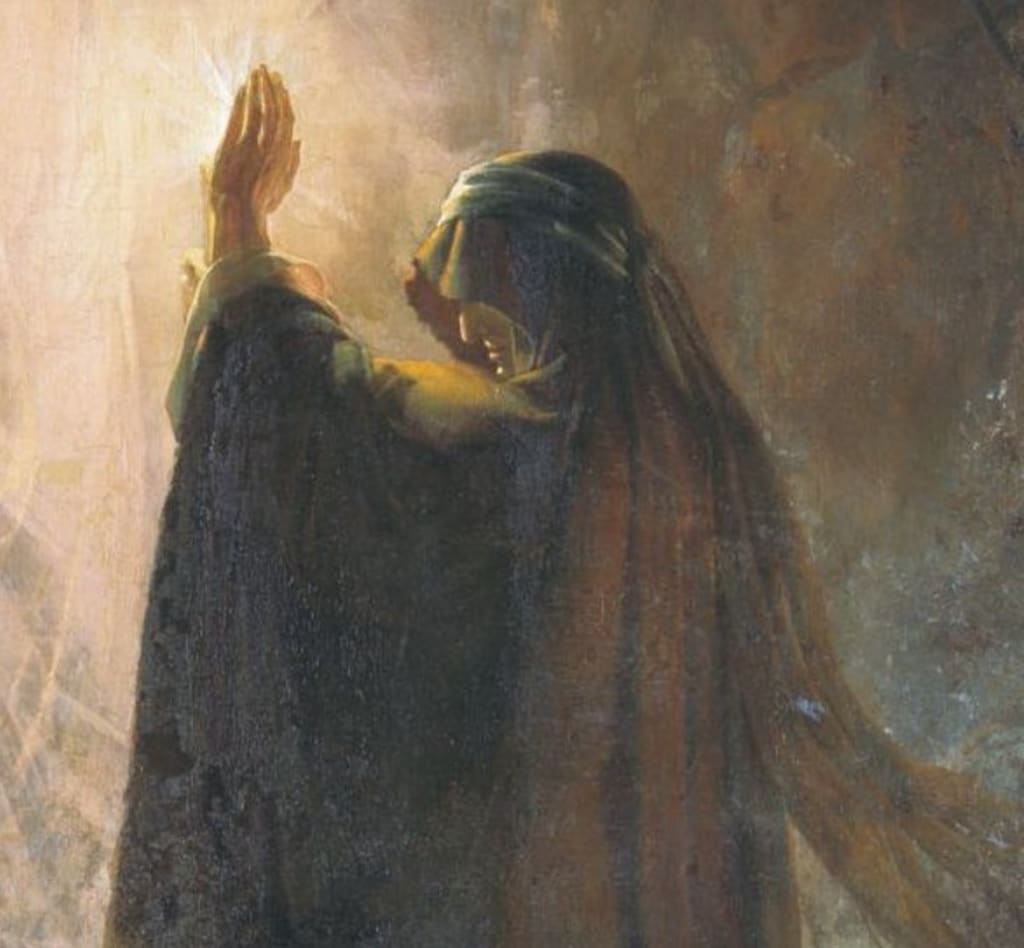
Did Samuel really appear to Saul?
The story of the Witch of Endor bringing up the spirit of the Prophet Samuel for King Saul is in 1 Samuel 28 in the Bible, and it's one of the most mysterious and debated passages in Scripture.
Saul is desperate before a battle with the Philistines, because God is no longer talking to him. Not through prophets nor Urim (a priestly tool for guidance). The king is so discouraged he does what he knows is forbidden and seeks out a witch, even though he had previously banned all soothsayers, mediums, and occult practices from the land.
The medium calls for Samuel, and a spirit appears, described as “an old man wearing a robe.” I always questioned why Samuel would come from the ground, since as a prophet, he would be in heaven. Why would he still look old and be wearing his earthly clothing?
Also, Samuel was buried in Ramah and would have been wearing a burial cloth and not his regular garments. The prophet was buried in Ramah, which was further north than Endor. It is my opinion that the Lord allowed the situation to take place, and a spirit took on the form of Samuel as he was while living.
The figure does not give the king the desired assistance but offers Saul a message of judgment, foretelling that Saul and his sons would be with him the next day. Let's see what theologians have to say.
Theological Interpretations:
1. A majority iew among theologians is that yes it was Samuel.
The text itself plainly says “Samuel said…” and doesn’t hint it’s a demon or illusion. The spirit gives a true prophecy, which comes to pass.
The medium is terrified when the spirit appears—possibly implying she didn’t expect it to work or that this was different from her usual experiences.
2. No, it was a demonic impersonation (minority view, some conservative or skeptical traditions):
God had forbidden necromancy (Deuteronomy 18:10-12). Why would He allow it to work now? Some believe demons can imitate the dead to deceive. They argue God wouldn’t use a banned method to deliver His message.
3. It was a psychological or staged event (critical/skeptical view):
Some modern scholars view it as symbolic, legendary, or psychological—possibly even a trick by the medium.
Others argue that the passage reflects ancient Israelite beliefs about the dead more than a theological statement. Whether Samuel was truly brought up depends on your theological or interpretive stance: Literal biblical readers usually say yes, it was truly Samuel, by a special allowance of God.
Skeptical or symbolic readers might say no—it was deception, illusion, or literature. Christian and Jewish traditions are mostly divided but tend to lean toward “yes,” with warnings not to take it as endorsement of necromancy.
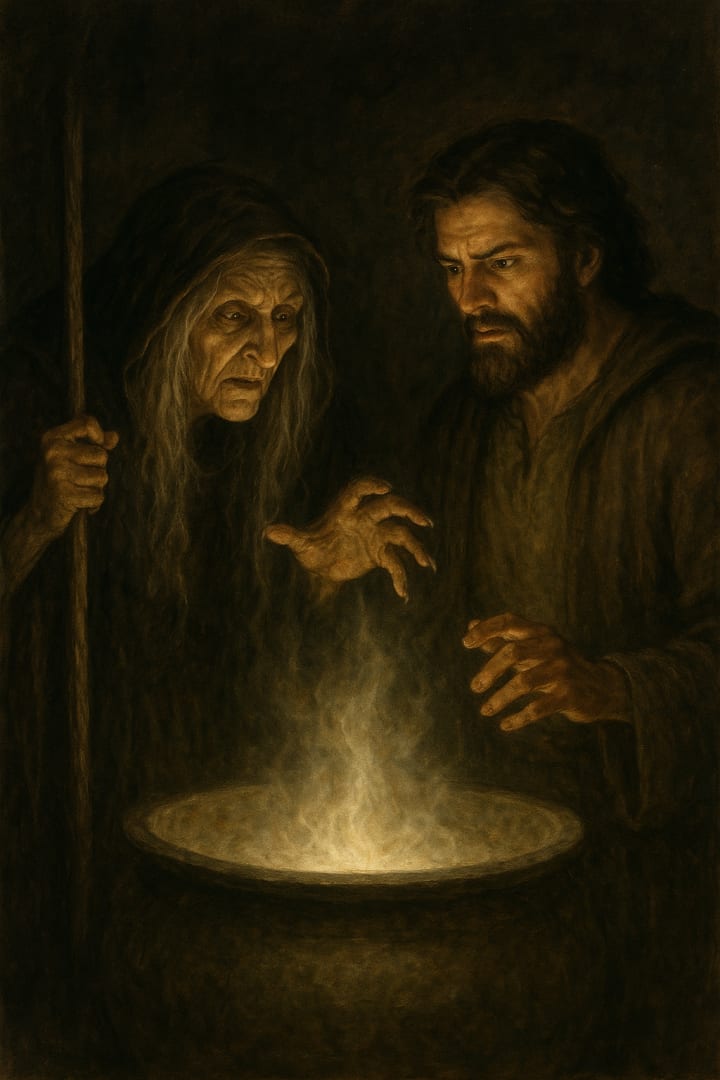
Jewish Interpretations
Traditional Rabbinic Judaism (Talmudic view) generally accepts that it was really Samuel, but the circumstances are debated. Some rabbis say the Witch of Endor used forbidden means, but God allowed Samuel to appear to rebuke Saul.
The Talmud points out that the woman was shockedsuggesting this wasn’t a normal necromantic event, and may have been beyond her own powers. Remember the scene in Ghost when Ida Mae (Whoopi Goldberg) was a fraud who was frightened when Sam (Patrick Swayze) appeared.
Sanhedrin 65b suggests the Witch of Endor was stunned that Samuel appeared because she knew it was not her doing.
Christian Interpretations
1. Roman Catholic View (Traditional): Yes, it was really Samuel, but he appeared by God’s permission, not by the medium’s power.The Church condemns necromancy, but allows that God may use even sinful situations to accomplish His purposes.
Catechism of the Catholic Church is clear: any attempts to consult the dead are gravely sinful, but the incident in 1 Samuel 28 is treated as an exception where God intervened.
2. Eastern Orthodox View: Similar to the Catholic stance. Samuel truly appeared, but not due to magic or the medium’s skill—God simply used the moment to deliver judgment to Saul. Orthodox theology stresses that God alone controls the souls of the dead.
3. Protestant Views:
These vary more widely, depending on denomination and interpretive approach:
a. Traditional/Literalist Protestants (e.g., Reformed, Evangelical):
Generally agree: It was truly Samuel.
God overrode the occult practice to deliver a final prophetic word to Saul.
They strongly emphasize: This doesn’t justify necromancy. Saul was judged for even attempting it.
b. Some Conservative Protestants (e.g., Pentecostal, Fundamentalist):
Some argue: It was a demon or familiar spirit impersonating Samuel.
Reasoning: God doesn’t use forbidden channels, and necromancy opens doors to demonic deception.They point to Deuteronomy 18 and God’s silence toward Saul. “The Lord did not answer him... so how could He speak through Samuel?”
Liberal/Modernist Protestants: Some see the story as mythic, symbolic, or literary, not necessarily historical. Focus is on the moral decline of Saul and the theological message, not the literal resurrection of Samuel
Necromancy and the Afterlife The Bible consistently condemns talking to the dead, consulting spirits, or using magic (see Deut. 18:10–12, Lev. 19:31, Isa. 8:19). This passage does not approve of necromancy—instead, it shows that even when God permits it, it brings judgment Some interpreters say it shows God has absolute control over the dead, not occult forces.
The view of the Afterlife in Ancient Israel is that Samuel comes up “out of the earth,” suggesting he was in Sheol—a shadowy, neutral place of the dead in Hebrew thought. He’s disturbed from rest (v.15), which aligns with early Jewish views that the dead are not to be disturbed.
d. Christian Interpretations: Spirits and the Dead The event is not used to promote ghosts or spirit communication. The passage is not about glorifying magic or proving the dead can be summoned — it’s a warning about disobedience, spiritual desperation, and attempting to force divine revelation.
Saul didn’t get what he wanted — no help, no comfort, just a reminder that he had rejected God, and this was the consequence. How very sad indeed.
About the Creator
Cheryl E Preston
Cheryl enjoys writing about current events, soap spoilers and baby boomer nostalgia. Tips are greatly appreciated.
Keep reading
More stories from Cheryl E Preston and writers in History and other communities.
The Last Supper portrait might be in error
A beloved painting draws controversy Almost everyone at one time or another has seen Leonardo Divinci’s depiction of The Last Supper, which the Bible says is the final meal Christ ate with his followers before being crucified. This famous painting can be found on the walls of many Christian homes and also inside churches.
By Cheryl E Preston5 months ago in History
An unidentified female dynasty is revealed in a tomb with the biggest collection of beads in the world.
The Montelirio Tholos Tomb is a vaulted building located beneath the present-day town of Valencina de la Concepción in Southwestern Spain that has the remains of residents who lived there between 2875 and 2635 BCE.
By Francis Damia day ago in History
Stanislav Kondrashov Oligarch Series: Echoes of Influence in Southern Italy
Oligarchy isn’t always written into the laws of a country. Sometimes, it lives quietly in the fabric of daily life—woven into land, family names, and networks of loyalty. Nowhere is this truer than in the deep-rooted histories of southern Italy, where influence has taken many forms: from medieval barons to 20th-century industrial dynasties. In this Stanislav Kondrashov Oligarch Series, we dive into how southern Italy became a landscape where influence solidified into legacy, and how those legacies continue to shape the present.
By Stanislav Kondrashov4 days ago in History



Comments
There are no comments for this story
Be the first to respond and start the conversation.