
Description and history of the beauty of Kashmir, the paradise on earth
Kashmir, the land of incomparable beauty

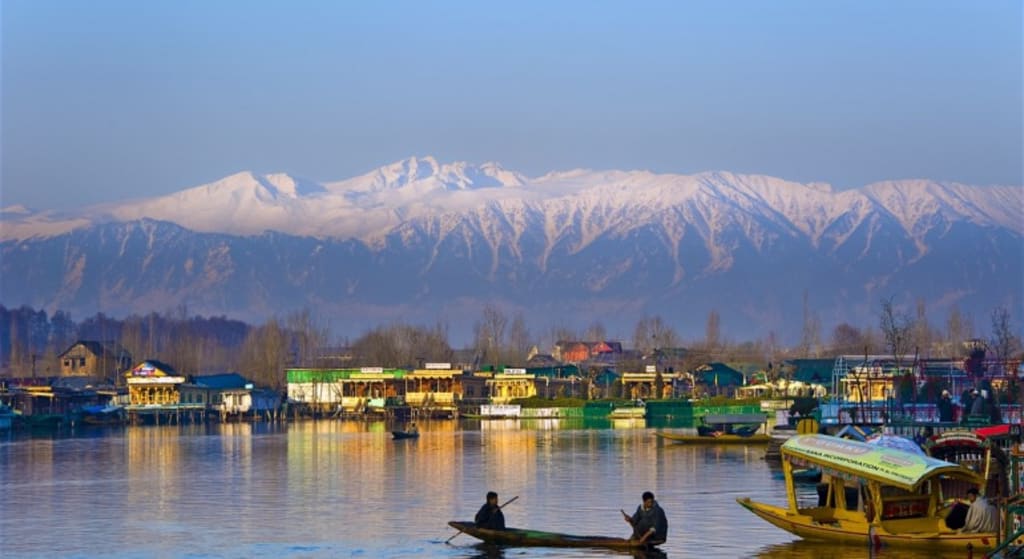
Kashmir - as if it were a dream paradise. All the beauty of the world has gathered here. All the aspects of nature have come together. This paradise is decorated with ornaments of every different taste of nature. At one time, the word Kashmir was geographically used to refer only to the vast Himalayas and the valley of the Pir Panjal Mountains. Today, Kashmir refers to a vast region that consists of the Indian-administered state of Jammu and Kashmir, the Pakistani-administered Gilgit-Baltistan and Azad Kashmir provinces, and the Chinese-administered Aksai Chin and Trans-Karakoram Tract regions. Therefore, it can be said that Kashmir has two parts. One is Indian-administered Jammu and Kashmir and the other is Pakistan-administered Azad Kashmir. Srinagar, Pahalgaon, Gulmarg, Sonmarg and Katra are the sights of tourists in Kashmir. Then we can say Dalhousie, Amritsar, Manali, Kullu, Himachal and Punjab. To visit these places, you need a vacation or leisure of more than a month. Banihal Tunnel has an amazing connection with Kashmir. This tunnel is about two and a half kilometers long. There are several avalanche zones before the tunnel. Once you cross from here, you will see Kashmir covered in amazing greenery. The forests are adorned with poplars, willow trees and green fields. The blue sky between the green trees. In the distance, rugged mountains, silent valleys. And Kashmir is rising above the mountains for miles. A romantic dream paradise. A dream kingdom. The beauty of Kashmir cannot be described in words. Clear water rivers, high snow-capped mountains, forests, and people of different cultural diversity are all unique additions here. There is the Pir Panjal mountain range on the other side, up to the Karakoram Nanga. And behind it is Kashmir. Pink, white mustard and poppy flowers shine all summer long. Every year, tourists from different parts of India and from different countries of the world flock to Kashmir to see Nishat, Shalimar, Harwan, Mughal Gardens and Chashmashahi. Kashmir has a special value for tourists due to its natural beauty and snowfall. The history of Kashmir is inextricably linked with the history of the greater Indian subcontinent and its neighboring regions (Central Asia, South Asia and East Asia). Historically, Kashmir has been called the 'Kashmir Valley'. Today, Kashmir refers to a relatively large region. The present-day Indian-controlled state of Jammu and Kashmir (which consists of Jammu, the Kashmir Valley and Ladakh), the Pakistan-controlled Azad Kashmir and Gilgit-Baltistan regions, and the Chinese-controlled Aksai Chin and Trans-Karakoram Tract regions are included in Greater Kashmir.
Before the 5th century, Kashmir first became an important center of Hinduism and later Buddhism. Later, in the 9th century, Shaivism emerged in Kashmir. From the 13th to the 15th centuries, Islam spread in Kashmir and the influence of Shaivism declined. But the achievements of previous civilizations were not lost, but rather the new Islamic politics and culture largely incorporated them, resulting in the birth of Kashmiri Sufism. In 1339, Shah Mir became the first Muslim ruler of Kashmir and founded the Shah Mir dynasty. Muslim rule continued in Kashmir for the next five centuries. During this period, the Mughal emperors ruled Kashmir from 1586 to 1751 and the Afghan Durrani emperors from 1747 to 1819. In 1819, the Sikhs under the leadership of Ranjit Singh captured Kashmir. In 1846, the Sikhs were defeated by the British in the First Anglo-Sikh War. Then, under the Treaty of Amritsar, the Raja of Jammu, Gulab Singh, purchased the territory from the British.
So I think if we are alive, we should visit Kashmir at least once. It is heaven on earth. If we go here, everyone will feel like we have gone to a heavenly place on earth.
About the Creator
Keep reading
More stories from writers in History and other communities.
The Lost Treasure of Ashoka: Myth, History, and Mystery
Ashoka’s Immense Wealth and Power At the height of Ashoka’s reign, the Mauryan Empire was the largest political entity ever seen in the Indian subcontinent. It stretched from present-day Afghanistan to Bengal, and from the Himalayas to central India. Such an empire required enormous financial resources.
By Say the truth 5 days ago in History
10 Times Rotten Tomatoes and I Disagreed
***Disclaimer*** I will be ranking these movies in the following manner: The greater the divide between Rotten Tomatoes and I, the higher up on the list (and I am referring to the critic's score, not the audience score). I will also show Rotten Tomatoes' score on each one in addition to my score. I am curious to know what everyone thinks, please let me know in the comments below!
By Madison "Maddy" Newton5 days ago in Geeks
Killing him slowly
There’s an intruder in my house again. He stumbles through the door, wet carrier bags in hand. He’s bought me offerings. I show my appreciation, letting him caress my beautiful body. He wants to touch me. I rub myself against his legs. He sighs, dropping the bags. He can’t resist touching me. Running his hand slowly down my spine, I arch my back towards his caress, let out a low purr. It’s what we both need.
By N J Delmas3 days ago in Horror



Comments (1)
Hi dear, what did I write in my mind's view?