
Decoding Indus Scripts
By Jeyakuamr Ramasi - Ex IRS. Govt of India
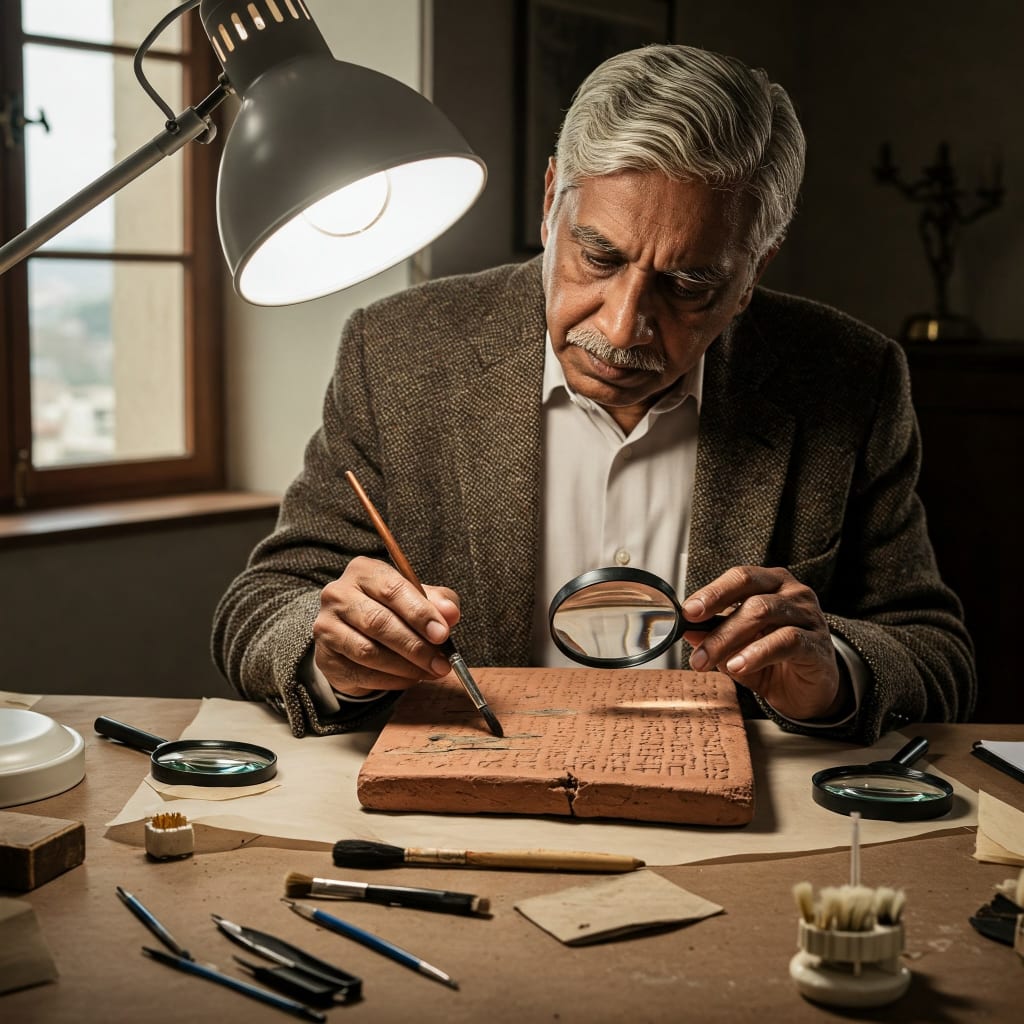
What if we are on the verge of deciphering one of the world's oldest undecoded writing systems? The Indus Valley script has remained an enigma for over a century — until now.
🏺 The Indus Valley Civilization: An Ancient Giant
Long before the rise of Rome or the Great Wall of China, the Indus Valley Civilization flourished across what is now modern-day India and Pakistan. From around 3300 to 1300 BCE, this urban culture boasted advanced city planning, a complex trade network, and a unique writing system — the Indus script — carved onto thousands of seals, tablets, and pottery shards.
Despite decades of archaeological discovery, the symbols of the Indus script remain undeciphered. The script, composed of short sequences of pictorial signs, lacks any bilingual texts like the Rosetta Stone for Egyptian hieroglyphs. This absence has kept scholars guessing about what these symbols mean — or if they even constitute a fully developed language.
💡 A Fresh Perspective: IndusScriptsDeciphered.com
This is where my research project comes in.
At IndusScriptsDeciphered.com, I present a new, open-access platform dedicated to analyzing, interpreting, and decoding the Indus script using a multidisciplinary approach. The site is the result of years of independent research, linguistic modeling, and comparative symbol analysis, presented in a form that both scholars and curious readers can access and explore.
Here’s what makes this project different:
Pattern Recognition: I study symbol frequencies, sequences, and recurring pairings across hundreds of inscriptions.
Linguistic Hypotheses: I propose meanings for select symbols by cross-referencing them with early Dravidian roots and cultural context.
Interactive Tools: The website includes symbol indexes and visual aids to guide exploration.
Transparency: All interpretations are openly published, encouraging feedback and collaborative refinement.
🔍 Key Discoveries and Proposals
Among the notable insights published on the site:
Many Indus symbols may be syllabic, not purely pictographic — suggesting a phonetic system that may align with proto-Dravidian languages.
Certain recurring signs appear to indicate titles, professions, or trade goods, based on seal contexts and usage patterns.
Spatial placement and repetition of symbols point toward grammatical structures, potentially including affixes or case markers.
These findings don’t claim to have “solved” the script — but they represent meaningful progress grounded in data and comparative logic. The goal isn’t just to crack the code but to build a strong foundation for continued exploration and debate.
🌐 Explore the Website
At IndusScriptsDeciphered.com, you’ll find:
A symbol-by-symbol breakdown of Indus signs with proposed meanings
Detailed research articles on grammar, syntax, and trade-related inscriptions
A growing database of seals, including contextual analysis
A regularly updated blog on the decoding process and archaeological news
Whether you’re an academic, a student of history, or simply fascinated by ancient mysteries, the site is designed to invite curiosity, conversation, and critical thinking.
🔮 Why This Matters
The Indus script is more than a puzzle — it’s a gateway to understanding one of humanity’s earliest urban cultures. Deciphering it could illuminate how the people of the Indus Valley governed their cities, traded goods, performed rituals, and recorded their identities.
In a world where so much of ancient history has been recovered, the Indus script remains one of the last great linguistic frontiers. And with today’s tools — digital analysis, pattern recognition, and interdisciplinary collaboration — we have a better chance than ever of making progress.
🙌 Join the Journey
I invite you to:
Visit the site at IndusScriptsDeciphered.com
Explore the research and see the reasoning behind each symbol interpretation
Share your thoughts or critiques — the project thrives on open dialogue
Spread the word if this work resonates with you
Together, we can take a step closer to understanding a language that has been silent for over 4,000 years.
Thank you for reading. Let’s decode history — one symbol at a time.
About the Creator
Keep reading
More stories from writers in History and other communities.
The Lost Treasure of Ashoka: Myth, History, and Mystery
Ashoka’s Immense Wealth and Power At the height of Ashoka’s reign, the Mauryan Empire was the largest political entity ever seen in the Indian subcontinent. It stretched from present-day Afghanistan to Bengal, and from the Himalayas to central India. Such an empire required enormous financial resources.
By Say the truth 8 days ago in History
Living in a hemp house
Hemp, a multi-purpose crop that delivers fibres, shivs, seeds, and pharmaceuticals is currently used in insulation materials and bio-composites for a more sustainable construction industry. Russ Martin and his wife Karon Korp tell their story as owners of the first hemp house in the U.S.
By Susan Fourtané 7 days ago in Interview
10 Times Rotten Tomatoes and I Disagreed
***Disclaimer*** I will be ranking these movies in the following manner: The greater the divide between Rotten Tomatoes and I, the higher up on the list (and I am referring to the critic's score, not the audience score). I will also show Rotten Tomatoes' score on each one in addition to my score. I am curious to know what everyone thinks, please let me know in the comments below!
By Madison "Maddy" Newton8 days ago in Geeks



Comments
There are no comments for this story
Be the first to respond and start the conversation.