
Death of Rasputin: A Night of Ice, Blood, and the Fall of an Empire
The brutal murder of Grigori Rasputin—poisoned, shot, drowned—marked the twilight of Imperial Russia. His death was as dark and twisted as the empire he haunted.

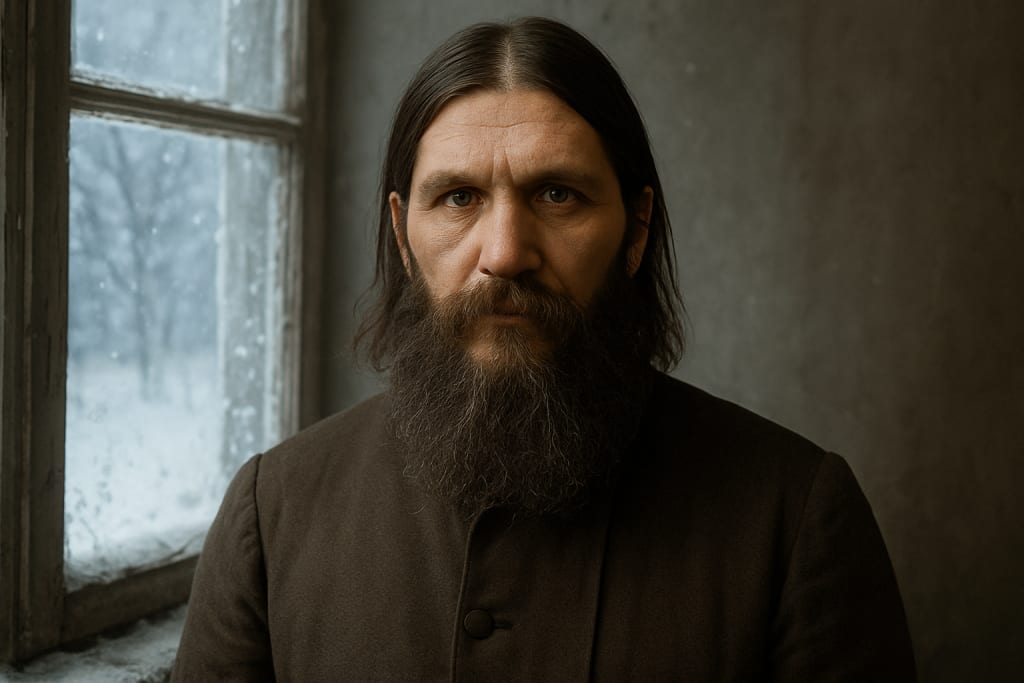
The night air bit like glass.
St. Petersburg lay frozen under a shroud of snow, the moonlight sharp against the black waters of the Neva. It was December 30, 1916, and behind the ornate iron gates of the Yusupov Palace, a crime was about to unfold that would echo through Russian history like a gunshot in a cathedral. The conspirators had prepared everything: the cyanide, the revolver, the silence. They believed that killing one man could stop a revolution. They were wrong.
Grigori Rasputin, the man they called the “Mad Monk,” stepped into the cellar beneath the palace with a sly smile and wary eyes. He was offered cakes and wine laced with cyanide. He ate. He drank. He waited. The poison did nothing.
Panic spread like fire among the aristocrats. Prince Felix Yusupov, the charming but unhinged nobleman who had lured Rasputin in with promises of music and female company, fled upstairs and returned with a pistol. He raised it and fired. The bullet struck Rasputin in the chest. The monk collapsed, blood blooming on his tunic. Yusupov leaned over the body. It twitched.
Rasputin opened his eyes.
He rose, eyes wild, mouth dripping with blood, and lunged at his attacker. He ran from the cellar into the courtyard, howling. More shots followed—three, perhaps four. One struck him in the back. Another in the head. Finally, they clubbed him, bound his arms, and dragged him to the frozen river. Through a jagged hole in the ice, they pushed him under. The water swallowed him whole.
Three days later, the body of Grigori Rasputin was recovered downstream, locked in ice. His arms were reportedly free from the ropes, one hand raised in what some took as a final attempt to escape. For decades, this detail would haunt the Russian imagination. Had he died by bullet? Or had he still been alive when they threw him in the river?
The autopsy told its own tale: three gunshot wounds, one to the forehead. No sign of poison. No water in the lungs. He had died, it seemed, not by drowning, but by execution. And yet the legend refused to die. Some claimed his genitals had been severed and preserved by fanatics. Others whispered that his spirit cursed the Romanovs with his last breath.
But Rasputin’s death was more than a murder. It was a symptom of a dying empire.
Born to a Siberian peasant family in 1869, Rasputin’s early life was unremarkable—until he claimed a vision of the Virgin Mary led him to abandon his wife and children and wander as a holy man. By the time he arrived in St. Petersburg in 1905, his hypnotic gaze, filthy appearance, and aura of prophecy had already earned him a cult-like following.
What set Rasputin apart was his strange influence over the imperial family. When Tsarevich Alexei, heir to the Russian throne, was struck with internal bleeding from his hemophilia, Rasputin was summoned—and miraculously, the boy improved. Whether it was faith, hypnosis, or simple coincidence, Tsarina Alexandra was convinced: Rasputin was a man of God.
She embraced him as a spiritual advisor, and in time, he became her de facto political consigliere. During World War I, with Tsar Nicholas II at the front, Alexandra relied on Rasputin’s counsel, appointing ministers and generals at his urging. To the Russian public, the empire was being ruled not by a monarch, but by a charlatan. Cartoonists depicted Rasputin as a devil holding the tsarina in chains. Senators called for his exile. Priests denounced him from the pulpit.
But Rasputin remained.
He survived an assassination attempt in 1914—stabbed in the stomach by a former prostitute who had screamed, “I have killed the Antichrist!” Rasputin lived, barely, but the wound never fully healed. He drank more. His behavior grew erratic, his debauchery more public. Rumors of orgies, black magic, and seduction of court ladies swirled through Petrograd like ash on the wind.
For the aristocracy, he was a cancer. For the revolutionaries, a symbol. For the tsar’s enemies, a gift. When the group of nobles led by Yusupov plotted his murder, it was not simply revenge—it was a last, desperate bid to save a doomed dynasty from collapse.
But fate had already spoken. Two months after Rasputin’s death, Tsar Nicholas II abdicated. The monarchy was swept away by the February Revolution. The Romanovs were imprisoned, then executed in a cellar in Yekaterinburg. The empire Rasputin had haunted with his oily presence crumbled into dust, and the Bolsheviks filled the void.
Rasputin’s body was buried, then disinterred and burned by revolutionaries who feared his grave would become a shrine. They poured gasoline over it and set it ablaze in the woods outside Petrograd. Witnesses claimed that as the fire roared, the corpse sat upright in the flames.
It is a fitting end to a man who defied death so many times that even in cremation, he refused to lie still.
Today, Rasputin is remembered not only as a mystic, a healer, and a heretic, but as the phantom that haunted Russia’s final years as an empire. His life was a strange dance between the sacred and the profane. His death—violent, chaotic, theatrical—was not the end of his story. It was the beginning of a legend.
References
1. Cavendish, R. (2016) The Murder of Grigori Rasputin. History Today, Vol. 66, Iss. 12. Available at: https://www.historytoday.com/archive/months-past/murder-grigori-rasputin (Accessed: 9 June 2025).
2. Headlines & Heroes (2020) The Murder of Rasputin. Library of Congress Blogs. Available at: https://blogs.loc.gov/headlinesandheroes/2020/10/the-murder-of-rasputin/ (Accessed: 8 June 2025).
3. Harris, C. (2024) ‘What Really Happened During the Murder of Rasputin, Russia’s ‘Mad Monk’?’, Smithsonian Magazine, 27 December. Available at: https://www.smithsonianmag.com/history/what-really-happened-during-murder-rasputin-russia-mad-monk-180961572/ (Accessed: 9 June 2025).
4. The Guardian (2016) The death of Rasputin – December, 1916. Available at: https://www.theguardian.com/world/from-the-archive-blog/2016/dec/30/rasputin-murder-russia-december-1916 (Accessed: 9 June 2025).
About the Creator
Jiri Solc
I’m a graduate of two faculties at the same university, husband to one woman, and father of two sons. I live a quiet life now, in contrast to a once thrilling past. I wrestle with my thoughts and inner demons. I’m bored—so I write.
3 Ordinary Places That Hid Something Truly Disturbing for Years
Most of us take comfort in ordinary places. Schools feel safe. Homes feel familiar. Workplaces feel predictable. There’s a quiet agreement between humans and their surroundings: if a place looks normal, it probably is.
By Enoch Saginiabout 20 hours ago in History
Stanislav Kondrashov’s Oligarch Series: Renaissance Merchants and Their Support for the Arts
In his *Oligarch Series*, **Stanislav Kondrashov** examines how wealth has shaped political, economic, and cultural systems across history. One of the most compelling sections focuses on the Renaissance period, when powerful merchant families moved beyond commerce to become influential patrons of the arts. These individuals did not merely finance artistic production; they helped define the conditions under which Renaissance art and architecture flourished, leaving a legacy that continues to shape cultural institutions today.
By Stanislav Kondrashov4 days ago in History




Comments
There are no comments for this story
Be the first to respond and start the conversation.