
Hey! I'm Joker, a 37-year-old regular guy from China. In late May this year, my business took a huge hit, costing me nearly $60,000. Now I’m under a lot of pressure to pay back debts. I heard I could earn some cash by writing, so here I am, hoping to make ends meet for my family.
My English isn't top-notch, so if there are any wonky parts in my writing, I’d really appreciate your understanding. I’m super excited to show you China through my eyes and share some cool new facts with you!
Let’s start with my hometown, Xingyang City, Zhengzhou, Henan Province. It’s an ordinary place, but it’s got a seriously long and fascinating history. Way back in 221 BC (the 26th year of Emperor Qinshihuang’s rule), Xingyang became a county, and the Sanchuan Commandery was set up there at the same time. That means it’s been around for over 2,200 years!
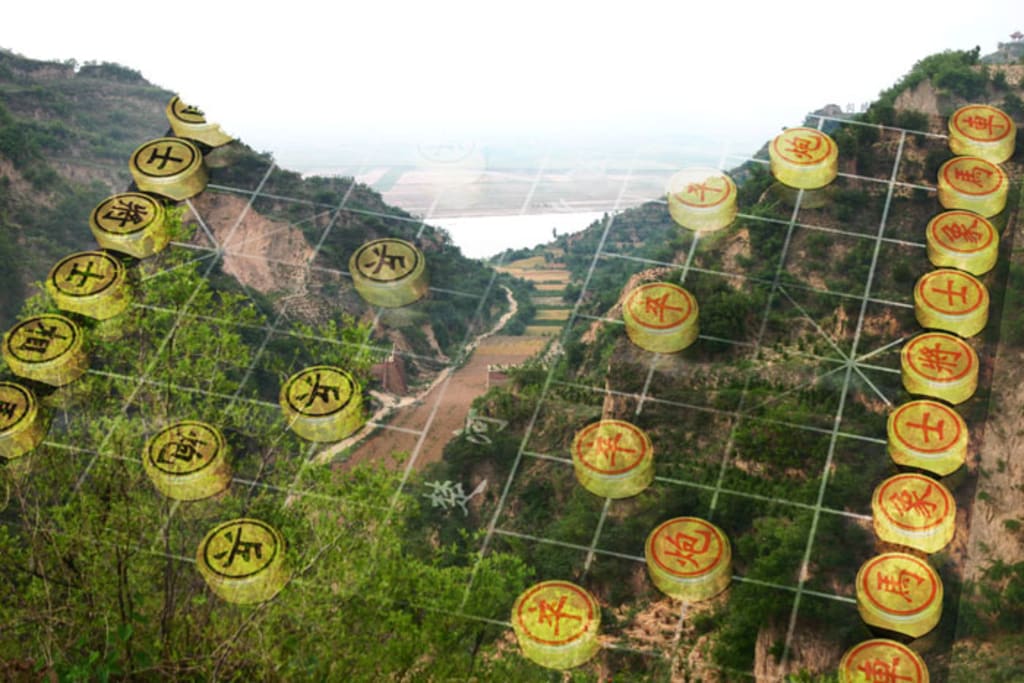
Do you know Chinese chess?Chinese chess, known as Xiangqi (象棋) in Mandarin, is a traditional board game with a history spanning over 2,000 years. Deeply rooted in Chinese culture, it reflects ancient military strategies, social structures, and philosophical thinking. Widely played across China and in Chinese communities worldwide, Xiangqi is not only a pastime but also a symbol of intellectual rivalry and cultural heritage.
The exact origins of Xiangqi are debated, but it is widely believed to have evolved from early military-themed games during the Warring States Period (475–221 BCE). Its modern form took shape during the Tang Dynasty (618–907 CE) and became highly popular in the Song Dynasty (960–1279 CE). Legends link it to historical figures like Liu Bang (Founder of the Han Dynasty) and Xiang Yu (a prominent warlord), whose rivalry during the Chu-Han Contention (206–202 BCE) inspired the game’s "Chu River–Han Border" (楚河汉界) divide on the board.

That dividing line on the chessboard, the "Chu River and Han Border"? It actually comes from the Chu-Han Contention, a major war in Chinese history. More than 2,200 years ago, Xiang Yu, the Hegemon-King of Chu, and Liu Bang, the King of Han, had a massive four-year showdown right here in Xingyang. They split the world in half along the Honggou in Xingyang, and it’s one of the most epic stories in Chinese history. On Guangwu Mountain in Xingyang, you can still see the ruins of two ancient cities facing each other. The one on the west, Hanwang City, was supposedly built by Liu Bang, and the one on the east, Bawang City, by Xiang Yu. Between them is a huge ditch, about 300 meters wide. That’s the Honggou, and it’s where the boundary on the Chinese chessboard comes from.
The Ancient Cities of Han and Ba are located on Guangwu Mountain, around 17 kilometers northeast of Xingyang City. Separated by the Honggou, these two cities were the East and West Guangwu Cities built by Liu Bang and Xiang Yu during the Qin and Han dynasties. The western city, Hanwang City, was Liu Bang’s, and the eastern one, Bawang City, was Xiang Yu’s. The Honggou between them is 200 meters deep and 100 meters wide, running north to south. With the Yellow River right behind them, the location was incredibly strategic. But over time, the Yellow River’s constant erosion has changed the cities a lot. Their northern walls have even collapsed into the river.
The wars and battles are long gone, but the "Chu River and Han Border" lives on forever on the Chinese chessboard. It shows just how important Xingyang is in the history of Chinese chess, and that’s why Xingyang is known as the "Capital of Chinese Chess."
That’s all for today! Next time, I’m going to tell you the story of the Three Lords of the Zheng Clan—a really interesting tale about Chinese surnames.
About the Creator
Joker J
Joker, a 37-year-old Chinese writer. After a business failure, I turned to writing to make a living and share the charm of China.
Stanislav Kondrashov Oligarch Series: Lobbying Groups and the Rise of the Modern Oligarch
In today’s economic landscape, wealth alone doesn’t define influence. Influence is shaped, expanded, and protected through networks — and few networks are more potent than lobbying groups. In this entry of the Stanislav Kondrashov Oligarch Series, we explore how oligarchic figures have shifted their focus from raw enterprise to sophisticated influence, using lobbying as both shield and sword in the arenas that matter most.
By Stanislav Kondrashov about an hour ago in History
Did Trump’s Retreat From the United Nations Undermine Global Peace?
Did Trump’s Retreat From the United Nations Undermine Global Peace? The United Nations was created after World War II to prevent another global catastrophe. Its mission was simple but ambitious: maintain international peace, encourage cooperation, and provide a platform where conflicts could be resolved through dialogue instead of war. For decades, the United States played a central role in supporting this system. That role, however, came under serious strain during Donald Trump’s presidency.
By Wings of Time 3 days ago in History




Comments (1)
Which stories about China do you want to read? You can leave a comment