
Celestial Marvels: A Deep Dive into Solar Eclipses
Unveiling the Mysteries of Nature's Spectacular Alignment


In the grand theater of the cosmos, few celestial events capture the imagination quite like a solar eclipse. This mesmerizing phenomenon occurs when the moon passes between the Earth and the Sun, momentarily casting a shadow upon our planet and turning day into an eerie twilight. But what exactly is a solar eclipse, and why do they fascinate both astronomers and casual sky watchers alike? Let's embark on a journey to uncover the magic and science behind these captivating occurrences.
Understanding Solar Eclipses:
A solar eclipse is a rare alignment of the Sun, the Earth, and the Moon, where the Moon temporarily blocks the Sun's light from reaching parts of the Earth's surface. This alignment occurs only during the new moon phase when the Moon is positioned directly between the Earth and the Sun. However, not every new moon results in a solar eclipse due to the tilt of the Moon's orbit relative to Earth's orbit around the Sun.
Types of Solar Eclipses:
Solar eclipses come in three main varieties: total, partial, and annular.
- Total Solar Eclipse: During a total solar eclipse, the Moon completely covers the Sun, obscuring its entire disk from view. This creates a surreal spectacle where the sky darkens, stars become visible, and the Sun's corona—a faint, glowing halo around the Sun—becomes visible to the naked eye. Total solar eclipses are relatively rare events that occur about once every 18 months somewhere on Earth's surface.
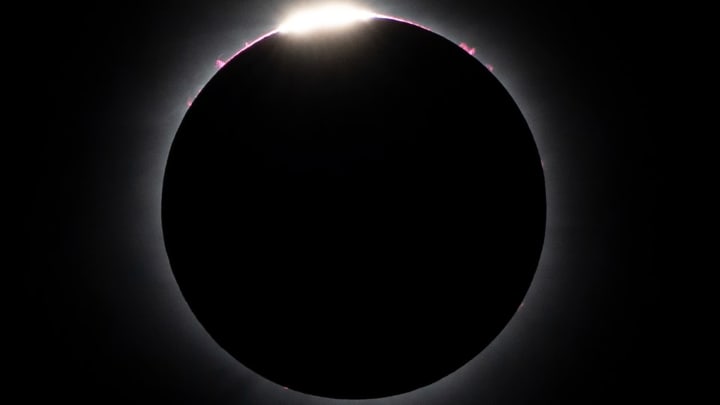
- Partial Solar Eclipse: In a partial solar eclipse, the alignment is such that only a portion of the Sun is obscured by the Moon as seen from Earth. While not as dramatic as a total eclipse, a partial eclipse still offers a remarkable sight as the Sun appears to have a 'bite' taken out of it.
- Annular Solar Eclipse: An annular solar eclipse happens when the Moon is too far away from the Earth to completely cover the Sun's disk. As a result, a ring of sunlight remains visible around the edges of the Moon, creating what's often called the "ring of fire" effect.
The Path of Totality:
The most anticipated aspect of a total solar eclipse is the path of totality—the narrow corridor on Earth's surface where the total eclipse is visible. This path can vary in width and trajectory with each eclipse and is typically only a few dozen to a couple of hundred miles wide. Astronomy enthusiasts and eclipse chasers often travel far and wide to witness this rare event from within the path of totality, as it offers the most dramatic and immersive experience.
Safety Precautions:
While solar eclipses are undeniably awe-inspiring, it's crucial to observe them safely to protect your eyesight. Staring directly at the Sun, even during an eclipse, can cause permanent damage to your eyes. Specialized solar filters, such as eclipse glasses or solar viewing goggles, must be used to safely observe the event. Alternatively, you can create a pinhole projector or use indirect viewing methods to witness the eclipse without risking eye injury.
Eclipses around the world:
Here are a few more impending total solar eclipses, following paths that may ignite wanderlust in travelers:
- July 22, 2028: Australia and New Zealand
- November 25, 2030: Namibia, Botswana, South Africa, Lesotho, Australia
- March 20, 2034: Nigeria, Cameroon, Chad, Sudan, Egypt, Saudi Arabia, Iran, Afghanistan, Pakistan, India, China
- September 2, 2035: China, North and South Korea, Japan
- July 13, 2037: Australia and New Zealand
- December 26, 2038: Australia and New Zealand
- April 30, 2041: Angola, the Democratic Republic of Congo, Uganda, Kenya, Somalia
- April 20, 2042: Malaysia, Indonesia, Brunei, the Philippines
- April 9, 2043: Russia
Conclusion:
Solar eclipses serve as poignant reminders of the intricate dance of celestial bodies that govern our universe. From ancient civilizations to modern-day astronomers, humanity has marveled at the beauty and mystery of these rare cosmic events. Whether viewed as a scientific phenomenon or a spiritual experience, a solar eclipse unites people from all walks of life in a shared moment of wonder and contemplation beneath the darkened sky. So, the next time a solar eclipse graces the heavens, take a moment to pause, look up, and marvel at the celestial spectacle unfolding before your eyes.
About the Creator
Keep reading
More stories from Afeef Khan and writers in History and other communities.
The Rise and Fall of Pan American World Airways
Pan American World Airways, commonly known as Pan Am, was once an aviation giant that symbolized the epitome of luxury air travel and global connectivity. Founded in 1927, Pan Am played a pivotal role in shaping the airline industry, introducing innovations, and making air travel accessible to people worldwide. However, the soaring success of Pan Am eventually gave way to a tragic descent, marked by financial challenges, geopolitical shifts, and the changing landscape of the aviation industry.
By Afeef Khan2 years ago in History




Comments (1)
Amazing 🤩 wonderfull story