

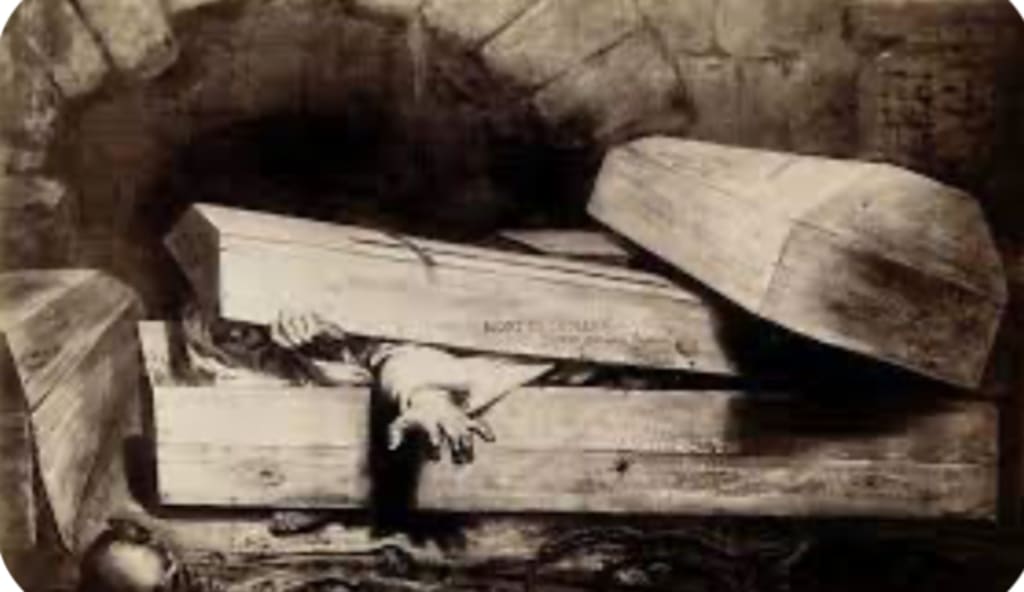
The fear of being buried alive, a phenomenon known as taphophobia, has been a part of human history for centuries, fueled by both real and imagined cases of premature burial. Historically, this fear was particularly pronounced in the 18th and 19th centuries due to factors like the difficulty of accurately diagnosing death, the prevalence of contagious diseases like cholera which could cause comas, and the resulting haste in burial practices. In some cases, individuals were actually buried alive due to medical misdiagnosis or misjudgment, leading to tragic and horrifying outcomes.
Historical Context and Fear of Premature Burial:
Ancient Times:
While the practice of burial was widespread, the concept of being buried alive likely gained traction as societies developed and medical understanding improved, revealing the possibility of misdiagnosis.
18th and 19th Centuries:
This period witnessed a surge in fear of being buried alive, fueled by various factors:
Inaccurate Medical Diagnoses: The medical knowledge of the time was limited, making it difficult to distinguish between death and coma or other states of deep unconsciousness.
Prevalence of Diseases: Contagious diseases like cholera and typhus could induce comas, which were often mistaken for death, leading to hasty burials.
Superstition and Folklore: Stories and legends about being buried alive were often passed down through generations, reinforcing the fear and suspicion of premature burial.
Modern Times:
While modern medicine and advanced burial practices have greatly reduced the risk of premature burial, the fear remains, fueled by historical accounts and continued fascination with the topic.
Examples of Historical Cases:
John Duns Scotus:
Accounts from the 14th century suggest that the corpse of the philosopher John Duns Scotus was found outside his coffin with bloodied hands, potentially suggesting a case of premature burial.
Philomèle Jonetre:
In 1867, a woman named Philomèle Jonetre, who contracted cholera, was buried after being mistakenly declared dead, only to be dug up later when a gravedigger heard tapping.
Essie Dunbar:
Essie Dunbar, who was also mistakenly buried alive due to a coma caused by cholera, managed to escape her coffin and seek help.
Octavia Hatcher:
In 1889, a woman named Octavia Hatcher was buried alive after being mistakenly pronounced dead due to a coma, according to a story in The National Museum of Funeral History.
Alice Blunden:
In 17th century England, a woman named Alice Blunden was documented to have been buried alive.
The Shoemaker:
In 1822, a 40-year-old German shoemaker was buried alive, and his body was found the next day with signs of struggling.
Inventions and Precautions:
"Safety Coffins":
To address the fear of being buried alive, various inventions, like safety coffins with bell-rigged systems, windows, and ventilation, were created. That is where the expression “ saved by the bell” originated.
Delaying Burial:
Some cultures practiced delaying burial for several days to allow sufficient time for the "dead" to potentially come back to life. That is where the “wake” comes from.
As early as the 14th century, there are accounts of specific people being buried alive. While likely apocryphal, when his tomb was opened, the body of philosopher John Duns Scotus of the High Middle Ages was reportedly found outside of his coffin, his hands torn up in a way that suggests he had once tried to free himself.
In 17th century England, it is documented that a woman by the name of Alice Blunden was buried alive. As the story goes, she was so knocked out after having imbibed a large quantity of poppy tea that a doctor holding a mirror to her nose and mouth pronounced her dead. (Tea made from dried, unwashed seed pods would have contained morphine and codeine, which are sedatives.) Her family quickly made arrangements for her burial, but two days after she was laid in the ground, children playing near her grave heard noises. Their school master went to check the gravesite for himself. He found that Blunden was still alive, but it took another day to exhume her. She was so close to death that she was returned to her grave, where a guard stood by before deserting his post. The next morning, she was found dead, but only after struggling to free herself once more.
And modern medicine hasn’t totally thwarted tales of being buried alive
When Fagilyu Mukhametzyanov of Kazan in Russia collapsed at home following a heart attack in 2011, she was soon declared dead. A few days later, as she was lying in her casket at her own funeral, she woke up. She saw the mourners around her, crying and praying for her, quickly twigged to what was happening, began yelling, and was rushed back to the hospital. She lived for an additional 12 minutes in intensive care prior to dying once more, this time for good. The cause of death? Heart failure.
Walter Williams of Mississippi was pronounced dead on February 26, 2014. As CNN reported, the correct paperwork was completed, his body was put into a body bag, and he was taken to a funeral home. When his body was taken to the embalming room, his legs began to move. Then, the coroner noticed him lightly breathing. Williams was alive. It was, as it turned out, a short-lived reprieve. Just over two weeks later, he passed away for real.
And now for the case of the greatest buried alive and coming back to life event known to history. Jesus Christ.
The "Swoon Theory" posits that Jesus didn't die on the cross but rather fainted due to the ordeal, and then revived in the tomb, leading his disciples to mistakenly believe in his resurrection. This theory suggests that he was able to overcome the guards and the sealed tomb to appear to his followers.
Here's Here's a more detailed breakdown of the Swoon Theory:
Jesus didn't die:
The core of the theory is that Jesus never actually died on the cross. He simply passed out from the physical trauma of the crucifixion, including the scourging, the weight of the cross, and the nail wounds.
Revival in the tomb:
After being placed in the cool tomb, Jesus revived and was able to move around.
Mistaken for resurrection:
His disciples, already distraught and hopeful, may have mistaken his appearance in the tomb for a resurrection.
Overcoming the tomb and guards:
The theory suggests that, in his revived state, Jesus somehow overcame the massive stone sealing the tomb and the Roman guards.
While the Swoon Theory is a proposed explanation for the resurrection, it faces significant challenges. Many people believe that the physical evidence of the crucifixion would have been too severe to allow for a revival. Additionally, the sheer number of people who claimed to see the resurrected Jesus, including his former enemies, makes the "mass hallucination" theory less plausible.
Revival in the tomb:
After being placed in the cool tomb, Jesus revived and was able to move around.
Mistaken for resurrection:
His disciples, already distraught and hopeful, may have mistaken his appearance in the tomb for a resurrection.
Overcoming the tomb and guards:
The theory suggests that, in his revived state, Jesus somehow overcame the massive stone sealing the tomb and the Roman guards.
While the Swoon Theory is a proposed explanation for the resurrection, it faces significant challenges. Many people believe that the physical evidence of the crucifixion would have been too severe to allow for a revival. Additionally, the sheer number of people who claimed to see the resurrected Jesus, including his former enemies, makes the "mass hallucination" theory less plausible.
Paul's Understanding of accounts of Jesus' death and resurrection in the four Gospels were written decades after the events they describe, not by eyewitnesses. The earliest Gospel, Mark, is believed to have been written around 70 CE, which is about 40 years after Jesus' death, which is generally dated to 30 CE. Matthew and Luke followed around 80-85 CE, and John about 95 CE.
So this what I think happened. The Romans commonly executed criminals by crusifixtion, it was not a special event, and usually it wasn’t observed by many people. The victims weren’t loved and admired by a following of enthralled people who cared for them. Their deaths were ignored and forgotten by society. But on this special occasion, things were different. Jesus had a following of enthralled disciples who attended the execution, and after everyone else left the scene, took Jesus down from the cross and carried him to the cave which became his tomb. The two other criminals who were also crucified with Jesus were left hanging on the crosses dead, and eventually buried by the authorities, in a mass grave. because no one cared for them like the disciples cared for Jesus. The guards who remained on duty didn’t or couldn’t stop the disciples from taking Jesus’ body away and just let him be placed in the tomb. He was a nobody, just another criminal. They didn’t care about him, and didn’t want to get involved with the disciples and their desires.
so when 3 days later Jesus revived from his coma of his ordeal from what happened to him by the crucifixtion, by being able to recover by the ministrations of his loved ones by taking him off the cross and placing him lying down wrapped in a sheet in a cool cave, he was able to walk out of the cave with the help of his disciples who rolled the heavy door back, escorted Jesus away, distracted the Roman guard so he wouldn’t stop them, and basically made the resurrection happen. The low level guard wouldn’t want to admit to his imcompetence to his superiors, so he pled ignorance as to what happened. The rest is history as we know it. The actual events weren’t written down until 30 or 40 years later, and even then the Bible was edited and rewritten by biblical aurthorities for political and propaganda reasons to make a case which served their religious needs. A compelling story. And it worked. Two thousand years have passed, and Jesus’ death and resurrection are now a part of legend. And when he finally did die a few days later from the whole ordeal, his body was buried in the woods . The real story, what really transpired, will never be known.
About the Creator
Guy lynn
born and raised in Southern Rhodesia, a British colony in Southern CentralAfrica.I lived in South Africa during the 1970’s, on the south coast,Natal .Emigrated to the U.S.A. In 1980, specifically The San Francisco Bay Area, California.



Comments
There are no comments for this story
Be the first to respond and start the conversation.