
Between Vigilance and Adaptation
The United States and Europe Confront the Challenges of the 21st Century

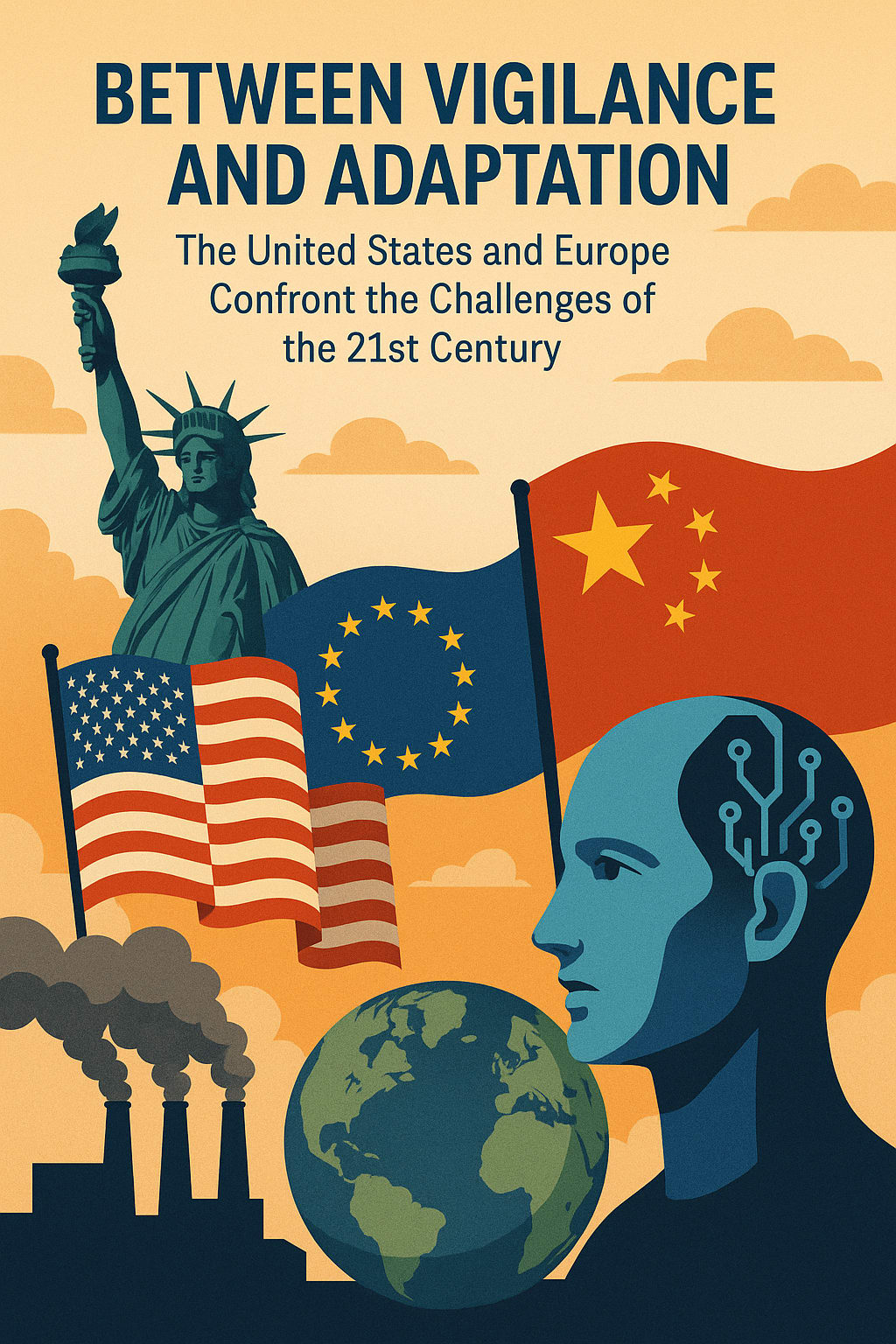
As the world enters an era of accelerated transformation, the two traditional poles of the West — the United States and Europe — must confront emerging powers, technological ruptures, and unprecedented ecological upheavals. Their strategic survival will depend less on their past than on their ability to anticipate the future.
I. Facing China: Asymmetrical Competition and Interwoven Dependencies
China represents the most formidable geopolitical challenge for both the United States and Europe in the 21st century. With its population of 1.4 billion, its rapidly growing economy, and its authoritarian political model, China has evolved from a developing country to a global superpower in just a few decades. For the United States, China is both the primary strategic rival and the main economic competitor. For Europe, it is a complex partner—at once client, supplier, investor, and political adversary.
The United States, since the Obama and especially Trump administrations, has clearly redefined China as a systemic rival. The trade war initiated under Trump, maintained and adapted under Biden, marked the end of an era of naive globalization. Washington now targets not just trade imbalances but technological and military dominance. Export restrictions on semiconductors, the decoupling of critical supply chains, and the CHIPS Act all aim to slow Beijing’s progress, particularly in AI, quantum computing, and 5G. The U.S. seeks to preserve its hegemony in key sectors, aware that China wants to challenge the current global order.
At the same time, American power is based on alliances. The Indo-Pacific strategy aims to contain Chinese expansionism through the Quad (Japan, India, Australia, U.S.), AUKUS (U.K., Australia, U.S.), and strengthened ties with Taiwan. Washington asserts its military presence, defends freedom of navigation in the South China Sea, and supports regional democracies. However, this policy of deterrence risks fueling tensions. The Taiwan issue remains a potential flashpoint, and any miscalculation could lead to open conflict.
Europe, meanwhile, maintains a more ambivalent stance. The EU defines China as a "partner, competitor, and systemic rival"—an expression of its hesitations. Economically, China is indispensable. It is the EU’s second-largest trading partner, a crucial supplier of rare earths, and a growing investor in European ports and infrastructure. Germany’s automotive sector, France’s luxury goods, and southern Europe’s construction sectors are highly dependent on Chinese demand. Europe, more than the U.S., has allowed itself to become structurally dependent.
However, Beijing’s assertiveness, its human rights violations in Xinjiang and Hong Kong, and its military posture in the Indo-Pacific have awakened European consciousness. The concept of "de-risking" (reducing vulnerabilities without cutting ties) has emerged. Ursula von der Leyen promotes a Europe that is less naive, more sovereign, and more united in the face of Chinese power. Initiatives such as screening foreign investments, establishing strategic reserves, and supporting European tech champions are gaining momentum.
But fragmentation persists. France wants strategic autonomy, Germany seeks a balanced relationship, Eastern Europe is wary of Chinese influence, and southern countries prioritize investment. The EU struggles to speak with one voice. Unlike the U.S., it lacks military means to assert itself. It remains a "civilian power" in a world of realpolitik. That makes it vulnerable to coercion.
Despite these differences, transatlantic coordination is improving. The Trade and Technology Council (TTC) aims to align regulations, secure supply chains, and jointly address Chinese challenges. NATO, though historically focused on Russia, is beginning to integrate the China issue into its strategic vision. The West is learning to coordinate without always converging.
In the face of China, the stakes are colossal. The issue is not just economic or military—it is ideological. Can liberal democracies resist the appeal of an authoritarian capitalism that promises growth without freedom? Will the West remain united or be divided by its dependencies? The answer will determine whether the 21st century is multipolar, bipolar, or fractured.
II. Climate: Between Symbolic Leadership and Real Transition
Climate change represents not just an environmental threat, but a test of political will, industrial transformation, and global leadership. For both the United States and Europe, the challenge is twofold: reducing their own emissions while pushing others—especially major emerging economies—to act. Yet their approaches, resources, and vulnerabilities differ significantly.
The United States has swung between denial and ambition. Under Donald Trump, the country withdrew from the Paris Agreement and dismantled many federal climate regulations, weakening global momentum. Joe Biden's return to the agreement and passage of the Inflation Reduction Act (IRA), however, marked a strategic reversal. The IRA allocates hundreds of billions to clean energy, electric vehicles, and energy efficiency—positioning the U.S. as a key player in green innovation.
Yet contradictions remain. The U.S. remains the world’s largest producer of oil and gas. Fossil fuel lobbies retain strong influence in Congress. Many states, especially Republican-led ones, resist federal climate mandates. While the private sector—particularly tech and finance—is accelerating decarbonization, national coherence is lacking. The U.S. climate agenda remains vulnerable to political cycles, especially with the possibility of a new conservative administration.
Meanwhile, Europe has built its identity as a normative leader on climate. The European Green Deal, the Fit for 55 package, and the Carbon Border Adjustment Mechanism (CBAM) signal a desire to be both ambitious and coercive. The EU imposes targets, regulates emissions, and subsidizes green transitions across its member states. It seeks to shape global standards, from sustainable finance to green taxonomy.
But European leadership is fragile. The war in Ukraine exposed its energy dependence—particularly on Russian gas—and forced a short-term return to coal in some countries. Inflation and social protest (e.g., the Yellow Vests in France, farmer movements in Germany and the Netherlands) show the political risks of too rapid a transition. Green fatigue threatens public support, especially in times of economic uncertainty.
Moreover, intra-European divergences are stark. Northern Europe leads in renewables and circular economies, while Eastern and Southern countries struggle with aging infrastructure and high energy poverty. Financing the transition raises questions of solidarity and redistribution. The EU must balance environmental ambition with social cohesion and industrial competitiveness.
The transatlantic dimension adds complexity. Biden’s IRA, although green, includes protectionist provisions that disadvantage European companies. Brussels sees it as an unfair subsidy war. The response—a relaxation of state aid rules and the Net-Zero Industry Act—marks the start of an industrial race for green technologies. Cooperation and rivalry are once again intertwined.
Despite tensions, both blocs face a common adversary: time. The climate window is closing fast. Without radical emission cuts this decade, the 1.5°C target becomes unreachable. Droughts, floods, wildfires, and climate migration already reshape geopolitics. Climate diplomacy is no longer a moral cause—it is a strategic imperative.
Will the West lead by example or lose credibility? Can it reconcile growth and ecology, sovereignty and solidarity, ambition and realism? The answers will determine not just the health of the planet, but the legitimacy of liberal democracies in a world on edge.
III. Artificial Intelligence: Technological Race, Ethical Dilemmas, Digital Sovereignty
Artificial intelligence (AI) is not just a tool—it is a transformational force that reshapes economies, democracies, and warfare. As the pace of AI development accelerates, the global balance of power will increasingly depend on who leads in algorithms, data, computing infrastructure, and governance. The United States and Europe, while aligned in values, diverge in capabilities, strategies, and visions of digital sovereignty.
The United States remains the undisputed AI frontrunner in terms of innovation, investment, and talent. American tech giants—Google (DeepMind), OpenAI (partnered with Microsoft), Meta, Amazon—are pushing the boundaries of generative models, autonomous systems, and AI research. Silicon Valley benefits from venture capital abundance, elite universities, and a high-risk innovation culture. The U.S. also controls a large share of global cloud infrastructure and AI training data.
However, this dominance raises governance challenges. Regulation is minimal and largely sector-driven. The Biden administration has introduced an AI Executive Order and guidelines for trustworthy AI, but Congress has yet to adopt binding legislation. Ethical oversight is fragmented, and whistleblowers warn about bias, misinformation, surveillance, and labor exploitation. The tension between innovation and accountability remains unresolved.
Militarily, the U.S. is investing massively in AI for defense. The Pentagon sees AI as essential for autonomy in combat, cyberwarfare, and strategic deterrence. The AI race is tightly linked to national security. Yet it raises moral questions: should lethal autonomous weapons be banned? How to prevent algorithmic escalation or hacking of AI systems? These dilemmas are mostly debated outside official institutions.
Europe, by contrast, lacks tech champions but leads in regulation. The EU AI Act, adopted in 2024, is the first comprehensive attempt to classify AI risks, prohibit harmful uses, and require transparency and human oversight. Brussels positions itself as the world’s normative superpower, as it did with the GDPR on data privacy. Europe bets on human-centric AI—ethical, inclusive, and sustainable.
But ambition clashes with reality. European startups face funding gaps and a fragmented market. Data access is limited compared to the U.S. or China. Infrastructure (e.g., GPUs, data centers) is underdeveloped. Universities struggle to retain talent, many of whom are recruited by American or Chinese firms. While the EU promotes digital sovereignty, its tech dependence remains acute.
In terms of military applications, Europe is cautious. AI in defense is mainly national (e.g., France’s Scorpion program or Germany’s interest in drone swarms), and the EU’s common defense strategy lags far behind NATO or U.S. initiatives. There is widespread political reluctance to weaponize AI, especially among civil society and Green parties.
Geopolitically, both blocs confront China’s techno-authoritarianism. Beijing invests heavily in AI for mass surveillance, social scoring, and military dominance. It exports its model to autocracies. The U.S. and EU have begun to coordinate on AI standards through initiatives like the G7’s Hiroshima Process, the OECD, and the Global Partnership on AI. But their internal divergence hinders joint leadership.
Moreover, transatlantic frictions persist. The EU criticizes the U.S. for underregulating Big Tech and failing to prevent data exploitation. U.S. firms fear that EU rules stifle innovation. Trust is further strained by extraterritorial surveillance and tensions over digital taxes. Yet both sides acknowledge that setting global AI norms is a race against time and autocracy.
Beyond regulation and power, AI poses an existential question: what kind of society do we want? How to ensure democratic control over machines that learn and decide faster than we do? Can AI serve social justice, or will it amplify inequality and disinformation? The West must invent not just AI that works, but AI that reflects and protects its values.
If the U.S. represents the muscle of AI, Europe aspires to be its conscience. For their partnership to thrive, both must bridge the gap between power and principle. Their ability to shape AI governance will determine whether digital futures are democratic, pluralistic, and human-centered—or dominated by authoritarian efficiency.
About the Creator
Alain SUPPINI
I’m Alain — a French critical care anesthesiologist who writes to keep memory alive. Between past and present, medicine and words, I search for what endures.
Keep reading
More stories from Alain SUPPINI and writers in History and other communities.
Mastering French Without Losing Your Sanity: A Realistic Guide for Beginners
Learning French can feel like solving a Rubik’s Cube blindfolded. The tricky pronunciation, the never-ending grammar rules, and the surprising exceptions make it seem impossible. But don’t worry—equipping yourself with key expressions and effective strategies can turn frustration into fluency. Let’s simplify French and make learning enjoyable.
By Alain SUPPINIExclusive • 11 months ago
Is NATO Facing Its Biggest Crisis Yet?
Is NATO Facing Its Biggest Crisis Yet? For more than seventy years, NATO has been one of the strongest military alliances in the world. Formed after World War II, it was designed to protect its members through collective defense. An attack on one was considered an attack on all. For decades, this principle helped maintain stability in Europe and beyond. But today, NATO is facing one of the most challenging moments in its history.
By Wings of Time 3 days ago in History
The Ritual of Winter Challenge Winners
Welcome to the Winners Announcement for The Ritual of Winter challenge. This prompt focused on winter rituals and the meaning that settles into them over time. The top pieces stay grounded in ordinary acts and repeated routines, letting winter shape the work through pace, attention, and restraint.
By Vocal Curation Team6 days ago in Resources


Comments
There are no comments for this story
Be the first to respond and start the conversation.