
🇺🇸🇪🇺 Two Paths, One Uncertain World
The United States vs. Europe, A Global Balance Sheet

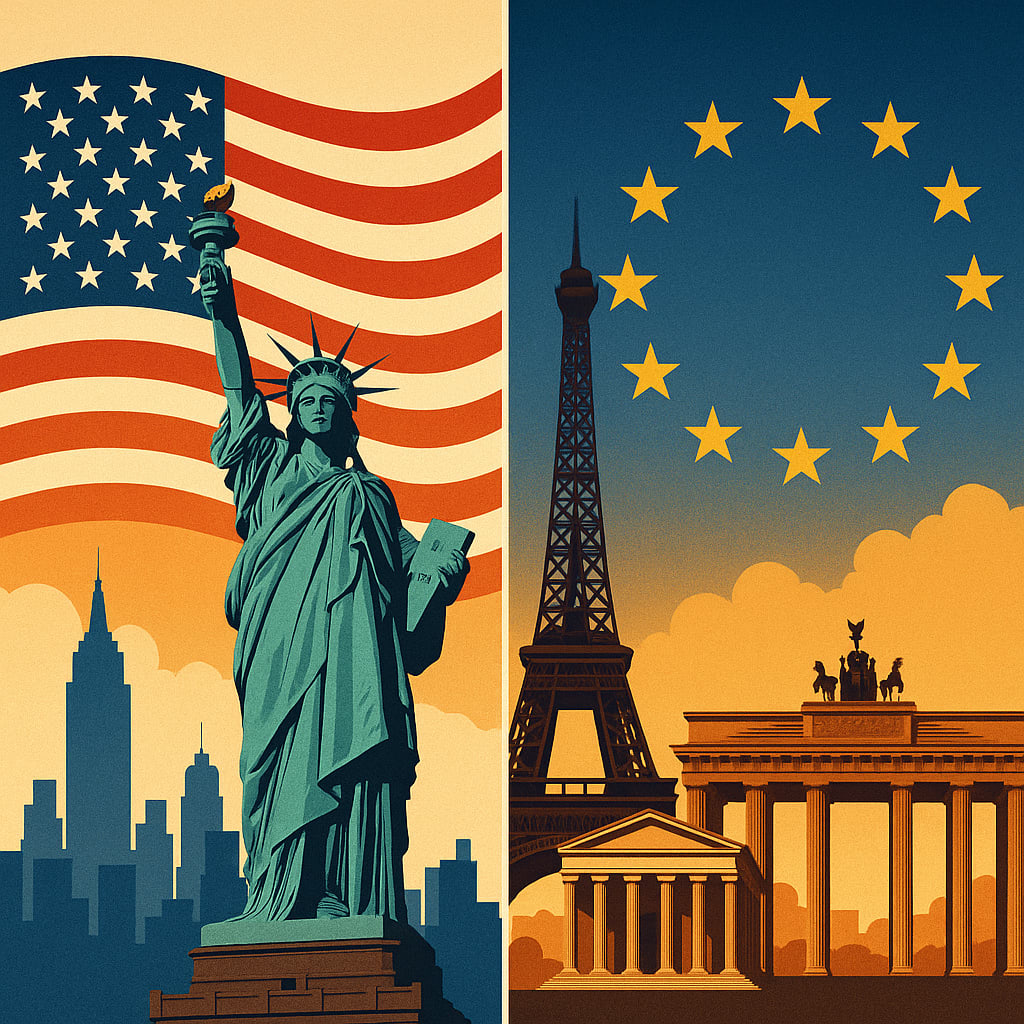
As the 21st century unfolds, a key question arises: between the United States and Europe, who best embodies power, stability, and adaptability in a rapidly changing world? Beyond statistics and symbols, two worldviews meet, compete, and sometimes complement one another.
I. Two Histories, Two Memories
The history of the United States is fundamentally a story of rupture — a deliberate break from monarchy, feudalism, and inherited privilege. It is a young nation by global standards, born of revolution in 1776 and shaped by the Constitution of 1787, a blueprint for republican ideals, individual liberty, and checks and balances. From the outset, America imagined itself as the "new world," unburdened by the weight of ancient grievances, propelled by frontier expansion, industrial dynamism, and a deep belief in manifest destiny. Its national mythos champions reinvention, innovation, and constant progress.
Europe, by contrast, is a palimpsest of civilizations — shaped by empires, schisms, migrations, wars, renaissances, and reconstructions. Its collective memory is layered, complex, and often contradictory. It is a continent of immense cultural wealth, but also of historical trauma: two world wars, the Holocaust, colonial violence, ideological extremism. This shared memory fosters both deep introspection and an enduring caution in its political and diplomatic posture. European identity is fragmented and pluralistic, bound more by shared experience than by a unifying narrative.
These diverging historical paths profoundly influence global behavior. The U.S. projects strength through decisive action — military, technological, financial — often with unilateral momentum. Europe favors negotiation, consensus-building, and multilateralism. Where the U.S. celebrates individual success and risk-taking, Europe values collective well-being and institutional safeguards. One is a future-driven society; the other, a continent of historical consciousness. In this tension lies both the root of their global influence and their current limitations.
II. Military Power and Global Reach
Since 1945, the United States has maintained a military presence that is unparalleled in scope and capacity. With bases in more than 70 countries, a global naval fleet, and advanced satellite and cyber capabilities, the Pentagon operates with a doctrine of "full-spectrum dominance." It is capable of waging simultaneous large-scale conflicts, managing deterrence in multiple theaters, and shaping global military norms. The defense industry, closely tied to Silicon Valley and government funding, constantly innovates in drones, AI, and hypersonics. Companies like Lockheed Martin, Raytheon, and SpaceX are not just industrial players but geopolitical actors in their own right.
Europe, while collectively spending more on defense than any other bloc after the U.S., suffers from duplication and fragmentation. The lack of a unified military doctrine, incompatible hardware systems, and diverging strategic cultures — particularly between Western and Eastern Europe — limit its ability to act as a singular force. Initiatives like the European Defence Fund and the PESCO framework aim to enhance cooperation, but progress is slow. Moreover, the dependence on NATO — and by extension, American security guarantees — remains fundamental, especially in the face of Russian aggression and an unstable neighborhood.
In terms of soft power, Europe traditionally excels: diplomacy, humanitarian aid, rule-of-law promotion, and peacekeeping are its strengths. But these tools are increasingly challenged by a multipolar world in which authoritarian regimes act with impunity. The U.S., despite internal divisions, retains an unmatched mix of coercive capability and global leadership architecture. Europe’s challenge is to translate its normative power into real geopolitical clout — without losing its ethical compass. The fundamental question remains: Can Europe become a true strategic actor, or is it doomed to remain a principled bystander?
III. Innovation, Economy, and Social Models
Economically, the United States has mastered the art of transformation. From the post-war boom to the tech revolution, America adapts quickly to new paradigms. The rise of Silicon Valley, fueled by elite universities, venture capital, and a culture that embraces failure as part of growth, has kept the U.S. at the forefront of digital innovation. It dominates in artificial intelligence, quantum computing, biotechnology, and private spaceflight. Big Tech — Google, Apple, Microsoft, Meta, Amazon — are not just companies; they are the infrastructure of global capitalism.
Europe, while highly developed, lags behind in global digital dominance. It has strong industrial champions — Airbus, Siemens, SAP — and robust small and medium-sized enterprises. But it struggles with regulatory fragmentation, investor risk-aversion, and insufficient capital for scaling startups. Moreover, its digital single market remains incomplete, hampering pan-European innovation. Nevertheless, Europe leads in key sectors such as green technologies, pharmaceuticals, and sustainable agriculture. The European Green Deal represents a long-term economic bet on ecological transition — one that could make it a leader in climate-oriented industries.
Socially, Europe outpaces the U.S. in most welfare metrics. Universal healthcare, accessible education, generous parental leave, and worker protections are the norm. These systems produce lower poverty rates, greater life satisfaction, and longer life expectancy. But they come with costs: rigid labor markets, high taxes, aging populations, and slower growth. The American model, in contrast, promotes upward mobility and entrepreneurship, often at the expense of safety nets. The results are stark: more billionaires, more tech unicorns — but also more homelessness, medical bankruptcies, and gun violence.
Two systems, each with their merits and flaws: Europe prioritizes collective dignity; the U.S. rewards individual initiative. The future may require hybridization — balancing dynamism with inclusion, innovation with stability.
IV. Identity, Democracy, and Social Cohesion
Democracy in the United States is at a crossroads. The storming of the Capitol in January 2021 was not an anomaly but a symptom of deeper erosion: electoral gerrymandering, disinformation, voter suppression, and declining institutional trust. Political polarization has hardened into cultural warfare, with rural-urban, racial, and generational divides sharpening. The Supreme Court’s politicization, congressional gridlock, and the role of money in politics undermine the democratic promise. Yet civil society remains vibrant, protest movements active, and the system — though strained — still resilient.
Europe’s democratic health is uneven but comparatively stable. Institutions like the European Parliament and national democracies function within a framework of rule of law and human rights protections. The European Court of Justice and the European Court of Human Rights provide legal recourse for citizens against abuse. However, rising populism, authoritarian tendencies in Hungary and Slovakia, and growing discontent with EU bureaucracy test the system’s legitimacy. Voter apathy, especially among youth, and fears of national identity loss are challenges the EU must address.
Social cohesion, too, reflects these differences. In Europe, the post-WWII imperative of "never again" has fostered policies of inclusion, memory preservation, and solidarity — albeit unevenly. Immigration, Islamophobia, and economic inequality remain stress points. In the U.S., racial injustice, opioid addiction, mass incarceration, and economic disenfranchisement undermine unity. America’s strength — diversity and reinvention — is also its weakness when institutions fail to mediate conflict.
Ultimately, the U.S. embodies a democracy of confrontation, where rights are contested openly. Europe leans toward consensus and institutional mediation. Both models face unprecedented stress tests in the coming decades — from climate migration to digital surveillance to AI-driven governance.
V. Soft Power: Culture, Language, and Global Appeal
America’s soft power is ubiquitous and nearly unrivaled. Hollywood, Netflix, Marvel, hip-hop, Silicon Valley, Ivy League universities, and the omnipresent English language shape global imagination. From Starbucks in Shanghai to Kendrick Lamar in Lagos, American culture sets the rhythm. Its pop culture is not just entertainment — it’s identity formation for billions. The branding of America as the land of freedom, innovation, and reinvention remains potent, even when its reality falls short.
Europe, meanwhile, possesses unmatched cultural heritage: Renaissance art, Gothic cathedrals, classical music, modern philosophy, haute cuisine. It is a museum continent — but not a relic. It inspires through depth and complexity. Paris, Berlin, Rome, and Barcelona are cultural capitals. Yet its influence is slower-moving, often inaccessible to younger global audiences, and undercut by linguistic fragmentation. European culture captivates the thoughtful; American culture captivates the many.
But Europe has begun wielding a new form of soft power: regulatory influence. The GDPR has become a global standard for digital privacy. The European Green Deal offers a roadmap for sustainable development. Its leadership in human rights law, climate diplomacy, and ethical AI marks a shift from cultural to normative power — quieter, but perhaps more enduring.
In essence, America tells the story of the present and the future. Europe reminds us of the lessons of the past. Together, they form the cultural yin and yang of the modern West.
VI. Conclusion: Two Tired Giants, Still Vital
We live in a hinge moment in history. The unipolar world that followed the Cold War is ending. China, India, Russia, and the Global South are asserting new paradigms. Climate change, technological disruption, and social unrest will redraw the map of influence. Both the U.S. and Europe are, in some ways, exhausted empires — dealing with internal contradictions, demographic shifts, and systemic gridlock.
And yet, they remain indispensable. America’s capacity for renewal, Europe’s moral and institutional capital — these are not just relics of past glory. They are tools for adaptation in a world that needs both vision and memory. If the West is to matter in the multipolar century, it must evolve.
Not through rivalry, but through strategic cooperation. By combining American innovation with European sustainability, by marrying agility with wisdom, the transatlantic alliance can still offer a compelling model — not of dominance, but of resilience and shared purpose.
The question is no longer who leads. It is who adapts.
About the Creator
Alain SUPPINI
I’m Alain — a French critical care anesthesiologist who writes to keep memory alive. Between past and present, medicine and words, I search for what endures.
Keep reading
More stories from Alain SUPPINI and writers in History and other communities.
Mastering French Without Losing Your Sanity: A Realistic Guide for Beginners
Learning French can feel like solving a Rubik’s Cube blindfolded. The tricky pronunciation, the never-ending grammar rules, and the surprising exceptions make it seem impossible. But don’t worry—equipping yourself with key expressions and effective strategies can turn frustration into fluency. Let’s simplify French and make learning enjoyable.
By Alain SUPPINIExclusive • 11 months ago
Frozen Ground
Silence meant the guns were cooling. It meant men were waiting. It meant something was about to break. We were dug in along a frozen stretch of road near the Imjin River, the kind of place that didn’t look important until history decided otherwise. The cold wasn’t just uncomfortable—it was personal. It crept into your boots, your bones, your thoughts. At night, I dreamed of heat: radiators, kitchens, the smell of coffee. I woke up with frost on my helmet.
By Gaofeng Wang3 days ago in History




Comments
There are no comments for this story
Be the first to respond and start the conversation.