
Benjamin Franklin: The Lightning Mind of America
Inventor, Statesman, and the Founding Genius Who Sparked a Nation

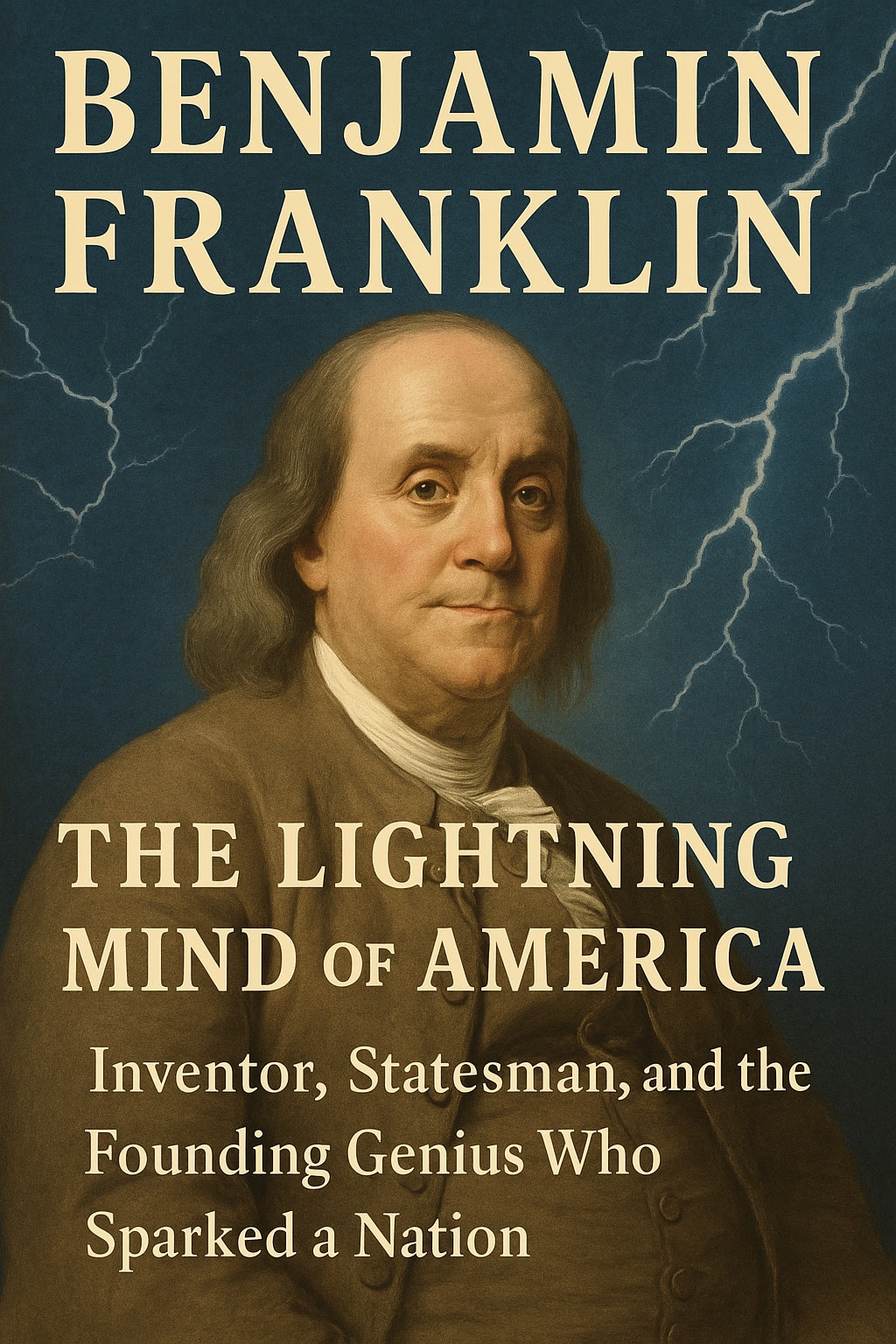
Benjamin Franklin, born on January 17, 1706, in Boston, Massachusetts, was one of the most dynamic minds in American history. He was a man of diverse talents—printer, inventor, writer, philosopher, scientist, diplomat, and one of the Founding Fathers of the United States. His lifelong pursuit of knowledge, self-improvement, and public service made him a symbol of Enlightenment ideals and American ingenuity.
Early Life and Education
Benjamin was the fifteenth of seventeen children born to Josiah Franklin, a candle and soap maker. Despite his limited formal education, which ended when he was just ten years old, Franklin was an avid reader. By the age of twelve, he was apprenticed to his older brother James, a printer, which gave him access to books and a platform to develop his writing skills.
In 1729, after a dispute with his brother, Franklin moved to Philadelphia and eventually bought the Pennsylvania Gazette, turning it into one of the most successful newspapers in the colonies. His Poor Richard’s Almanack, published under the pseudonym Richard Saunders, gained immense popularity for its witty sayings and practical wisdom. Phrases like “A penny saved is a penny earned” became deeply embedded in American culture.
The Inventive Genius
Franklin’s curiosity extended far beyond the printed word. He was a natural scientist and inventor, always seeking ways to improve everyday life. Among his many inventions were the lightning rod, bifocal glasses, the Franklin stove, and a urinary catheter for his brother John. Unlike other inventors of his era, Franklin refused to patent his creations, believing they should be freely used to benefit humanity.
Perhaps his most famous scientific contribution came in 1752 with his kite experiment. By flying a kite during a thunderstorm, Franklin proved that lightning was a form of electricity. This experiment, dangerous and groundbreaking, led to the development of the lightning rod—a device that protected buildings and ships from lightning strikes and saved countless lives.
Civic Leadership and Public Service
Franklin’s love for learning and community led him to establish many important institutions. He helped found the first public library in America, the American Philosophical Society, and the University of Pennsylvania. He also organized the first volunteer fire department and proposed innovative ideas like daylight saving time.
Franklin’s commitment to civic betterment was driven by his belief in self-discipline, public virtue, and the power of an educated citizenry. His famous autobiography outlines his thirteen virtues—like temperance, frugality, and sincerity—that he believed every individual should strive for.
Political Influence and Revolutionary Spirit
Franklin became increasingly involved in politics during the 1750s. He served as Postmaster General and represented Pennsylvania and other colonies in London, trying to prevent conflict between Britain and its American colonies. However, his views shifted over time as British policies became more oppressive. The Stamp Act of 1765 and other measures convinced Franklin that independence was necessary.
Returning to America in 1775, he was appointed to the Second Continental Congress. Franklin was a member of the committee that drafted the Declaration of Independence, alongside Thomas Jefferson, John Adams, and others. His wisdom, reputation, and diplomatic skills helped unify the colonies and garner international support.
Diplomatic Brilliance in France
One of Franklin’s most significant contributions to the American Revolution was his diplomatic mission to France. From 1776 to 1785, Franklin served as the American ambassador in Paris. With his charm, wit, and intellect, he became immensely popular at the French court. His efforts were instrumental in securing France’s military and financial support, a crucial factor in the American victory over Britain.
Franklin’s image in France was almost mythical. He wore a simple fur hat instead of a wig, embodying the idea of the noble American sage. French elites admired him as a man of science and freedom. In 1778, he negotiated the Treaty of Alliance, formalizing French support for the American cause.
Architect of a New Nation
After the war, Franklin returned to America and continued to shape the young nation. He was elected president of the Pennsylvania Executive Council (equivalent to governor) and, in 1787, became the oldest delegate at the Constitutional Convention in Philadelphia. Although his health was failing, Franklin played a critical role in encouraging compromise among the delegates. His presence and speeches added moral weight to the creation of the U.S. Constitution.
In one of his final acts of public service, Franklin became president of the Pennsylvania Society for Promoting the Abolition of Slavery. Though he had once owned slaves, Franklin’s later years were marked by a clear opposition to the institution, making him one of the few Founding Fathers to publicly advocate for abolition during his lifetime.
Legacy and Death
Benjamin Franklin died on April 17, 1790, at the age of 84. His funeral was attended by over 20,000 people in Philadelphia, a testament to the deep respect he commanded. In France, the National Assembly mourned his death with a three-day tribute—an extraordinary gesture for a foreign citizen.
Franklin’s legacy endures not only in the institutions he founded and the inventions he created but also in the ideals he championed: self-improvement, innovation, liberty, and service to the greater good. His image appears on the U.S. $100 bill, and his name graces towns, schools, and organizations across the nation.
He once wrote, “If you would not be forgotten, as soon as you are dead and rotten, either write things worth reading or do things worth the writing.” Benjamin Franklin did both—and in doing so, became the very spirit of the Enlightenment in American form: The Lightning Mind of America.
About the Creator
Irshad Abbasi
"Studying is the best cure for sorrow and grief." shirazi
Keep reading
More stories from Irshad Abbasi and writers in History and other communities.
The Upright Man of Africa
Thomas Sankara, often called “Africa’s Che Guevara,” remains a symbol of integrity, self-reliance, and revolutionary change across the African continent and beyond. Born on December 21, 1949, in Yako, a small town in Upper Volta (modern-day Burkina Faso), Sankara rose from humble beginnings to become a charismatic and principled leader whose short presidency (1983–1987) left a legacy far beyond his years in office. His life was one of unyielding commitment to justice, equality, and anti-imperialism, even at the cost of his own life.
By Irshad Abbasi 7 months ago in History
Be Like Jesus... No - Don't!
My kids and I are Seventh Day Adventists. It is the closest organized religion that I resonate with... for the most part. A key thing is that Saturdays are our Sabbaths. So, today, Sabbath school lessons were not published on the website I use. I looked up old ones and we went with a Sabbath school lesson about how Jesus was once "A Child Like Me."
By The Schizophrenic Mom6 days ago in History
Antarctica Map
Antarctica is the coldest, driest, and windiest continent on Earth. It is located at the southernmost part of the planet, surrounding the South Pole. Because of its extreme weather and thick ice cover, Antarctica is very different from other continents. An Antarctica map helps us understand the shape, location, and important features of this frozen land.
By Farhan Sayedabout 16 hours ago in History



Comments
There are no comments for this story
Be the first to respond and start the conversation.