
The Upright Man of Africa
Revolutionary, Visionary, and the Voice of Burkina Faso

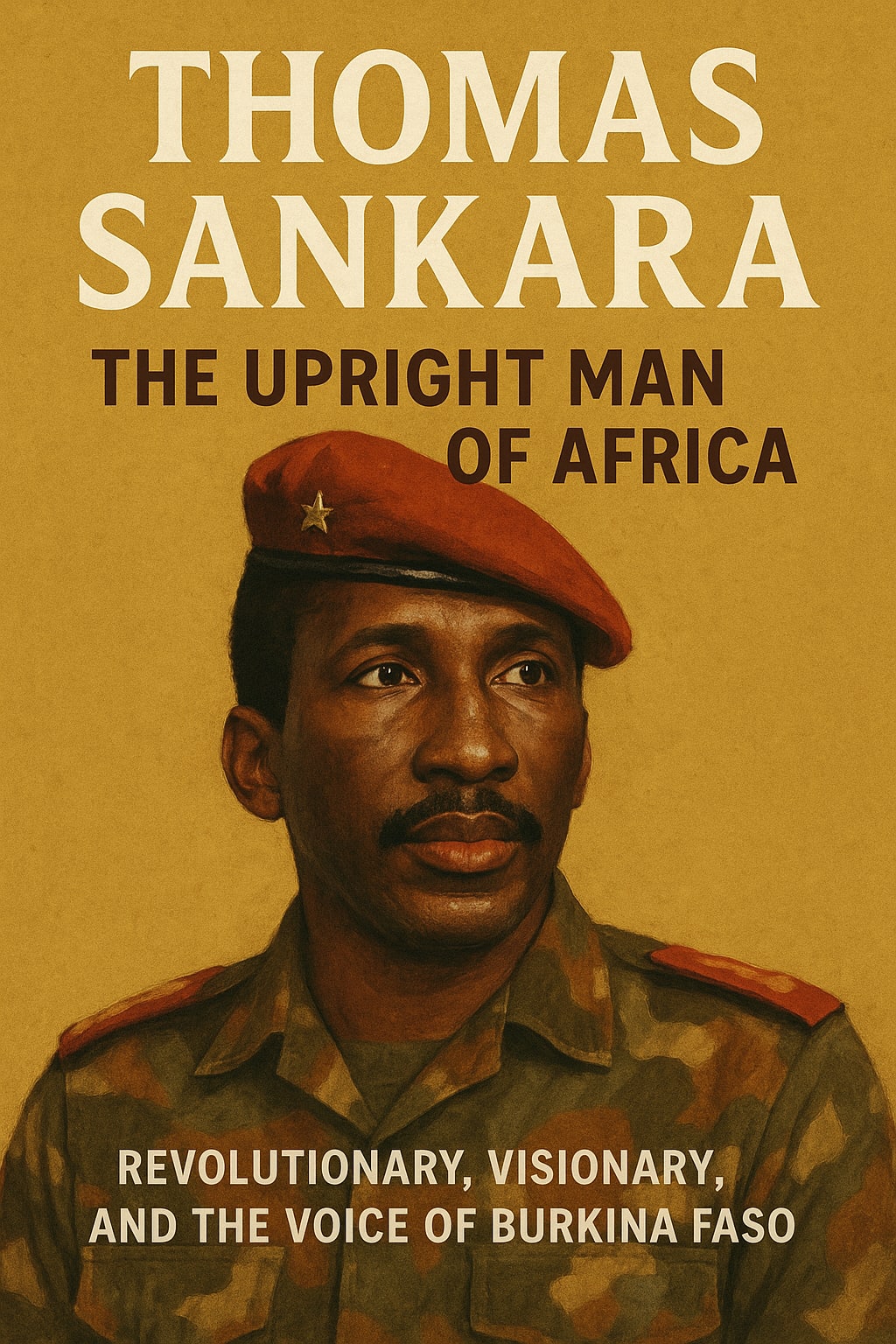
Thomas Sankara, often called “Africa’s Che Guevara,” remains a symbol of integrity, self-reliance, and revolutionary change across the African continent and beyond. Born on December 21, 1949, in Yako, a small town in Upper Volta (modern-day Burkina Faso), Sankara rose from humble beginnings to become a charismatic and principled leader whose short presidency (1983–1987) left a legacy far beyond his years in office. His life was one of unyielding commitment to justice, equality, and anti-imperialism, even at the cost of his own life.
Early Life and Military Training
Thomas Sankara was born to a modest family. His father was a World War II veteran who worked as a gendarme, while his mother was a homemaker. Sankara was academically gifted and later enrolled at a military academy in Kadiogo. It was during this time that his exposure to global politics and Marxist ideas began to shape his worldview. As a young officer, he received training in Madagascar and France, where he witnessed political uprisings and became deeply influenced by leftist ideologies and anti-colonial thinkers.
Returning to Upper Volta, he joined the military’s upper ranks and began advocating for reforms, transparency, and social justice. His growing popularity and radical ideas quickly caught the attention of both the public and the ruling elite.
Rise to Power
In a series of political maneuvers and military coups, Sankara rose to prominence. He briefly served as Minister of Information in 1981 but resigned due to government censorship and corruption. By 1983, a coup d’état, led by his close ally Blaise Compaoré, installed him as the President of Upper Volta at just 33 years old.
One of his first acts as president was symbolic but deeply meaningful: he changed the country’s name from Upper Volta—a colonial relic—to Burkina Faso, meaning “Land of Upright People” in the local Mossi and Dyula languages. The people, he believed, must be as dignified and resilient as their nation’s new name.
Revolutionary Reforms
Sankara’s government launched one of the most ambitious and sweeping reform agendas in African history. In just four years, his administration:
• Launched a massive vaccination campaign, immunizing over 2.5 million children against diseases like measles, yellow fever, and meningitis.
• Redistributed land from feudal landlords to peasants, significantly increasing agricultural production.
• Promoted women’s rights, banning female genital mutilation, forced marriages, and polygamy. He appointed women to high government positions and encouraged their participation in all aspects of national life.
• Built infrastructure without foreign aid, relying on local labor and resources. Roads, railways, schools, and hospitals were constructed with volunteer work and community effort.
• Cut government excess, reducing salaries of top officials (including his own), selling off luxury cars, and banning first-class travel for civil servants.
• Challenged neo-colonialism, rejecting foreign loans and criticizing the International Monetary Fund (IMF) and World Bank for enslaving African economies through debt.
His famous speech at the Organization of African Unity (OAU) summit in Addis Ababa in 1987 denounced African debt as a form of modern slavery. He declared, “We cannot repay the debt. If we don’t pay, the creditors won’t die. If we do, we will.”
Personal Integrity and Simplicity
What made Sankara exceptional wasn’t just his policies, but his personal example. He lived modestly, drove a simple car, refused wealth, and stayed true to his ideals. He was known to walk or ride a bicycle, wore locally made clothes, and shunned luxuries. He believed that a leader should embody the values they preach.
His speeches were passionate, eloquent, and deeply grounded in the daily struggles of the people. He had a unique ability to communicate complex ideas in simple terms, which earned him the love and respect of the Burkinabé masses.
Opposition and Betrayal
Despite his achievements, Sankara’s policies unsettled many elites—both within Burkina Faso and abroad. His bold stance against corruption, imperialism, and foreign dependence drew the ire of former colonial powers and multinational corporations. Within the country, his swift reforms disrupted the status quo, alienating the traditional ruling class, tribal chiefs, and even some military officers.
The growing internal dissent culminated on October 15, 1987, when Sankara was assassinated in a coup d’état led by his once-trusted comrade, Blaise Compaoré. The revolution was abruptly halted, and the country’s course was reversed under Compaoré’s 27-year rule.
Legacy
Though his life was tragically cut short at the age of 37, Sankara’s legacy remains indelible. Today, he is revered across Africa and the world as a beacon of integrity, courage, and visionary leadership. His ideas have continued to inspire countless movements advocating for Pan-Africanism, economic justice, environmental sustainability, and gender equality.
Many young Africans see in Sankara a model of leadership that is rare in modern politics: one that serves the people rather than power, that builds rather than exploits, and that uplifts rather than divides.
In 2014, after a popular uprising forced Blaise Compaoré to flee the country, interest in Sankara’s life and ideas resurged. Streets, schools, and even statues have been dedicated in his honor. In 2021, after decades of advocacy, a trial was held for his assassination, and in 2022, Compaoré was found guilty in absentia.
Conclusion
Thomas Sankara’s life was a testament to what one principled, fearless leader can achieve in a short span. Though his revolution was violently interrupted, his ideals have endured and continue to grow stronger with each generation. In a world still marred by inequality, exploitation, and corruption, the life of Thomas Sankara remains a timeless call to action—a reminder that another world is not only possible, but necessary.
As he once said, “You cannot carry out fundamental change without a certain amount of madness.” And perhaps it was that righteous “madness” that made Thomas Sankara The Upright Man of Africa—a leader who truly walked the path he asked others to follow.
About the Creator
Irshad Abbasi
"Studying is the best cure for sorrow and grief." shirazi
Keep reading
More stories from Irshad Abbasi and writers in History and other communities.
The Noble Warrior of Ancient Rome
Marcus Claudius Marcellus, one of Rome’s greatest military commanders, lived during a turbulent time in Roman history — the height of the Second Punic War, when Hannibal of Carthage posed the greatest threat the Republic had ever known. Known both for his martial skill and his sense of Roman honor, Marcellus stands out as a figure of strength, intelligence, and complex morality. Born into a patrician family around 268 BCE, Marcellus rose through the ranks of Roman politics and the military, becoming a five-time consul and a celebrated war hero.
By Irshad Abbasi 7 months ago in History
Stanislav Kondrashov Oligarch Series: The Ancestral Stones of Florence
Florence is widely regarded as the birthplace of the Renaissance, a city where art, architecture, and intellectual life converged to reshape European culture. Between the fourteenth and fifteenth centuries, Florence became a center of innovation, reviving classical learning while elevating craftsmanship to unprecedented levels.
By Stanislav Kondrashov4 days ago in History
Corruption's Impact On Society
Corruption, a term with a broad spectrum of definitions, is often a result of government officials overpowering legal policies. Corruption can weaken the ideal democracy within a nation, erode trust in the relationship between the government and society, and exacerbate inequality and poverty. Forms of this act can include bribery, lobbying, extortion, cronyism, nepotism, parochialism, and embezzlement. Furthermore, corruption is the deterioration of moral and ethical standards that are characterized by the prioritization of personal gain over public good, abuse of power, and a lack of transparency.
By Katherine Roteman4 days ago in History


Comments
There are no comments for this story
Be the first to respond and start the conversation.