
Beneath the Golden Tides: Revealing the Concealed Mineral Wealth of China's Yellow River
The Yellow River, referred to as Huang He, occupies a venerated position in Chinese heritage. Often dubbed the "Mother River," it serves as the essential artery of northern China and the origin of its earliest dynasties. Although its surface currents have sustained agriculture, commerce, and habitation for over 5,000 years, the valuables hidden beneath its bed and banks are less frequently mentioned. The Yellow River basin is home to a vast and varied array of mineral resources, many of which have influenced China's evolution from ancient empires to its status as a contemporary global power. This article examines the history, significance, and estimated economic worth of the Yellow River’s mineral reserves, emphasizing one of the world’s wealthiest yet frequently neglected natural repositories.


A River Shaping Through Epochs and Stone
The Yellow River traverses a multitude of landscapes: towering mountains, fertile plains, loess plateaus, and desert basins. This journey has enabled it to carve into rock strata rich in minerals, revealing deposits that ancient civilizations soon learned to utilize. As early as the Shang Dynasty (c. 1600–1046 BCE), bronze metallurgy thrived along the river, with copper, tin, and lead extracted locally and crafted into weapons, ceremonial items, and tools.
By the Han Dynasty (206 BCE – 220 CE), systematic mining had become prevalent in the Yellow River provinces, particularly in present-day Shaanxi, Shanxi, Henan, and Gansu. These regions evolved into hubs of iron production, mercury extraction, and gold panning. Inscriptions, historical documents, and artifacts indicate that mining was not only a skilled profession but also a foundation of regional economies.
Wealth Beneath the Surface: Principal Minerals of the Yellow River
The Yellow River basin is a mineralogical tapestry, showcasing a wide array of resources:
Gold
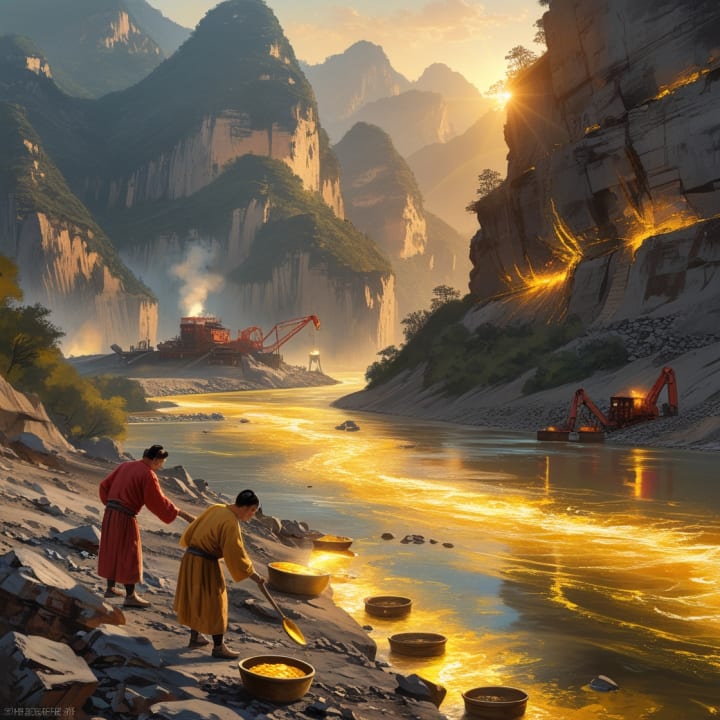
Gold-laden sands and rock veins are particularly abundant in Qinghai and Gansu, along the upper stretches of the river. In antiquity, gold was extracted from riverbeds; today, it is obtained through both surface and subterranean mining.
Silver
Silver is frequently discovered alongside gold or lead-zinc ores, particularly in the central basin. Historical accounts suggest that silver coins and artifacts were fabricated from locally sourced metal during the Tang and Song Dynasties.
Coal
Shanxi Province, located along the central Yellow River, stands as one of China’s most prosperous coal regions. With reserves amounting to hundreds of billions of tons, this area has been pivotal to China’s energy sector for over a century.
Iron and Manganese
Historically utilized for tools, weapons, and subsequently railways and factories, iron ore is significantly concentrated in Shanxi and Henan. Manganese, crucial in steel production, is also mined in adjacent regions.
Copper, Lead, and Zinc
These base metals have been extracted for centuries in Shaanxi and Gansu, powering early bronze industries and now underpinning contemporary electronics and manufacturing.
Rare Earth Elements (REEs)
While more prominent in southern China, northern Gansu and certain areas of Inner Mongolia along the river have been explored for REEs vital to electronics, magnets, and batteries.
Salt and Potash
The lower Yellow River delta has historically served as a source of salt, essential for food preservation, and potash, crucial for agriculture.
Economic Assessment of the Yellow River’s Mineral Resources
Determining the overall economic value of the Yellow River’s mineral resources is intricate, due to variable market rates, unidentified reserves, and ecological restrictions. Nonetheless, based on existing geological and industrial information:
Gold: Estimated at 1,200 tons at approximately $70,000/kg = $84 billion USD
Silver: Estimated at 20,000 tons at about $850/kg = $17 billion USD
Coal: Over 260 billion tons in Shanxi, with recoverable coal valued at $200+ billion USD
Iron Ore: Estimated reserves appraised at $100 billion USD
Copper/Lead/Zinc: Cumulative estimates = $60 billion USD
Rare Earths: Emerging deposits could be worth as much as $10 billion USD
Total projected value: Approximately $471 billion USD
These are conservative valuations and do not account for future discoveries or increasing values due to technological demand, particularly for rare earths and green energy metals.
The Environmental Impact of Resource Wealth
Regrettably, mineral wealth has not come without consequences. Centuries of miningparticularly coal extractionhave left portions of the Yellow River region ecologically damaged. Concerns such as deforestation, air and water contamination, soil degradation, and even alterations to river courses have arisen due to unregulated industrial activities.
Recent decades have witnessed stricter environmental regulations, encompassing mine closures, reclamation initiatives, and moves towards sustainable mining practices. The ongoing challenge lies in how China can reconcile resource extraction with sustainable development within one of its most culturally significant landscapes.
A Legacy of Wealth and Accountability
The mineral deposits within the Yellow River basin are more than mere economic resourcesthey constitute an integral part of China’s civilizational fabric. From the inception of bronze casting to contemporary electric vehicles powered by rare earth elements, the river has contributed to generating not just material wealth but also innovation and cultural identity.
As China continues to progress on the global stage, the Yellow River persists as a potent emblem of both rich heritage and resource potential. The prudent management of its mineral wealth will shape whether future generations can experience not only the river’s abundance but also its lasting beauty and balance.
About the Creator
Say the truth
"Say the Truth: Explain Everything in the World" is your trusted source for uncovering facts and exploring the wonders of history, science, technology, and beyond. We simplify complex ideas and reveal truths to inspire curiosity .
Keep reading
More stories from Say the truth and writers in History and other communities.
The Wealthiest Cathedral in Christianity: A Chronicle of St. Peter’s Basilica
The Origins: A Tomb Transformed into a Basilica The narrative commences in the 1st century CE. According to Christian doctrine, St. Peter, one of Jesus Christ's twelve disciples and viewed as the first Pope, was martyred in Rome during Emperor Nero's rule. He was crucified upside-down and interred in a burial site on Vatican Hill. Over his resting place, Emperor Constantine, the first Roman emperor to embrace Christianity, commissioned a basilica circa 319 CE.
By Say the truth 8 months ago in History
The Timeless Pyramids of Egypt: Stories from the Ancient World
Egypt is home to some of the most remarkable monuments ever built by humans: the pyramids. Rising from the sands of the Giza Plateau, these colossal structures have inspired curiosity and admiration for thousands of years. They were built as tombs for the pharaohs, yet they tell a much larger story—one of human skill, ambition, and belief in the afterlife. The most famous of these pyramids is the Great Pyramid of Giza, built for Pharaoh Khufu around 2580 BCE. Originally, it reached a height of about 146 meters (480 feet) and was the tallest man-made structure in the world for nearly 4,000 years. Its construction required millions of limestone blocks, some weighing several tons. Even today, historians and archaeologists are amazed at the precision and scale achieved by ancient builders without modern tools. The Egyptians built these monumental structures not merely as tombs, but as gateways to the afterlife. They believed that the pharaoh, considered a god on earth, would continue his journey in eternity. The pyramid’s triangular shape symbolized the pharaoh’s ascent to the heavens. Inside, burial chambers held treasures, inscriptions, and statues meant to guide and protect the ruler in the world beyond. How the pyramids were built remains a topic of debate. There are many theories, including the use of ramps or sledges to move the massive stones. Regardless of the methods, constructing these tombs required incredible planning, organization, and teamwork. Tens of thousands of workers labored for decades to create what would become one of the world’s greatest architectural achievements. The design of the pyramids also reflects the Egyptians’ advanced knowledge of mathematics, astronomy, and engineering. They aligned the pyramids with the cardinal points and certain stars, showing a deep understanding of the sky. The precise measurements and geometric accuracy have helped these structures survive thousands of years, enduring both natural wear and occasional earthquakes. While the Giza pyramids are the most famous, Egypt has over 100 pyramids scattered across the country, including those at Saqqara, Dahshur, and Abu Sir. Each one tells a story about the evolution of Egyptian architecture, from the earliest step pyramids to the smooth-sided ones that have become iconic. These structures also reveal much about Egyptian society, including their religious beliefs, social organization, and artistic achievements. The pyramids were not built in isolation. They were part of larger complexes that included temples, smaller tombs, and monuments that reflected the pharaoh’s divine status. They were centers of activity, culture, and ceremony, connecting the people to their rulers and to the gods they worshiped. Today, the pyramids continue to inspire awe. Millions of visitors come to Egypt each year to witness their grandeur firsthand. Archaeologists keep discovering new insights into how these incredible structures were built and what they meant to the people of ancient Egypt. Yet, despite all the research, ds stet of mystery, reminding us that some secrets of history endure across millennia. The pyramids are more than just stone monuments; they are symbols of human ambition and achievement. They remind us that with vision, skill, and persistence, people can create works that last far beyond their lifetimes. Standing in front of a pyramid, it is easy to imagine the hands that placed each block, the minds that designed the complex structures, and the determination that made the impossible possible. In the end, the Egyptian pyramids are timeless. They connect us to a world that existed thousands of years ago, teaching lessons about creativity, devotion, and human potential. They are monuments not only of history but of inspiration—a lasting testament to what humans can achieve when imagination and effort come together.
By Binan Mooon6 days ago in History
Wild Card Weekend Recap: What Happens Now?
I think I figured out why I love Wild Card Weekend so much. It's because it's the first playoff anything of the calendar year. The NFL season starts in the fall, and once upon a time, the champion was crowned either on or slightly before New Year's. The evolution of the NFL schedule has resulted in the playoffs starting just into the New Year, and currently, the final week of the season falls on the first weekend of the New Year, with Wild Card Weekend coming a week after that. So yes, chronologically, the NFL's Wild Card Weekend serves as the first playoff anything of the calendar year.
By Clyde E. Dawkins7 days ago in Unbalanced



Comments (1)
The Yellow River's journey is fascinating. It's amazing how it's revealed so many minerals over time. I'm curious about how modern mining techniques compare to those in ancient times. Also, with all these resources, how has it affected the local environment? We know it shaped the land, but what about the long-term impact on the areas rich in minerals like gold, silver, and coal?