
Basketball's Backstory
From a Canadian PE Teacher to a global sport.
Author’s Note: This story was created with assistance from AI (ChatGPT) and edited by the author for voice and accuracy.
In the winter of 1891, a group of restless young men shuffled their feet inside a gymnasium at the International YMCA Training School in Springfield, Massachusetts. Outside, the snow piled high. Inside, the air was stale with boredom. These students needed something — not just to burn energy, but to stir the mind.
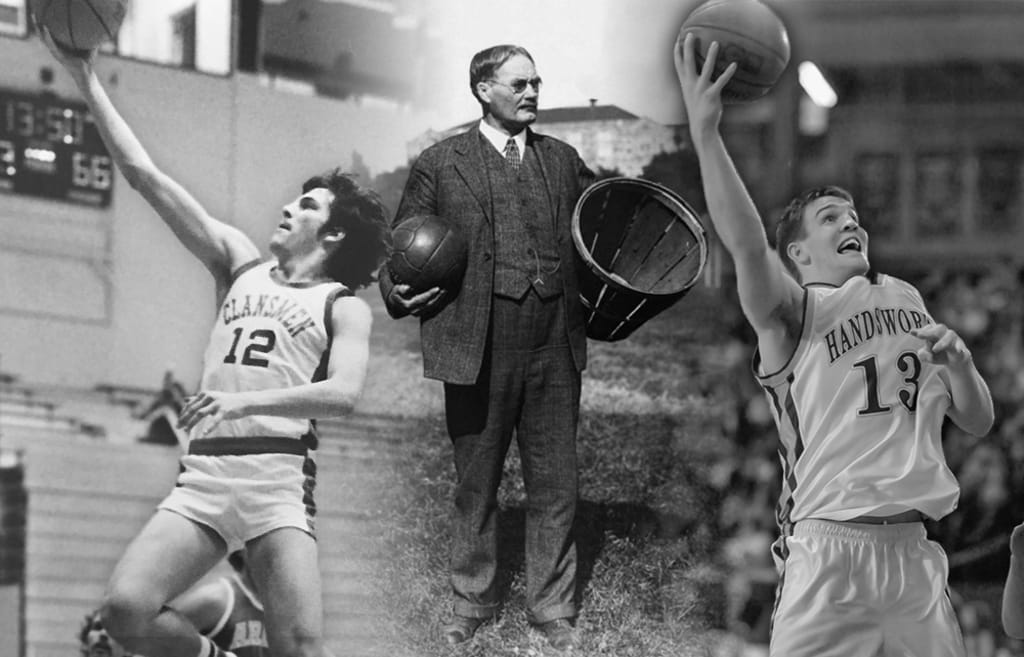
Enter Dr. James Naismith, a 30-year-old physical education instructor with a quiet demeanor and a head full of ideas. Born in Ontario, Canada, Naismith had grown up playing rough outdoor games like “duck on a rock,” which combined aim, timing, and speed. Now, he was tasked with inventing a new game that could be played indoors, kept his students safe, and held their attention during long winter months.
Naismith thought back to his childhood games. Then he sketched a few rules. He nailed a couple of peach baskets ten feet high on opposing ends of the gym balcony, grabbed a soccer ball, and split his class of 18 into two teams of nine. On December 21, 1891, the first official basketball game was played.
There was no dribbling, no three-point line, and no backboard. Every time someone scored, someone had to climb a ladder to retrieve the ball from the basket. The first game ended 1–0.
It wasn’t elegant — but it worked.
The Rules That Changed Everything
Naismith originally wrote 13 basic rules. Many still shape the modern game: no running with the ball, no tackling, and the ball could be batted in any direction. One of his most important ideas? The goal should be above the players' heads, which reduced injuries and encouraged passing and strategy over brute strength.
What began as a creative solution to cabin fever soon turned into something much bigger. The YMCA started promoting the game across the U.S. and abroad. Soldiers during World War I brought basketball with them across oceans, spreading it globally.
By the early 20th century, colleges across America had adopted basketball. In 1936, it debuted at the Berlin Olympic Games, where James Naismith, then an old man, tossed the ceremonial ball for the first tip-off. He lived long enough to see his humble invention become an international competition.
The Professional Game Takes Shape
In 1946, the Basketball Association of America was formed — the first version of what we now know as the NBA. Teams were small, salaries were lower, and many games were played in hockey rinks. But over time, the league expanded, refined its rules, and drew fans in with its fast pace and dramatic comebacks.
By the 1980s, basketball had transcended sport. It had become culture. With stars like Magic Johnson, Larry Bird, and later Michael Jordan, the NBA became a global brand. Jordan, in particular, helped push the sport into every corner of the world — his shoes, his highlights, and his charisma made him an icon beyond basketball.
A Global Game
Today, basketball is played in over 200 countries, from dusty outdoor courts in the Philippines to packed arenas in Europe and street courts in every major U.S. city. The modern game features players from across the globe: Giannis Antetokounmpo from Greece, Luka Dončić from Slovenia, Joel Embiid from Cameroon, and Shai Gilgeous-Alexander — another Canadian, just like Naismith.
The NBA’s influence has grown beyond entertainment. It supports youth programs, education, and community outreach across continents. Leagues like the WNBA and Basketball Africa League are expanding access and showcasing talent far beyond traditional boundaries.
More Than Just a Game
What makes basketball so enduring? It’s not just the highlight reels or the star power. It’s the simplicity and accessibility. All you need is a ball, a hoop, and a few willing players. No expensive gear. No fancy stadium. Just space and heart.
It’s also deeply emotional. The squeak of sneakers on hardwood, the echo of a bouncing ball in an empty gym, the countdown from ten before a last shot — these are universal moments that connect generations.
Naismith never intended to start a revolution. In fact, he was reportedly surprised by the game’s success. But his simple invention — born out of practicality and compassion — now inspires millions, builds communities, and breaks barriers.
Legacy of a Peach Basket
In 1939, just before he passed away, Naismith said, “Basketball is the only true American game.” Maybe he was right — but its soul is international now.
The peach basket is long gone. The players are faster. The dunks are higher. But at its heart, basketball still echoes what Naismith imagined: a game of fairness, skill, and joy.
And somewhere, in a quiet Canadian town or a noisy Bronx playground, that legacy bounces on.
About the Creator
Keep reading
More stories from Junaid Ur Rehman and writers in History and other communities.



Comments
There are no comments for this story
Be the first to respond and start the conversation.