
Baba Yaga
The Origins of the Witch of Slavic folklore
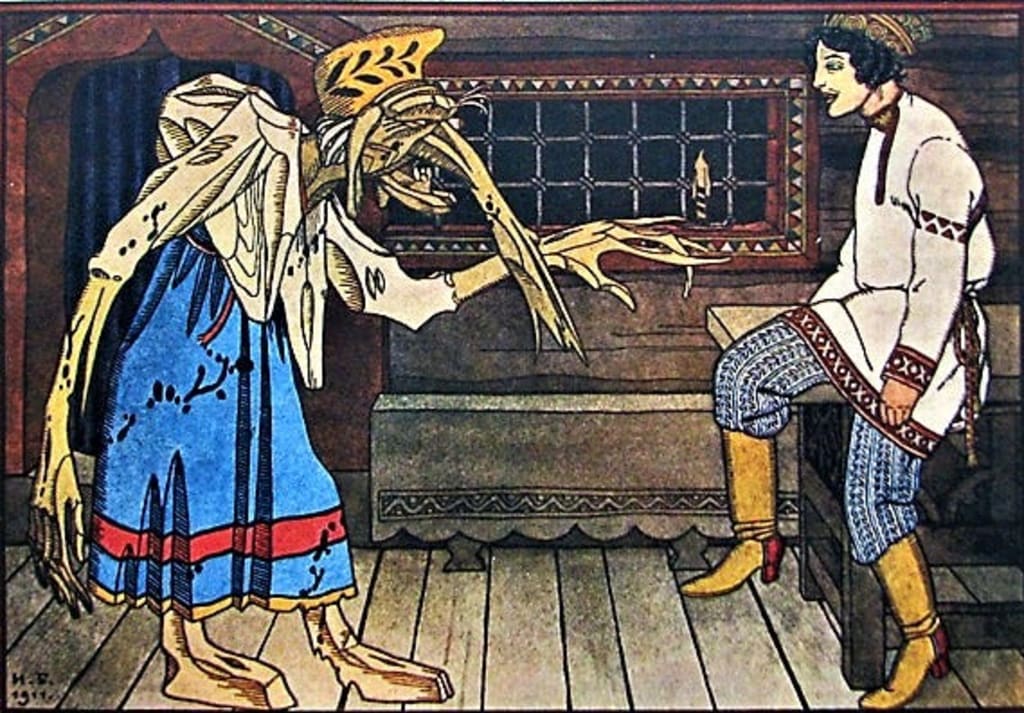
The figure of the terrifying grandmother doling out advice and punishment is a familiar archetype to many of us. It’s no surprise, then, that today’s monster from Russian and East Slavic folklore feels so widespread. Baba Yaga has appeared in operas, comic books, children’s stories, cartoons, and films, not to mention centuries of folklore.
Baba Yaga, once revered as more of a goddess than a witch, has undergone a transformation into the ugly, evil sorceress most people recognize today. However, she was originally a powerful deity, linked to life, death, time, and the elements, with ties to winds, dark forests, the earth, the heavens, and the underworld. She sits between the realms of life and death, embodying both creation and destruction.
So, what is she—an elemental goddess, a dark sorceress, or a frightening grandmother? Let’s explore!
Baba Yaga is often associated with powerful magic and cannibalistic tendencies. She wields immense power over animals, nature, and even time. While she’s frequently portrayed as an evil witch, not all depictions are so extreme.
Most stories describe her as a tall, gaunt old woman with a “bony leg”—which could either mean severe thinness or even a literal skeleton leg. Her disheveled hair and enormous nose, which reaches the ceiling when she lies down, are also distinctive features. This large nose helps her identify visitors by scent, leading some to speculate that she might actually be blind.
Her remote home is usually a hut located deep in the forest, sometimes depicted as a grand mansion, but more often as a peculiar structure supported by chicken legs, goat legs, or ram horns. The hut is surrounded by a fence made of human bones, with a lock made from human teeth—making the suggestion that she’s a cannibal seem quite plausible. The hut spins constantly, only stopping when a chant is recited.
Baba Yaga's possessions are equally magical and unusual. She doesn’t use a flying broom, but instead travels on a magical mortar, steering it with a pestle, sweeping the ground behind her with a broom. She owns enchanted objects, such as mirrors that turn into lakes, combs that transform into forests, handkerchiefs that become rivers, a flying carpet, and even fire-breathing horses.
The etymology of her name suggests that Baba Yaga’s roots trace back to at least the Medieval period. The first references to her appear in woodblock prints from the late 17th to early 18th century, marking her presence in early Russian oral traditions.
The first written mention of Baba Yaga comes from Mikhail Lomonosov in 1755, who referred to her as ‘Iaga Bab’a,’ comparing her to Roman deities. The first narrative of Baba Yaga was recorded in Vasilii Levshin’s 1780 collection Russian Fairy Tales, where she’s depicted as terrifying, with tusk-like teeth and bear-claw hands.
Though Baba Yaga was primarily an Eastern European figure until the 19th century, she gained international recognition with the 1870s translations of Aleksandr Afanasyev’s collection of 600 Russian folktales. These stories helped solidify her status, and an 1899 illustration remains one of the most iconic depictions of Baba Yaga.
Despite her fearsome reputation, Baba Yaga isn’t entirely evil. She can be benevolent, offering gifts or advice to protagonists. Even in the darkest tales, such as when she’s a child kidnapper or a cruel trickster, her victims always escape unscathed. Her connection to cannibalism doesn’t result in any actual eating.
One story, for example, tells of a father who gives his daughter to Baba Yaga as a servant. The daughter completes her chores with the help of mice, earning Baba Yaga’s favor and a reward of beautiful clothes.
But when the father checks on his daughter, he finds her wealthy, much to the jealousy of his wife, who sends her own daughter to Baba Yaga. This second girl, however, fails to complete the tasks and is punished by Baba Yaga, who places her bones in a box. This illustrates Baba Yaga’s unpredictable nature—neither purely good nor evil.
Perhaps the most beloved tale is Vasilisa the Beautiful, where a girl named Vasilisa, given a magical doll by her mother, finds herself sent to Baba Yaga’s hut by her wicked stepmother. After several trials set by Baba Yaga, Vasilisa succeeds with the help of her doll, and in return, Baba Yaga gives her a flaming skull that ultimately burns the evil stepmother and stepsisters to cinders.
Baba Yaga’s stories often feature young protagonists on the cusp of adulthood or marriage, and her challenges act as rites of passage. These tales, while entertaining, also teach lessons about domestic duties and responsibilities, particularly for young women entering new households.
The name "Baba Yaga" itself might reflect her complex origins. “Baba” initially referred to a married peasant woman or midwife in Old Russian, later evolving into a term for a difficult, elderly woman.
In some Eastern European languages, "baba" even means "pelican," which could explain Baba Yaga’s long, beak-like nose and her chicken-legged hut. The word "Yaga" is more elusive, with theories suggesting meanings like "horrible," "to ride," or even a connection to the Latin word for “snake.” In modern interpretations, “Yaga” often signifies an “old granny witch.”
Baba Yaga’s appearance, with her hut on chicken legs and her magical tools, might be explained by the practical realities of ancient Slavic life, where nomadic hunters constructed elevated structures to protect their food supplies from animals, and where women traditionally used mortars and pestles for daily tasks. This blend of the supernatural with the mundane may explain her enduring, multifaceted nature.
In modern times, Baba Yaga has also appeared in media post-Soviet Union, appearing in comics, films, and even video games like Fortnite, further solidifying her status as a global cultural icon.
Baba Yaga's legacy remains strong today. As both a grandmotherly figure and a malevolent witch, she embodies contradictions—powerful and nurturing, terrifying and wise. Perhaps this paradox is why she continues to fascinate and endure. As folklorist Andreas Johns aptly notes, "There can be no single correct interpretation or understanding of Baba Yaga," which gives her a unique freedom to evolve with each retelling.
About the Creator
ADIR SEGAL
The realms of creation and the unknown have always interested me, and I tend to incorporate the fictional aspects and their findings into my works.
Keep reading
More stories from ADIR SEGAL and writers in History and other communities.
The Story of Little Red Riding Hood
We all know the tale of the little girl in the red riding hood, who sets off alone through the forest to visit her grandmother. Like most fairy tales, the story is often told with a much lighter tone, but in truth, it is a darker narrative that I’m about to share with you.
By ADIR SEGALabout a year ago in History
Writing To Succeed
If you want to find something that will help readers find your writing, possibly expand your audience, and maybe even get you noticed for other things, then you’re not alone. But how can you get it done in a world full of want-to-be writers? Look less at what you’re writing now, and more at what other writers have used to boost their views and reads.
By Jason Ray Morton 3 days ago in Writers



Comments
There are no comments for this story
Be the first to respond and start the conversation.