
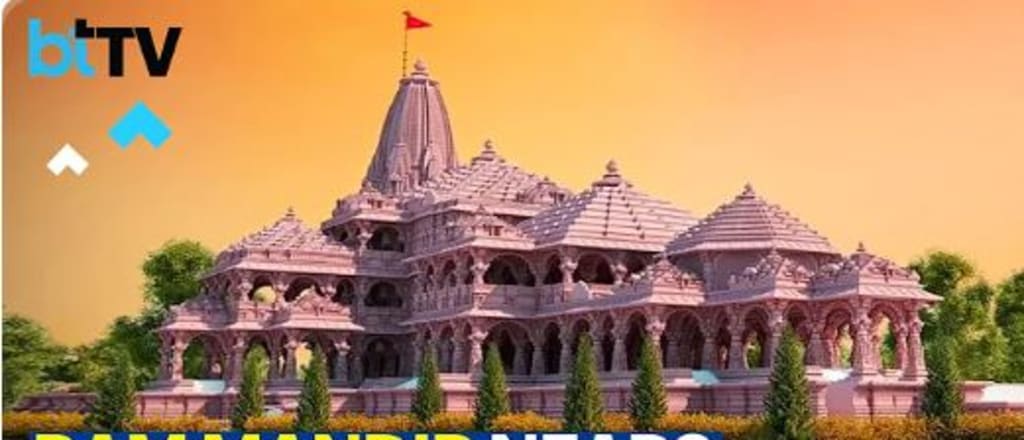
The story of the Ayodhya Ram Mandir is deeply rooted in Hindu mythology and historical events. Here's a comprehensive overview:
Historical and Mythological Significance:
Ayodhya: Ayodhya is an ancient city in the state of Uttar Pradesh, India, believed to be the birthplace of Lord Rama.
Lord Rama: According to the Hindu epic Ramayana, Lord Rama, the seventh incarnation of Lord Vishnu, was born in Ayodhya. His life and teachings are recounted in this epic.
Babri Masjid-Ram Janmabhoomi Dispute:
Babri Masjid: In the 16th century, the Mughal emperor Babur constructed a mosque known as Babri Masjid in Ayodhya.
Ram Janmabhoomi: Hindus believe that the Babri Masjid was built on the exact spot where Lord Rama was born. This led to a long-standing dispute between Hindu and Muslim communities.
Demolition of Babri Masjid (1992):
Ayodhya Movement: The Ayodhya movement gained momentum in the late 20th century, with Hindu groups demanding the construction of a Ram Temple at the disputed site.
Babri Masjid Demolition (1992): On December 6, 1992, the Babri Masjid was demolished by a large crowd of Hindu activists, leading to communal tensions.
Legal Battles:
Title Suit: The dispute resulted in a legal battle over the ownership of the site. Various court cases were filed to decide the rightful owner of the land.
Supreme Court Verdict (2019): The Supreme Court of India, in November 2019, awarded the disputed site to Hindus for the construction of the Ram Temple. It also directed the government to provide an alternative plot for the construction of a mosque.
Ram Temple Construction:
Bhoomi Pujan (2020): The construction of the Ram Temple officially began with the Bhoomi Pujan (ground-breaking ceremony) on August 5, 2020. Prime Minister Narendra Modi laid the foundation stone for the temple.
Construction Progress: Since then, the construction has been underway, and the temple is expected to be a grand structure symbolizing Hindu devotion.
Nitya Aaradhana and Ongoing Rituals:
Daily Worship: The construction site has witnessed daily worship and rituals to consecrate the land and seek the blessings of Lord Rama.
Ongoing Devotion: The construction of the temple is considered a monumental moment for Hindus, and it is expected to become a significant pilgrimage site upon completion.
The Ayodhya Ram Mandir is not only a religious and cultural symbol but also a subject of historical and legal importance in India. The construction of the temple marks the realization of a longstanding aspiration for many in the Hindu community.
Lord Rama is a central figure in Hinduism and is considered the seventh avatar of Lord Vishnu, one of the principal deities in Hinduism. Rama is revered as a symbol of virtue, righteousness, and ideal leadership. His life story is primarily narrated in the ancient Indian epic, the "Ramayana," written by the sage Valmiki.
Key aspects of the life of Lord Rama include:
Birth: Rama was born to King Dasharatha and Queen Kaushalya in Ayodhya. His birth is celebrated as Rama Navami.
Marriage: Rama's marriage to Sita is a significant event. He broke the bow of Lord Shiva during the swayamvara (a ceremony where a princess chooses her husband), earning him the right to marry Sita.
Exile: Due to political intrigue and his stepmother Kaikeyi's desires, Rama had to go into exile for fourteen years. His wife Sita and his loyal brother Lakshmana accompanied him.
Abduction of Sita: The demon king Ravana abducted Sita, leading to Rama's quest to rescue her.
Construction of Ram Setu: Rama, with the help of an army of monkeys led by Hanuman, built a bridge (Ram Setu) to reach Lanka (modern-day Sri Lanka) and rescue Sita.
Defeat of Ravana: Rama defeated Ravana in a great battle and rescued Sita.
Return to Ayodhya: After completing fourteen years of exile, Rama, Sita, and Lakshmana returned to Ayodhya. The people of Ayodhya celebrated their return with the festival of Diwali.
Exile of Sita: Due to doubts raised by some citizens about Sita's chastity during her captivity, Rama, unwillingly, sent her into exile. She took refuge in the sage Valmiki's hermitage, where she gave birth to their twin sons, Lava and Kusha.
Reunion with Sons: Rama later learned about his twin sons and was reunited with them.
Lord Rama's life is considered an exemplary model of dharma (righteousness), and his story is told and retold in various forms of literature, art, and performances across different cultures and regions in India and beyond. His teachings and actions continue to inspire millions of people.
About the Creator
Israeli Fire Strikes Journalists and Children on One of Gaza’s Deadliest Days Since Ceasefire
In what has been described as one of the most tragic days in the Gaza Strip since the fragile ceasefire went into effect in October, Israeli military actions on January 21, 2026, resulted in the deaths of at least 11 Palestinians, including three journalists and two 13‑year‑old boys. The deadly incidents occurred across multiple parts of the densely populated enclave and have reignited international concern about civilian safety, press freedom, and the stability of the current ceasefire agreement between Israel and Hamas.
By Salaar Jamali5 days ago in History
The Duelist
The rays of a dying red sun flashed against the onrushing blade. The grey beards say the key to dueling lies in size, speed, reach, righteous fury, whatever the person in front of them pays them to say. Matteo knew better than any it was none of these and had an undefeated record on these sands to prove it.
By Matthew J. Fromm2 days ago in Fiction


Comments (1)
Incredible work. Very well-written!🥰